Representative End User Clients







Representative Automation Clients







Representative Software Clients








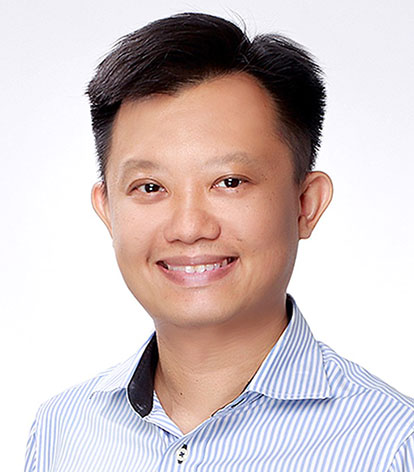
The Asian Downstream Summit and Asian Refining Technology Conference, held on October 23-24 in Singapore, featuring a great lineup of speakers who shared valuable insights and the latest industry developments. The event also provided good networking opportunities, allowing participants to connect and collaborate on advancing the industry.
These events were part of the Singapore International Energy Week (SIEW), an annual gathering where energy professionals, policymakers, and stakeholders come together to network, discuss, and exchange ideas on energy-related challenges and opportunities.
A notable addition this year was the Ammonia & Carbon Capture Asia Conference. This conference spurred discussions on alternative low-carbon fuels and carbon capture and storage—key components in the ongoing energy transition. It emphasized the importance of adopting a comprehensive approach to investing in sustainable energy solutions.
The theme of this year's summit was “Advancing Sustainable Energy Solutions in Asian Petrochemicals and Refining Industries”. Minister Low emphasized Singapore’s commitment to exploring all possible pathways to achieve its 2050 net zero ambition. She shared on the country’s pursuit of advanced technological solutions, such as carbon capture, utilization, and storage (CCUS), hydrogen, and ammonia research, along with initiatives like pathfinder projects that focus on these areas. Minister Low expressed confidence that these efforts could transform the industry and enhance its value proposition. She also stressed the importance of collaboration and partnerships, emphasizing that the expertise of industry leaders in carbon management and process engineering will be crucial for driving low-carbon solutions.
In addition to regional insights shared by country experts, end users provided updates on developments in the green fuels sector, including hydrogen, biofuels, and sustainable aviation fuels. The discussion also highlighted the role of electrolyzers in sustainability, particularly for renewable fuels such as electro-sustainable aviation fuel, e-methanol, and e-ammonia.
A significant portion of the event focused on the transformative impact of emerging technologies on the energy sector. This included the use of digital technologies, artificial intelligence (AI), machine learning (ML), and automation to improve operational efficiency, sustainability, and safety in the downstream industry. Industry leaders participated in presentations and in panel discussions on effectively harnessing these technologies, emphasizing strategies to position ASEAN for success in a rapidly changing global landscape. They addressed the opportunities, challenges, and partnerships necessary to accelerate carbon capture and storage (CCS) and hydrogen initiatives in the region, highlighting the critical role of technology-driven advancements in shaping the industry's future:

Adam Harris, APAC Pole Leader at Honeywell, discussed how the company is enabling a sustainable low-carbon future for efficient refining and petrochemical industries through technology and digital transformation. Following recent developments in AI, he shared how Honeywell is collaborating with Chevron to develop advanced AI-assisted solutions aimed at enhancing efficiency in refining processes and improving safety within the industrial automation space, as announced in early October this year.
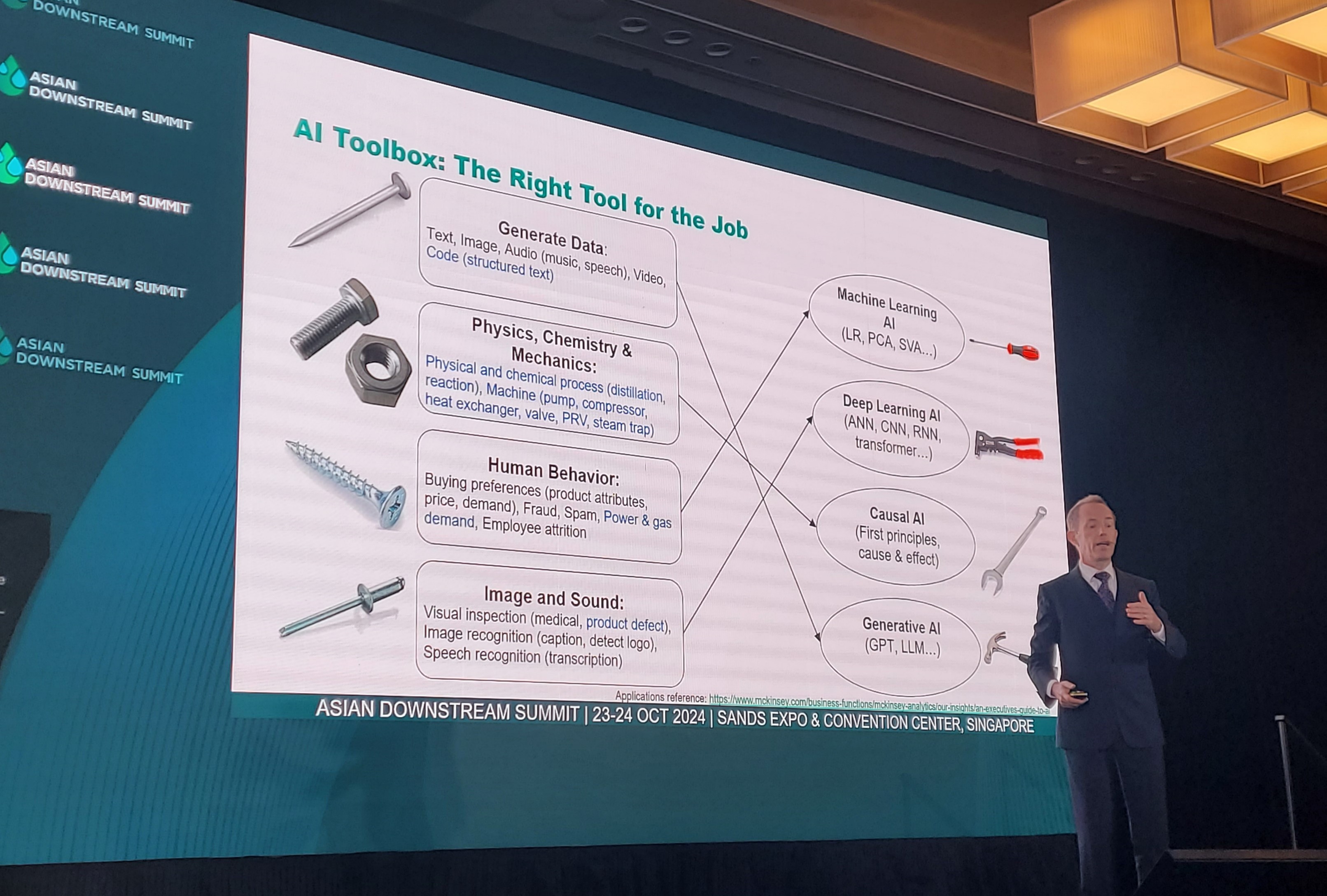
In his presentation on AI, Jonas Berge, Senior Director of Applied Technology at Emerson in Singapore, offered valuable insights into navigating the diverse landscape of AI technologies in the process industry. He emphasized that no single AI tool can address every need and highlighted the importance of selecting the right tool for specific applications. Jonas explained that various AI technologies—such as machine learning, deep learning, causal AI, and generative AI (GenAI) are each well-suited for specific applications.

Left to right: Andrew Saunders-Tack, Director, Asia Pacific Operations, Becht, New Zealand, Dr. Pratap Nair, Founder, President & CEO, Ingenero, India, Dr Mobin Rahman, Vice President, Technology, ChemOne Group, Singapore and Naveen Kumar, Vice President, Chemicals, Natural Resources and Manufacturing Industry Segments, AVEVA, Singapore
Naveen Kumar, Vice President of Chemicals, Natural Resources, and Manufacturing Industry Segments at AVEVA, Singapore, along with other industry leaders, discussed the importance of digital transformation as a crucial element for the refining industry in achieving a more sustainable future while enhancing operational excellence. Despite the availability of technology and its evident benefits, the panel emphasized the necessity of a mindset shift to embrace these changes fully.

Christopher Chan, Vice President of the E&C Segment for the APAC region at Schneider Electric in Singapore, moderated an engaging panel discussion on hydrogen. As a promising green fuel alternative for the region, panelists from intergovernmental organizations and solution providers shared updates on hydrogen initiatives and projects, along with strategies for progressively scaling these efforts to maximize their impact.

The conferences concluded with an insightful panel discussion on CCUS, featuring industry leaders from companies such as PETRONAS, BP, and Indonesia’s Carbon Capture and Storage Center. They explored strategies for advancing CCUS technologies, including new use case scenarios for carbon utilization and cost mitigation approaches. The panel also highlighted emerging technologies such as membrane-based capture and emphasized the importance of bilateral cooperation and agreements for successful implementation.