Representative End User Clients







Representative Automation Clients







Representative Software Clients








Traditionally, the Consumer Electronics Show (CES) in Las Vegas serves as a launch pad for the latest electronic gadgets targeted at consumer markets. So, what is Siemens doing there? For the second year in a row, Siemens CEO Dr. Roland Busch used a keynote slot at CES to show how industrial and consumer technologies have merged to connect physical systems to virtual models, enabling real-time design, simulation, and optimization. Busch was eager to show how “industrial grade” AI has become a transformative force in industry, going as far as equating industrial AI’s transformative effect with that of electricity well over a century ago.
Together with NVIDIA, Siemens announced a major expansion of their strategic partnership, which kicked off nearly four years ago. According to the companies, the goal is to build the “Industrial AI operating system.” This means embedding AI-driven intelligence in every step of the industrial lifecycle, from product design and engineering to manufacturing, operations and supply chains. To achieve this lofty goal, Siemens will contribute industrial AI expertise together with hardware and software, while NVIDIA will provide AI infrastructure, simulation technologies and accelerated computing platforms.
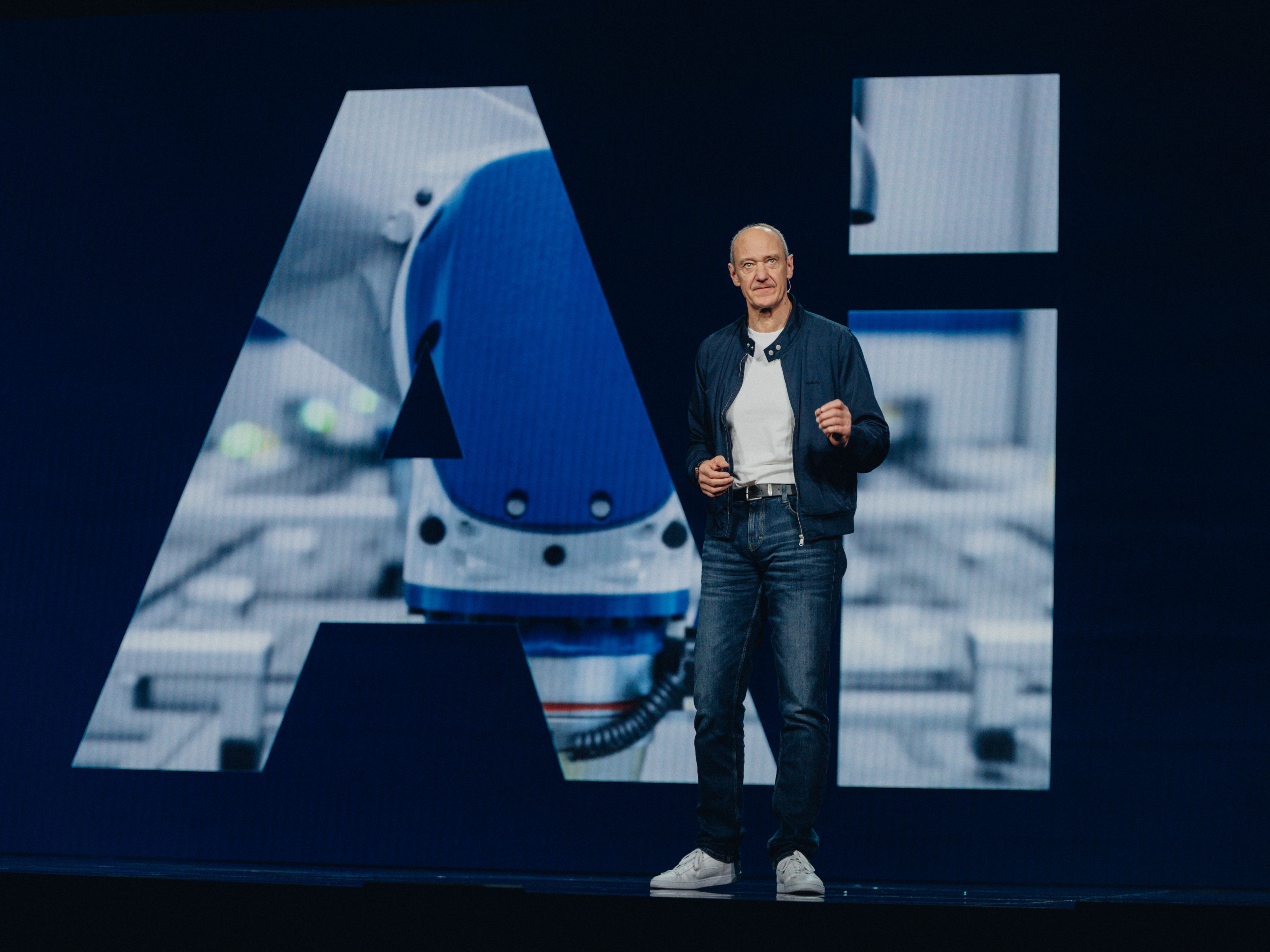
Starting this year, Siemens plans to turn an electronics plant in Germany into a fully AI-driven, adaptive manufacturing site. The factory will use an “AI Brain” powered by software-defined automation and NVIDIA Omniverse libraries to continuously optimize operations through digital twins and real-time analytics. For simulation, digital twins will be used as active intelligence tools, enabling real-time performance analysis in real time to quickly test improvements virtually and convert successful adjustments directly into operational changes.
Ultimately, Siemens and NVIDIA plan to create an Industrial Metaverse, an utopian view of an immersive, interconnected digital ecosystem that bridges the physical and virtual worlds. The Industrial Metaverse will use digital twins, real-time data, and simulations to visualize, analyze, and optimize complex systems in manufacturing and public infrastructure.
What does the Industrial Metaverse mean for industry users?
Today, digital twins accelerate the design and testing of new products with sophisticated modeling and simulation. They also help to design workflows of new manufacturing processes, allowing factory owners to identify and eliminate bottlenecks before production even starts.
But digital twins can do much more. Today, according to Roland Busch of Siemens, simulations using digital twins explore thousands of options on how to improve processes. In the future, complex industrial foundation models will be trained to explore hundreds of thousands of options on unprecedented amounts of industrial data, thus allowing a digital twin to control an entire plant in real time. For end users, this means no longer just reacting to errors and restarting processes as future machines will act and adjust themselves autonomously. This will eliminate much of the human intervention currently necessary, and leaving only complex, strategic decisions to humans.
To achieve this, of course requires huge amounts of compute in gigantic, centralized AI factories run by partners like AWS and Microsoft, but also available at the edge, close to machines and infrastructure. This, according to Busch, is the essence of the Industrial AI Revolution.
As with every game-changing technology, the Industrial AI Revolution will most likely be an evolutionary journey of incremental investments, in which each step is tested to ensure that it delivers a return in the short term and real value in the long term. Perhaps more than with any previous technology revolution, Industrial AI will help innovative manufacturers to use technology to differentiate themselves from competitors and continue to compete in a world that is rapidly throwing up hurdles to trade.
The Siemens-NVIDIA partnership marks a significant step toward the industrialization of AI, promising to reshape manufacturing, engineering, and supply chain operations worldwide. By combining Siemens’ industrial expertise with NVIDIA’s AI platforms, the collaboration aims to deliver scalable, resilient, and sustainable solutions for the next generation of factories and industrial workflows.