Representative End User Clients







Representative Automation Clients







Representative Software Clients








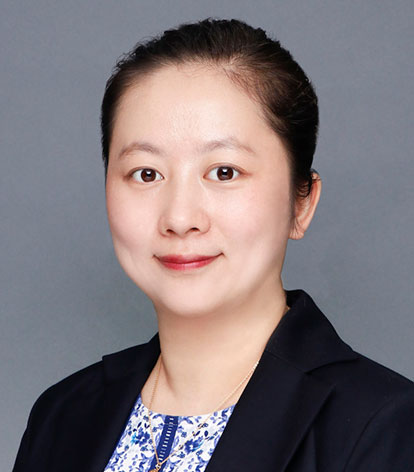
On March 23-24, 2026, the Siemens RXD (Real Meets Digital) grand event officially kicked off, gathering more than 2,000 industry partners and leaders. It not only focused on demonstrating full-stack technological capabilities but also simultaneously launched 26 innovative products combining global innovation with local innovation in China and spanning industrial infrastructure, automation and AI-powered applications. As a global industrial giant deeply rooted in the Chinese market for over 150 years, Siemens holding the first conference in Beijing is not only a high recognition of China's innovation vitality, industrial scale and rich application scenarios but also a key measure for it to accelerate the "integration of digital and physical worlds" strategy and deepen the layout of localized innovation.
It is worth noting that the “X” in RXD not only means “Meet” but also represents Siemens' Xcelerator. This open digital business platform empowers ecosystem collaboration, drives Industrial AI into a new stage of large-scale implementation, and injects strong momentum into global industrial transformation. At the conference, Siemens President and CEO, Roland Busch, stated in his keynote speech: “Bringing AI into the real world requires not only excellent models but also an Industrial AI ‘operating system’—a complete technology stack connecting data, software, and intelligent hardware.” This core concept ran through the entire summit, echoing the core value of Siemens Xcelerator and serving as a key lens to interpret Siemens’ Industrial AI strategy and its role in driving intelligent transformation across industries.
One of the most anticipated highlights of the summit was a top-level dialogue known as the “Industrial AI Dream Team.” Roland Busch, Joe Tsai, Wang Xingxing, and Ni Jun participated in a joint discussion. They examined the current state of Industrial AI across sectors and outlined how technology, use cases, and partnerships can work together to enable digital transformation and foster the coordinated development of the Industrial AI ecosystem.
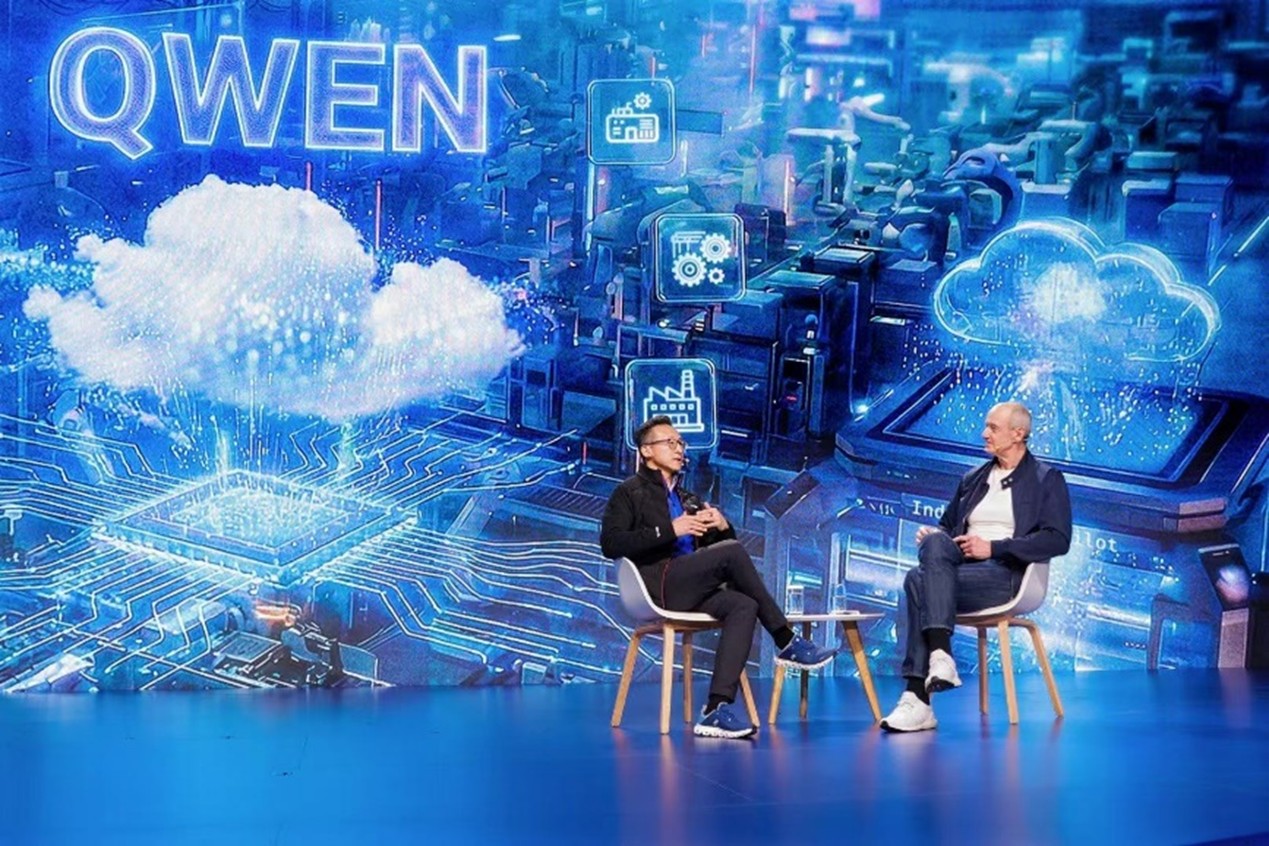
Alibaba takes "Everything Driven by AI" as its core strategy. Its cloud infrastructure has been fully adapted to various AI tasks to ensure stable computing power output; the AI agents have made breakthroughs, which can independently complete the whole process of planning, reasoning, memory and other tasks, and will achieve a leapfrog from "Copilot" to "main pilot" in the future. Alibaba laid out the large model field three years earlier than ChatGPT, developed self-research trillion-parameter Qwen large model, adopted the dual mode of "Closed-Source API + Open-Source deployment", and relied on its own cloud service system to provide an efficient computing power base for various industries.
Roland Busch believes that, essentially, AI training and optimization are continuous evolution processes, and the new data generated by model applications will continue to feed back into the iteration of the next generation of models; in future industrial settings, the share of computing power devoted to AI inference will gradually exceed that used for training, and data strategy and scenario-based implementation are the keys to the development of Industrial AI. Regarding the complementarity and cooperation prospects between the two leading enterprises, Jose Tsai said bluntly: "Siemens has so many customers in China in the manufacturing sector. They make things. Alibaba’s DNA and our history has been in software, and, you know, shopping is consumer-facing. And so, there are actually a lot of complementary skill sets that could bring us together."
Jose Tsai further emphasized, "I firmly believe that China is the best testbed for that, because China is the largest manufacturing economy in the world. About 30 percent of the world’s industrial output is coming from China. That means, where does all that data reside? It's in China. So, this is a great area to test, to get access to data, to continuously improve our joint endeavors and our models and all that. So, I'm very excited to work with Siemens to continuously try and make Industrial AI a real thing.”
Roland Busch also echoed this cooperation vision, saying: "We want to boost the Industrial AI revolution together. We need many partners, but obviously we need a partner who knows how to run cloud services, a partner who builds models, and we are bringing a lot of technology, as I said before — hardware, software, domain know-how, the full technology stack, and data.”
Consensus on Cooperation: The two parties will deepen and upgrade their cooperation, integrate Siemens' simulation product portfolio with Alibaba Cloud's computing power and infrastructure. It will provide SaaS-based CAE capabilities for the Chinese market, establish a scalable cloud simulation environment for engineering teams, and effectively reduce the entry barrier for SMEs’ digital transformation. At the same time, Siemens is also exploring large language models like Alibaba's Qwen to carry out customized fine-tuning and optimization using industrial-specific time-series, design and simulation data; Alibaba will further improve the industrial implementation capacity of its own large models with the help of Siemens' rich industrial scenarios, achieving two-way empowerment and win-win cooperation.
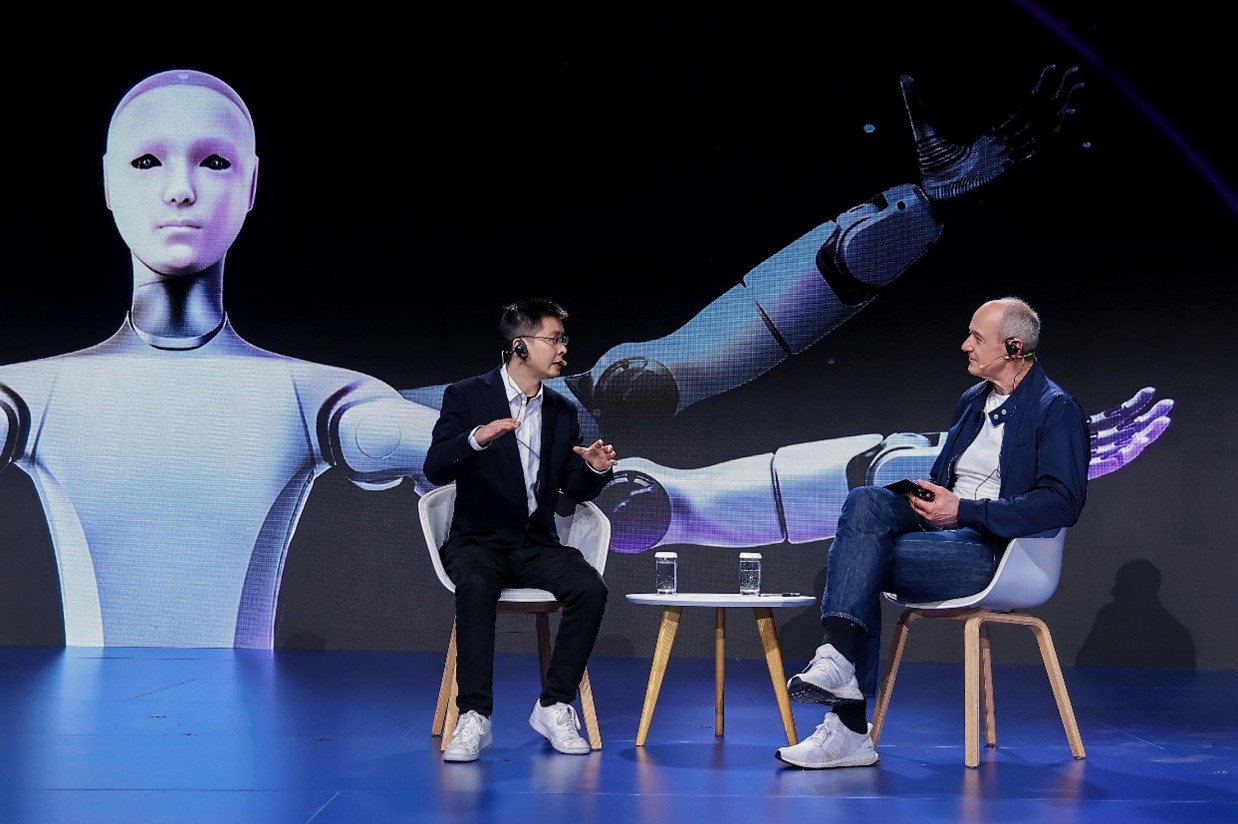
As early as 2021, Unitree Robotics shifted all its robots to AI control. In 2023, it launched the first pure AI-trained humanoid robot. In 2025, it conquered the motion stability and impact resistance of robots, realizing the implementation of scenarios such as combat robots and the rapid movement of "Wu BOT" at the Spring Festival Gala, becoming a top global player in this field. In this regard, Wang Xingxing has a clear understanding, and he has always firmly believed: "Only when robots can make various rich movements and then combine AI technologies such as large language models to allow the system to call these combined movements, can robots truly implement practical tasks. Therefore, the richness of movements directly determines the intelligence level of robots."
From the perspective of motion optimization, the movement and basic actions of humanoid robots have been solved, but the grasping, operation and tactile simulation technologies have not yet been broken through, the versatility in unfamiliar environments is low, and the training of practical tasks still relies on real human data collection, and the application of simulation technology in practical scenarios is not mature. In response to this industry pain point, Roland Busch responded, combining Siemens' technological advantages: "We are proficient in the manufacturing processes of various products, especially in the production and manufacturing of robots and automation equipment. When it comes to the field of simulation, this is also Siemens' specialty. We have been deeply engaged in various simulation technologies, and our capabilities are constantly optimized; I also often challenge the team to achieve greater breakthroughs and unlock more possibilities in the field of simulation, helping enterprises such as Unitree Robotics break through technical bottlenecks and promote the improvement of robot practical capabilities."
Consensus on Cooperation: Siemens provides professional manufacturing technologies to Unitree, Unitree robots are deployed in Siemens shopfloor, and the two parties share the SIMOVE Fleetmanager platform to achieve coordination of workshop equipment; relying on its own advantages in simulation technology, Siemens helps Unitree realize "Digital Simulation Training + Offline Practical Implementation" of robot tasks, greatly reducing training costs and time. Unitree plans to enable the generation of arbitrary robot movements within six months and allow these movements to be freely and smoothly combined through AI training, so as to improve the practical capabilities of robots in Industrial and living scenarios.
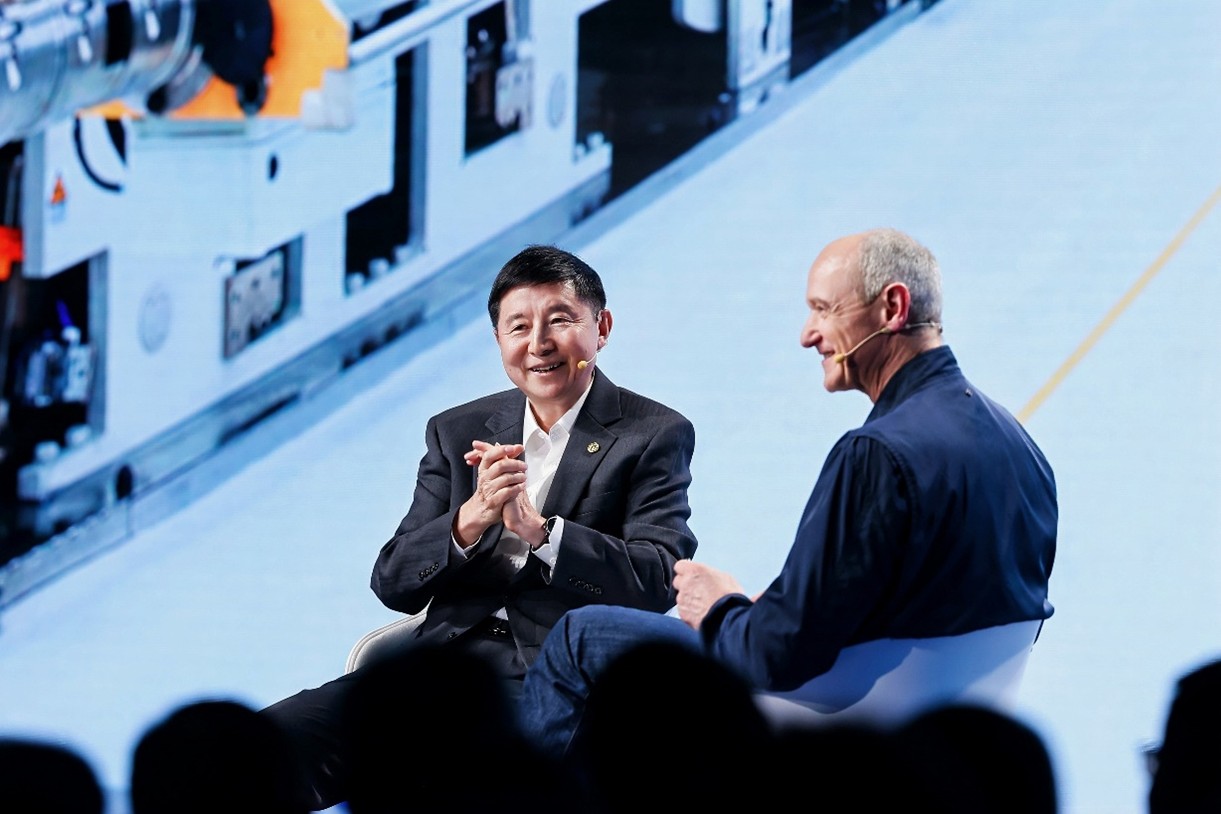
Over the past decade, CATL has invested more than US$13 billion in R&D, developing advanced battery technologies such as Kirin and Shenxing, along with next-generation innovations including sodium-ion batteries, condensed matter batteries, all-solid-state batteries, and even lithium-air batteries. Among them, the "Naxin" sodium-ion battery with excellent low-temperature performance and significant cost advantages will be put into large-scale mass production and marketing in 2026. Different technical routes of battery products will also achieve precise scenario coverage. For example, sodium-ion batteries focus on energy storage and low-temperature scenarios, and Kirin batteries focus on the high-end new energy vehicle field, comprehensively meeting the diversified energy needs of different industries.
Battery manufacturing has extremely high requirements on process and precision. Batteries are the most complex industrial products, integrating multidisciplinary knowledge, and the manufacturing precision requirement reaches the level of one billionth (ppb), far exceeding the traditional six sigma standard of general manufacturing industry. To achieve "zero-defect" manufacturing, CATL has extensively applied AI and digital twin technologies, optimized design through simulation, and real-time monitored the production process through AI models to achieve micron-level precise control.
Consensus on Cooperation: As a leader in the field of battery manufacturing automation, Siemens supports CATL, which extensively uses Siemens' simulation and AI products to ensure manufacturing precision and standards; the two leading enterprises form an AI and energy collaboration — the large-scale development of AI relies on sustainable energy, and breakthroughs in battery technology will provide adaptive power support for AI data centers, helping to address the energy bottleneck of AI computing power.
At the same time, regarding CATL's global layout, Roland Busch clearly stated: "CATL is going global. So, you're working internationally. Whenever you sit on Siemens technology, you can bring it, and you want to really have a consistent way of producing. We follow you wherever you are."
Ni Jun further explained CATL's original intention of globalization: "For CATL's strategy, we believe we only have one Earth. That’s our home. So we want to bring the innovations not only from China to the global stage. At the same time, we want to bring global innovation to China. I think this is the sustainable future that requires all human beings, it doesn't matter where you live, to work collectively to bring our innovation, to bring our human intelligence together to solve the global problem. So for that, we actually try to bring the best technology to the global community.”
26 innovative products fully developed by the Chinese team and oriented to China and beyond were launched collectively. These new products provide high performance, high reliability and high-cost performance, covering key fields such as automation, motion control, industrial networks, intelligent power distribution and computing power, and forming an important part of the industrial AI "operating system".
“X is the launchpad for Industrial AI.” At this Siemens RXD Summit, the Xcelerator business platform, as the core carrier of Siemens' industrial AI strategy, was mentioned as being the launchpad for Industrial AI. With "open collaboration and localized adaptation" as the core, the Xcelerator platform integrates Siemens' own IoT-enabled hardware, software, industrial knowledge and third-party partners' solutions, adopts a flexible architecture based on microservices, and can provide lightweight and easy-to-deploy SaaS products, greatly reducing the threshold for digital transformation of small and medium-sized enterprises. Focusing on the actual pain points of enterprises, Siemens Xcelerator enables enterprises to quickly obtain suitable digital solutions, technical support and partner resources from the growing ecosystem by aggregating resources from both supply and demand sides, achieving "on-demand access and win-win cooperation".
Siemens Xcelerator brings the companies capabilities together to make industrial AI accessible and ready to scale. On it’s marketplace customers can discover Siemens products, services and solutions and partner offerings to conquer any digitalization challenge, in the community customers can connect with top industry voices, get AI updates and be inspired by leaders across industries and in the Learning Hub customers can upskill with the latest Industrial AI trainings and stay ahead of the curve.
It deepens localized innovation and promotes ecosystem collaboration — all 26 localized innovative new products will be available on the marketplace, realizing seamless connection with the platform's existing solutions which are open, flexible, interoperable and cybersecure. The cooperation between Siemens, Alibaba, Unitree Robotics and CATL will foster co-innovation and co-operation and will result in new offerings which will be available on the Siemens Xcelerator marketplace, promoting the technical integration and scenario reuse in fields such as computing power, robot practical operation and ultimate manufacturing, helping Chinese innovative technologies go global through the platform, and attracting more local ecological partners to join, building an industrial AI ecological system of "technology sharing, scenario co-construction and global connection".
Centered on the core concept of the Industrial AI "operating system", the Siemens RXD Summit brought together in-depth dialogue among industry leaders and pooled the joint efforts of ecosystem partners. It not only demonstrated the cutting-edge level of global industrial technology but also clearly outlined a new paradigm for large-scale implementation of Industrial AI. The implementation of industrial-grade AI is by no means a simple superposition of "Algorithm × Computing Power", but requires the organic integration of the "Depth of Technology Stack × Thickness of Data × Precision of Industry Know-How × Breadth of the Ecosystem"; the future digital transformation of the industry is even more inseparable from the collaborative empowerment of "Technology + Scenarios + Partners".
This grand event is not only a vivid manifestation of Siemens' deep cultivation in China and fulfillment of its global commitments but also releases a strong signal of accelerated industrial transformation. In the future, Siemens will continue to deepen ecosystem collaboration, break down the barriers between the digital and physical worlds, promote the industry to upgrade towards intelligence, efficiency, and sustainability, and let the vision of digital-physical symbiosis take root.