Representative End User Clients







Representative Automation Clients







Representative Software Clients








By Ralph Rio
Summary
Today's increasingly dynamic and competitive business environment requires an effective manufacturing execution system (MES) solution to manage production. MES can provide the needed visibility and decision support tools to achieve on-time shipment, lower inventory, high quality, and cost control. In one example, Hanwha Q CELLS, a leading manufacturer of photovoltaic solar cells and panels, reported a successful MES deployment working with service provider, L&T Infotech.
Business Dynamics Drive Critical Need for MES
Production managers typically have KPIs for meeting customer shipment commitments while obtaining high inventory turns. This enhances customer satisfaction which grows revenue while conserving cash in the balance sheet. But, a combination of factors have made success in scheduling production and minimizing work-in-process (WIP) increasingly difficult.
To gain market share, a business targets a wider array of markets segments, which results in product proliferation with an expanding set of options. To sell regionally and globally, localization results in a proliferation in part and stocking unit numbers (SKUs).
Even though the overall business may be stable or growing, the higher number of SKUs translates into smaller lot or batch sizes, and more of them to manage. Hiring more production expeditors to monitor and control these lots is expensive, has diminishing returns, and often becomes counterproductive.
| Dynamic | Trend |
| Demands for error free quality | Increasing |
| Product and options proliferation | Increasing |
| Production lot or order size | Smaller |
| Quantity of lots and orders | Higher |
| Frequency of schedule changes | Increasing |
| Cost pressures from competitors worldwide | Increasing |
| Government regulations globally | Increasing |
| Speed of new product intro | Faster |
| Risk of Inventory Obsolescence | Increasing |
| Is the effect of a change | Unintended consequences |
Factors Impacting Production Management
and Driving the Adoption of MES
SKU Proliferation Drives Down KPIs
With more SKUs, there are more items to forecast and more chance for error. The difference between each item's forecast and what is actually ordered either increases finished goods inventory (high forecast), or lowers delivery to customer promised date down (low forecast). Either case has a negative effect on the plant manager's metrics.
Shorter product lifecycles speed obsolescence, with write downs or discounts required to move the old finished goods inventory, which hurt the senior executives' metrics for profitability.
MES Can Help Improve KPIs
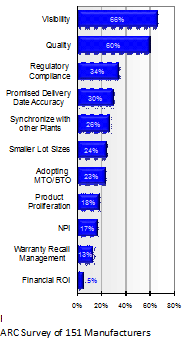
Enterprise resource planning (ERP) systems provide a key business planning tool; but executing the plan requires MES. Production managers need visibility to determine order status and track an order through production. This need for visibility drives the need for a production management application. In an ARC Advisory Group survey of 151 manufacturers, 66 percent chose visibility as their primary reason for acquiring an MES application. Only 5 percent chose financial ROI. In this case, KPIs and job security trump the investment's financial return.
Business Process Automation
MES includes functionality to plan, operate and report on production operations. It is at the center of the major value streams of a corporation, which include supply chain (source, make, deliver), product lifecycle (design, new product introduction, post-sales support), and enterprise integration (plant floor-to-business systems). These value streams are managed with multiple applications and the opportunities for business process automation often involve the MES application.
Hanwha Q CELLS Case Story
Recently, ARC Advisory Group discussed the MES implementation at Hanwha Q CELLS with Maiko Kenner, Director, Manufacturing IT.
Business Dynamics for MES
Hanwha Group, a Top-Ten Korean business group and a "Fortune Global 500" company, launched Hanwha Q CELLS in 2012 and merged the company with its sister company Hanwha SolarOne in 2015, forming a globally leading solar power company. Its Q.ANTUM technology provides a high conversion rate of solar energy into electricity under real, day-to-day conditions including cloudy skies and across a range of temperatures. MES and data collection helps sustain and improve the high product performance for both the cells and assembled panels.
Faster Speed of Operations Needed
Solar cell manufacturing has similarities with semiconductors in that silicon provides the substrate and chemical deposits create the circuits. In both instances, many process steps are needed to build the needed layers and the work flow becomes complex – sometimes passing through the same equipment for several iterations. MES manages the workflow and tracks the work in process (WIP). This helps reduce manual operations, improve automation, and transfer materials to the right place at the right time.
MES Solution
Hanwha Q CELLS uses the SAP ERP application to set the plan and overall schedule, while the MES executes the schedule. The chosen MES application is CAMSTAR Manufacturing, Semiconductor Suite. The functions of the MES application can be grouped into three layers:
Data are automatically collected from process and material handling tools, a wide range of measurement tools, and identification readers (such as for bar codes and RFID tags), and transferred to the MES. After processing, analyzing and aggregating, the MES sends production feedback to the ERP. To deliver appropriate response times (down to milliseconds) and handle large volumes of data and transactions, the MES is located in the data center next to the production area. The SAP application has one central instance which is located in Germany, with communication to CAMSTAR via the company WAN.
L&T Infotech Contribution
L&T Infotech, with its decade-long domain expertise, helped design and customize solutions, re-engineer applications, and architect new and existing solutions. The company provided the implementation services including requirements definition, configuration management, commissioning, and consulting for the CAMSTAR application. This involved all three layers for data integration, analysis and presentation. This work included integrating CAMSTAR with the plant tools and external applications (such as ERP). L&T Infotech also augments existing staff for ongoing application maintenance, 24/7 support, and report generation.
Benefits
By integrating the production tools and SAP, the MES application eliminated manual data collection and transfer between the enterprise-level systems and plant floor production, improving data quality and integrity. Users gained more confidence in the data analysis and results. The business benefits reported include:
Lessons Learned at Hanwha Q CELLS
IT and production use specific terms that can have different meanings. Good communications avoids misunderstandings. The project team should include people with experience in both areas. To assure a common understanding, IT should present and "sell" what they are doing to production, including a clear description of what is needed, what IT is doing, and closing the loop to assure the real problem is being addressed.
L&T Infotech – Global Service Provider
L&T Infotech's seven established delivery centers can offer an array of skills and scale to fit a wide range of information technology needs. Parent company, Larsen & Toubro Ltd. (L&T), is a major global technology, engineering, manufacturing and construction conglomerate.
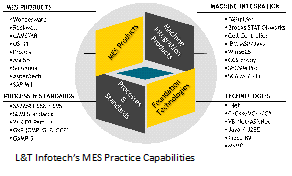
L&T Infotech's MES practice offers services across the discrete and process industries. According to the company, it provides IT solutions and services that extend from shop floor (controls and SCADA) to top floor (ERP), including integration.
Conclusion
Today's increasingly dynamic and competitive business environment requires an effective MES solution to manage production for on-time shipment, low inventory, high quality and cost control. MES provides the needed visibility and decision support tools. As was the case with Hanwha Q CELLS, working with an experienced MES service provider with a proven track record is often the key to successful MES deployment.
Within a manufacturing organization, there's often a divide between IT and manufacturing engineering. Each organization has its own, very different KPIs, culture, and terminology. Misunderstandings, false starts and rework often occur. ARC Advisory Group agrees with Mr. Kenner's recommendation for IT to present its understanding of the needs and what they plan to do to close any gaps with plant personnel and gain trust.
All signed-in ARC Advisory Group clients can view this report in pdf format at this Link
If you would like to buy this report or obtain information about how to become a client, please Request ARC Info
Keywords: Manufacturing Execution System, MES, Hanwha Q CELLS, L&T Infotech.