Representative End User Clients







Representative Automation Clients







Representative Software Clients








It is impossible to ignore the tidal wave of excitement and hype surrounding Generative AI. However, at ARC Advisory Group, we consistently advise our Industrial Sector clients that success in this new era requires understanding the entire Industrial AI toolbox, not just the newest, shiniest instrument. This ongoing Industrial AI (R)Evolution is fundamentally reshaping operations and architecture across IT, OT, ET, and Data Science domains.
To cut through the noise and provide clear guidance, I've been hosting a detailed podcast series on Industrial AI with thought leaders across the ecosystem. In this context, I was thrilled to welcome Dustin Johnson, CTO of Seeq Corporation, back for our third conversation.
In our previous two discussions, we established three critical, non-negotiable pillars necessary for industrial organizations to move beyond "pilot purgatory" to scaled, reliable AI deployment:
The Industrial Data Fabric (IDF) is the non-negotiable prerequisite. We confirmed that without a unified, contextualized data foundation—addressing data quality, governance, and contextualization—AI initiatives are destined to remain brittle proofs-of-concept.
Generative AI is primarily a "Gen UI" and knowledge engine. We agreed that Gen AI's immediate value is in democratizing access to complex operational systems through natural language and solving the pervasive challenge of unstructured data and tribal knowledge capture.
The future is Agentic AI. The definitive path to scaled operational intelligence is not a single, monolithic AI model, but a distributed architecture of specialized AI agents. This ensures each task utilizes the right tool for the job.
In this third, critical installment, Dustin and I focused on how these three pillars converge to enable true machine-to-machine (M2M) intelligence and unlock the full potential of the Industrial AI toolbox.
Listen on BuzzSprout:
Watch on YouTube:
Here are the key takeaways and insights from our discussion:
The conversation quickly moved beyond human-in-the-loop chatbots to the more profound, scalable value of machine-to-machine (M2M) communication. Dustin argued this shift is even more interesting than the human-to-machine interface because it addresses the value locked in the "interstitial tissue" between systems.
This M2M architecture requires industrial platforms to act as collaborative ecosystem players, exposing their specialized capabilities (like Seeq's time-series analysis) as secure "tools" for other agents to consume. This enables a "1 + 1 = 3" scenario where context from one system, time-series insights from another, and planning data from a third can be combined to create value far greater than the sum of its parts.
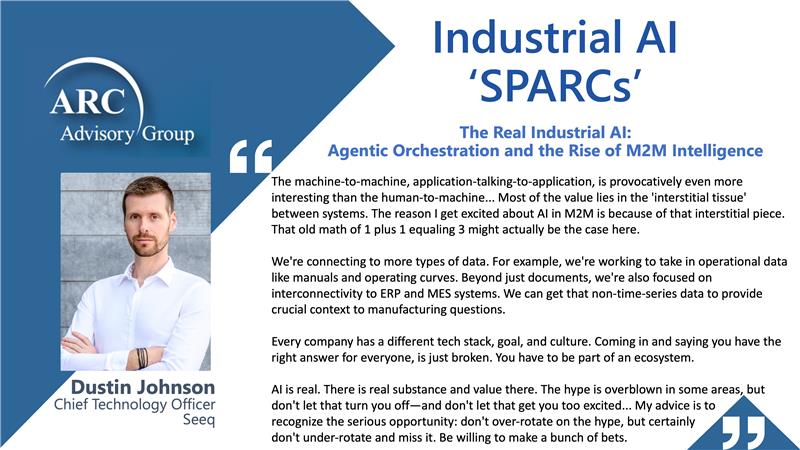
Dustin Johnson (CTO, Seeq): “The machine-to-machine, application-talking-to-application, is provocatively even more interesting than the human-to-machine... Most of the value lies in the 'interstitial tissue' between systems. The reason I get excited about AI in M2M is because of that interstitial piece. That old math of 1 plus 1 equaling 3 might actually be the case here.”
Colin Masson: “This brings us back to Agent-to-Agent (A2A) and the Model Context Protocol (MCP). They really need to go together. And before you can even do MCP, you need unified namespaces to provide some of the context.”
I pressed Dustin to move from architectural theory to practical application. If agents need to answer complex questions, they need more than just one type of data. He outlined Seeq's pragmatic steps to broaden its data foundation beyond time series to provide this essential, richer context.
This involves building connectors for unstructured data (like operational manuals and operating curves) and, crucially, interconnecting with transactional enterprise systems like ERP and MES. This evolution is being guided directly by customer requests, who are asking complex, multi-domain questions that no single system can answer alone.
Colin Masson: "What are the practical steps you are taking to broaden the data foundation? There's a lot of knowledge in unstructured data that you can leverage and blend with your OT data insights to make that data more accessible and ensure people understand the context."
Dustin Johnson (CTO, Seeq): "We're connecting to more types of data. For example, we're working to take in operational data like manuals and operating curves. Beyond just documents, we're also focused on interconnectivity to ERP and MES systems... We can get that non-time-series data to provide crucial context to manufacturing questions."
This M2M architecture and expanded data foundation are the enablers for the ultimate goal: Agentic AI as an orchestrator. This architecture is the key to enterprise-wide scale, enabling a "mix-and-match" approach where specialized models (e.g., causal AI, physics-informed models, or Seeq's time-series analytics) can be selected and coordinated seamlessly.
Dustin was very clear that this future is not about one vendor winning or building a monolithic platform. The reality of industrial environments is a heterogeneous ecosystem of best-in-class tools. Success is not about replacing this ecosystem, but providing the M2M and A2A connections to orchestrate it effectively, often through a central corporate AI like Microsoft Copilot.
Colin Masson: "Agentic AI is the approach that will unleash the benefits of Gen AI and all the other great tools. It allows us to use the right tool for the job, whether it's for cost, latency, accuracy, or explainability reasons."
Dustin Johnson (CTO, Seeq): "Every company has a different tech stack, goal, and culture. Coming in and saying you have the right answer for everyone, all in the exact same shape, is just broken. You have to be part of an ecosystem."
Throughout the discussion, we stressed the need for a pragmatic focus on measurable business outcomes. While the hype is real, industrial leaders must prioritize reliable data foundations (the IDF) over simply chasing the newest frontier models.
Dustin offered candid advice: don't "over-rotate" on the hype but also don't "under-rotate" and miss the genuine opportunity. The most successful strategies will involve making selective bets across the full AI spectrum, with an increasing focus on data traceability to combat hallucinations and move away from "data swamp" approaches.
Dustin Johnson (CTO, Seeq): "AI is real. There is real substance and value there. The hype is overblown in some areas, but don't let that turn you off—and don't let that get you too excited... My advice is to recognize the serious opportunity: don't over-rotate on the hype but certainly don't under-rotate and miss it. Be willing to make a bunch of bets."
Colin Masson: "We'll see more pressure on 'where did that data come from? How was it contextualized?' There’s a definite pushback from the 'data swamp' approach, where data is moved without context. That's the problem—it wasn't contextualized before you moved it."
The dialogue on industrial AI and digital transformation is constantly evolving. To stay informed and hear more insights from industry leaders, we invite you to subscribe to ARC Advisory Group's Digital Transformation podcast series.
If you are an innovator in this space and would like to contribute to a future discussion, please reach out to Colin Masson at ARC Advisory Group.
For ARC Advisory Group recommendations for Navigating the AI Wars - including the Industrial Robot Wars - Closing the Digital Divide by Embracing Industrial AI, assembling your Industrial-Grade Data Fabric, and governing and guiding major decisions about enterprise, cloud, industrial edge, and AI software, please contact Colin Masson at [email protected].
Or set up a meeting with my fellow Analysts and I, at ARC Advisory Group to find out more about our Executive Insights Service for Industrial organizations, and Industrial AI Insights Service for Vendors.