Representative End User Clients







Representative Automation Clients







Representative Software Clients








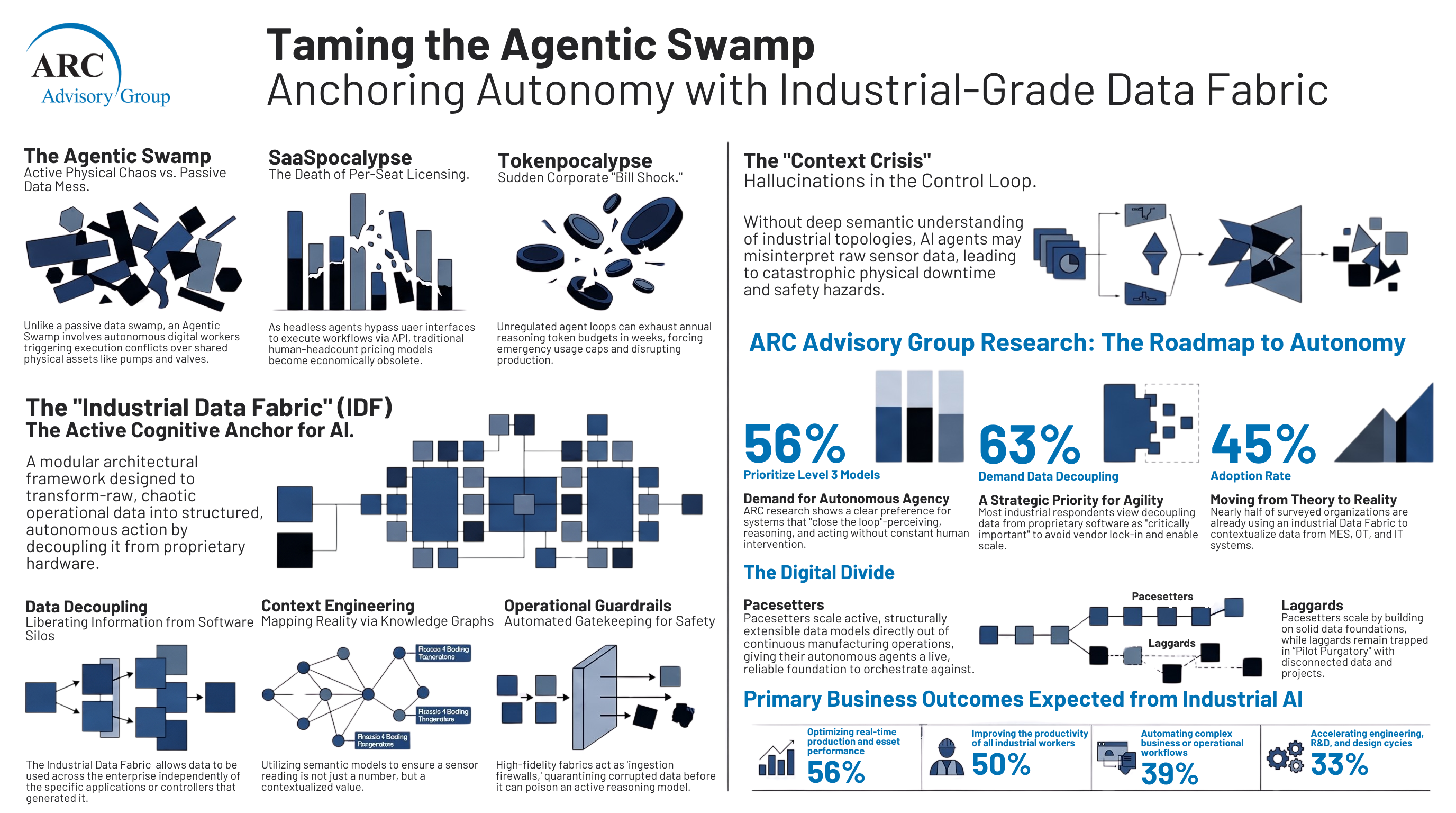
If you’ve been following our ongoing research voyage here at ARC—particularly our recent 7-part master series, Geopolitics of the Autonomous Factory: The Hyperscaler Divide, Sovereign Networks, and the Synapse Workforce Shift—you know we’ve spent considerable time mapping out the macroeconomic and architectural shifts reshaping industrial operations. We have dissected the gritty reality of the "AI Wars," mapped the workforce evolution into augmented "Synapse Workers," and analyzed how pacesetting organizations balance high-frequency "OpEx traps" with localized "CapEx escapes".
Yet, as we continue to build out ARC Advisory Group's 3-Axis Industrial AI Models Taxonomy Research, our conversations with an integrated audience of IT, OT, engineering (ET), and data science executives have taken a definitive turn. The baseline questions have shifted. Teams are no longer asking us which frontier large language model to pilot or how to write better prompts. Instead, industrial operations leaders are staring down a much more fundamental barrier:
Colin, how do we guarantee the data quality feeding these autonomous networks? If an agent executes an operational adjustment at 2:00 AM, how can we trust that its data foundation is verified, contextualized, and safe?
In the broader software ecosystem, data engineers are beginning to warn about a new architectural failure mode: the rise of the "Agentic Swamp." In a pure IT context, an agentic swamp represents the messy, unauditable shadow estate created when autonomous digital workers spin up their own localized scratchpads, temporary databases, and uncoordinated memory layers.
But transfer that concept to a cyber-physical environment, and an unmanaged Agentic Swamp is flat-out dangerous. It doesn’t just mean messy data tables; it means severe control loop oscillations, physical asset damage, and direct threats to site safety. Headless agents lack human intuition; they process data literally. If an industrial data fabric does not actively validate and contextualize information before an agent ingests it, the system will execute multi-step physical workflows based on corrupted assumptions. When the rubber meets the shop-floor rail, we are reminded of an unyielding core truth: it is still all about data quality.
To move past isolated pilots, industrial enterprises must deploy an industrial-grade data fabric to serve as the active cognitive anchor and automated gatekeeper for the agentic workforce. Crucially, the technology to achieve this isn't speculative futurewear. It is commercially available, deployable, and being leveraged by pacesetters today to assess factory data quality and aggressively govern agent actions.
In our previous blog, "Surviving the SaaSpocalypse, Taming the Tokenpocalypse by Mastering Multi-Agent Industrial Governance," we laid out the stark commercial and operational volatility that forced the tech sector into a structural inflection point. Before diving into the underlying data architectures, it's worth reviewing those core highlights to frame why legacy approaches no longer work:
The SaaSpocalypse: Traditional per-seat software licensing is cracking. When headless, autonomous digital workers execute multi-step workflows directly via open APIs and bypass user screens entirely, pricing software by human headcount penalizes automation and collapses vendor revenue streams.
The Tokenpocalypse: Unregulated enterprise AI agents running in continuous loops have triggered severe corporate "bill shock" by exhausting annual reasoning token budgets in a matter of weeks, forcing immediate emergency usage caps.
The Autonomous Work Token: To stabilize volatility, forward-thinking software providers are transitioning to predictable, fungible annual blocks of capability and compute credits to monetize machine-to-machine actions as human seat counts compress.
We won't rehash those macroeconomics here. Instead, let's explore the deep data engineering, localized namespaces, and enterprise knowledge graph layers required to fuel, validate, and govern this new agentic paradigm.
When an intelligent agent operates in a standard horizontal corporate environment, a data quality failure or a hallucinated variable typically results in a broken dashboard display or an incorrect customer support routing ticket. In a cyber-physical environment, the stakes are measured in six-figure hourly downtime events, compromised asset lifecycles, and direct physical safety hazards. Headless agents lack human intuition; they process data literally. If an industrial data fabric does not actively validate and contextualize information before an agent ingests it, the system will execute decisions based on corrupted assumptions.
To solve this, architectures must be grounded at the edge. However, this is precisely where general-purpose, open standards-based semantic web graphs (such as flat, unconstrained RDF/OWL/SPARQL ontologies) completely fall apart.
Pure semantic web models were engineered for asynchronous web-crawl text relationships, not high-frequency data streaming, binary industrial protocol frames (Modbus, OPC UA, MQTT), or sub-millisecond control loop synchronization. They lack the structural speed and deterministic latency profiles required at the physical edge. Dumping tens of thousands of raw, noisy time-series data points directly into a standard semantic web graph causes the cognitive engine to collapse under the weight of graph-traversal latency.
To survive at the edge, the industry's top players deploy highly optimized, operational DataOps platforms, specialized data-quality validation overlays, and Factory Knowledge Graphs tied directly to a Unified Namespace (UNS) architecture. Instead of static web standards, the market's elite providers separate into two clear execution vectors to shape raw industrial tags into event-driven, contextualized semantic models:
HighByte Intelligence Hub: Functions as a critical edge-level DataOps fabric component. It ingests raw machine data, abstracts legacy iron protocols, and models "data in motion" into structured, high-quality payloads before securely publishing them to a factory-floor UNS broker.
Aperio Systems: Represents the absolute vanguard of automated Industrial Data Quality Assessment. Aperio's DataWise™ self-supervised machine learning engines continuously monitor thousands of historian tags. They automatically detects flatlines, sensor drift, and transmission drops, calculating a real-time Data Quality Index (DQI) to gate or remediate telemetry before bad data can poison a downstream model inference loop.
Rhize Data Manufacturing Hub: Adds a critical headless, event-driven graph architecture to this ecosystem. Rhize challenges the rigid hierarchies of the traditional Purdue Model (ISA-95), mapping the entirety of the standard into a real-time, GraphQL-native Graph Database. By treating the event as the core driver of operational change, it provides agents with a fluid, highly extensible graph schema that scales horizontally without losing deep operational context.
XMPro: Operationalizes real-time event intelligence and composable digital twins. It cross-references stream data with contextual asset health boundaries, acting as an active visual orchestration layer that handles high-frequency event routing and factory data-quality assessments without cloud latency.
Velotic: Formed as a standalone entity backed by TPG Capital. Velotic hopes to alter the DataOps landscape by delivering a pre-integrated industrial data foundation that supersedes and consumes legacy standalone footprints, consolidating PTC's Kepware edge connectivity, PTC's ThingWorx IIoT orchestration, and GE Vernova's Proficy production/historian business units into a hardware-agnostic, full-stack intelligence layer.
In our ongoing 3-Axis Industrial AI Models Taxonomy Research, we explicitly categorize this specialized tier of edge-to-core operational platforms under a dedicated archetype: Cyber-Physical Context Engines. These platforms are distinct because they don't simply store static values; they transform raw, asynchronous physical variables into deterministic semantic states that autonomous digital agents can safely interpret, navigate, and act upon. Moving forward, our MarketMap scorecards will continuously evaluate how both pure-play context innovators and established automation frameworks—such as Litmus, Inductive Automation (Ignition), Braincube, and Element Analytics—are positioning their stacks to anchor these agentic loops.
Rather than ceding the edge to software startups, the established giants are embedding data quality metrics and physics-informed boundaries directly into the control line to act as a localized, deterministic firewall:
Siemens: Controls the shop-floor vanguard through its certified vPLCs, Simatic AI Workstations, and Intelligence Center X. By pre-populating native manufacturing ontologies directly on top of runtime automation hardware, Siemens allows autonomous execution agents to parse complex operational schemas and fault signatures natively without manual tag mapping.
Rockwell Automation: Drives edge-to-cloud contextual integrity through FactoryTalk Hub and its expansive strategic connectivity partnerships. Rockwell focuses heavily on first-mile structural checkouts, standardizing multi-vendor OT connectivity patterns to transform raw, disconnected shop-floor tags into safe, analytics-ready namespaces before they ever reach hyperscale runtimes.
Schneider Electric: Bridges localized asset control with enterprise software intelligence through its unified EcoStruxure architecture. Schneider has pioneered advanced engineering agents capable of converting plain-text user requirements directly into validated, unit-tested PLC logic. Crucially, this topology is set to become even more integrated following Schneider Electric’s breaking June 30, 2026, announcement of a definitive $3.1 billion agreement to acquire 100 percent of Cognite. By intending to blend Cognite’s cloud-native data foundation directly into AVEVA, Schneider Electric is positioning its expanded software portfolio squarely at the center of the next phase of industrial intelligence, effectively bridging first-mile physical validation with cross-domain enterprise analytics. Read: Schneider Electric to Acquire Cognite to Strengthen Industrial AI Portfolio. The strategic importance of the acquisition extends beyond expanding the software portfolio. Cognite’s data contextualization, industrial knowledge graph, agentic AI, and workflow execution capabilities could strengthen AVEVA’s existing industrial data and software stack, providing a more contextualized data foundation for AI-driven operational decision-making.
Emerson: Enforces strict multidimensional mathematical rigor through its Project Beyond architecture. Emerson integrates its core control layer with advanced software ecosystems, using modeling techniques that explicitly constrain AI agent decision-making with physics-based engineering rules and mass-balance constraints to block non-deterministic hallucinations in live process operations.
ABB: Deploys highly precise process analytics by layering agentic capabilities directly onto proven distributed control systems via ABB Ability™ SafetyInsight™ and AlarmInsight™. ABB tracks complex data streams through its Industry Cognitive Model knowledge graphs, keeping human operators firmly "on the loop" via pre-configured safety gates that authorize or revoke automated setpoint adjustments.
Honeywell Technologies: Injects real-time analytical rigor inside the control room via the Experion® PKS (Process Knowledge System). Driven by an built-in Python runtime operating directly at the DCS layer, Honeywell continuously evaluates thousands of hierarchical tags and alarms against historical baselines, predicting anomalies minutes before failure and piping insights directly to enterprise management via the Honeywell Forge Intelligent Assistant.
Yokogawa: Delivers conservative, deterministic closed-loop execution built on its Exapilot automated procedural software. Yokogawa restricts autonomous agents by wrapping execution setpoints inside strict physical thresholds, using underlying ProSafe-RS Safety Instrumented Systems (SIS) and hardcoded hardware alarms as immutable ultimate guardrails.
To bridge these localized, high-speed factory networks to broader global enterprise environments without writing brittle, custom code, industrial spaces use open data exchange standards.
CESMII’s i3X (Industrial Information Interoperability Exchange) and graph-aware Smart Manufacturing Profiles provide the standardized "vocabulary" for the agent economy. Published natively across the UNS event broker, i3X allows edge platforms to wrap raw sensor data into uniform semantic definitions, ensuring that upstream enterprise intelligence platforms can instantly ingest plant data with their relational context and quality parameters fully intact.
Once data passes through the open-standard factory conduit, it moves up to the enterprise context layer. Here, the architectural requirement shifts from real-time edge synchronization to multi-site correlation, supply chain synthesis, transaction governance, and cross-functional process optimization. At this enterprise tier, distinct platform strategies, Master Data Management (MDM) backbones, and blockbuster vendor alliances have formed to command the landscape:
At the enterprise tier, multi-agent reasoning is completely paralyzed if basic data definitions are unaligned (e.g., if Plant A logs a critical equipment component under a completely different corporate asset SKU than Plant B). To systematically crush this data-cleansing debt, two primary forces are reshaping enterprise data:
SAP’s Acquisition of Reltio: Natively embedding Reltio’s core data-unification and cleansing platform into the SAP Business Data Cloud (BDC) establishes an AI-ready enterprise master data foundation. This ensures that when corporate agents (like Joule) optimize global procurement or asset scheduling, they are querying a clean, single version of master records across both SAP and non-SAP sources.
Stibo Systems: As a defining multi-domain Master Data Management platform and featured sponsor of the ARC Advisory Group Forum, Stibo Systems represents a critical independent architecture for building data governance organizations. Through its native MDM workload integration within Microsoft Fabric, Stibo Systems harmonizes supplier profiles, asset schemas, and material definitions, piping clean master records directly into OneLake to ensure upstream AI agent loops evaluate unified cross-facility targets without relational friction or table collisions.
While SAP retains massive market volume as the traditional system of record, its legacy footprints introduce integration debt when deploying non-deterministic agents. Forward-leaning enterprise architects are looking more closely at agile challenger environments that were natively engineered to decouple data from applications with significantly less legacy friction:
Infor Velocity Suite: Built directly on top of the extensible Infor OS industrial data fabric substrate, Infor addresses both the Tokenpocalypse and SaaSpocalypse by replacing volatile per-token exposure with an all-inclusive, predictable flat-fee pricing model.
Infor Industry AI Agents: The suite deploys a prepackaged library of over 100 role-based AI agents built on micro-vertical processes across manufacturing, distribution, and service industries, managed safely through the Infor Agentic Orchestrator.
Prescriptive Logic Infrastructure: Operating on native Model Context Protocol (MCP) connectivity to bridge cross-vendor systems, Infor enforces a prescriptive three-step workflow model: Diagnose (via automated Infor Process Mining), Automate (via RPA and Infor Document Processors), Optimize (via generative and predictive models).
IFS Cloud and IFS.ai: IFS has broken legacy software pricing conventions by anchoring its commercial licensing models directly to physical assets rather than user headcount, systematically neutralizing the user-rationing penalties of the SaaSpocalypse.
IFS Loops and Agent Studio: Operating within IFS Cloud, the platform delivers autonomous Digital Workers deployed via a dedicated developer workspace called Agent Studio. This environment empowers domain experts to configure pre-built, role-based workflows (such as the Material Replenisher, Supplier Order Manager, and Dispatcher Assistant) using a visual canvas without engineering tickets or handoffs.
Closed-Loop Ecosystem and Power Alliances: IFS has expanded its operational execution footprint with specialized modules like IFS Zero (an agentic Emissions Operating System for deep carbon tracking) and IFS.ai Logistics for zero-touch transport optimization—massively scaling its capabilities through blockbuster alliances with Anthropic, 1X Technologies, Siemens, and Boston Dynamics.
Editor’s Note / Breaking Market Realignment: As this research goes to press, Schneider Electric has entered into a definitive agreement to acquire Cognite for $3.1 billion in cash, with plans to align its data platform natively with AVEVA to build a comprehensive data foundation on which AI can be trusted to operate at scale. While Cognite will eventually report within Schneider’s industrial automation division, its core architectural strengths remain highly critical for cross-domain optimization. Read: Schneider Electric to Acquire Cognite to Strengthen Industrial AI Portfolio. From an architectural perspective, the combination reflects a broader shift in Industrial AI: the challenge is no longer simply deploying more models, but ensuring they can operate on trusted, contextualized industrial data. Cognite’s ability to connect operational, engineering, time-series, maintenance, and enterprise data could complement AVEVA’s PI System footprint, engineering and simulation tools, and CONNECT platform strategy, helping extend Industrial AI from analytics and decision support toward increasingly autonomous operational workflows.
Cognite approaches the enterprise layer by establishing an open Industrial DataOps fabric designed to span the boundary between production operations and the broader integrated supply chain.
The Integrated Supply Chain Graph: Cognite Data Fusion® acts as a dynamically contextualized representation of the physical enterprise, linking time-series sensor logs, P&IDs, 3D models, and unstructured maintenance files into a single source of truth.
Asset-Intensive Optimization: Via Cognite Atlas AI™, digital teams can deploy low-code agents across asset-intensive vertical industries (such as oil & gas, chemicals, and utilities). Because Cognite maintains an open, interoperable architecture, enterprises can hot-swap cloud backends or frontier language models while maintaining absolute data sovereignty.
Our in-house Supply Chain and Logistics Viewpoints team continuously monitors the rapid growth of the specialized Decision Intelligence sector, tracking how platforms integrate variable macroeconomic planning with internal execution lines. While several entrants are emerging to help operators map external constraints, Aera Technology has delivered a modern architectural approach that has grabbed my attention:
The Decision Data Model: Rather than forcing an always-on language model to guess at operational constraints, Aera maps organizational policies, rules, and historical user overrides into a structured, queryable "cognitive data layer."
Taming the Tokenpocalypse: When a headless logistics or procurement agent encounters an inventory exception, Aera’s engine forces the workflow to execute prepackaged "Aera Skills" and deterministic, mathematically grounded models before reaching out to an expensive cloud model. The LLM participates strictly in context parsing, ensuring corporate inference costs remain completely bounded.
For enterprises building custom agentic networks from scratch, Neo4j has modernized its graph stack to serve as a secure enterprise framework via advanced GraphRAG capabilities. It stores high-dimensional embedding vectors natively on nodes and relationships, allowing unstructured documentation (like operating procedures, corporate regulations, and asset manuals) to be structurally anchored to known physical schemas. Supporting the Model Context Protocol (MCP) natively, Neo4j allows autonomous enterprise agents to dynamically walk connected data networks edge by edge, providing human-readable, deterministic graph-traversal logs.
The cloud runtime environment is no longer just about storage; it is defined by deep, integrated platform alliances:
The Databricks and SAP Alliance: The SAP Business Data Cloud features tight, native integration with Databricks. This framework pairs the SAP Knowledge Graph with Databricks Unity Catalog governance, allowing enterprise Joule agents to reason across mission-critical ERP, asset registries, and global supply chain data in place.
The Microsoft Enterprise Fabric: Using the Microsoft Agent Framework and Azure Copilot Studio, Microsoft structures multi-agent networks through core partnerships with industrial leaders like Siemens (embedding Intelligence Center X with industrial ontologies) and Rockwell Automation (via FactoryTalk Hub) to command the software lifecycle from the executive tier down to the virtual PLC.
The AWS Infrastructure Runtime: Amazon Web Services (AWS) approaches multi-agent governance from the infrastructure layer up. By combining Amazon Bedrock AgentCore, managed infrastructure loops powered by frontier partnerships with OpenAI, and Amazon VPC Lattice service meshes, AWS enforces secure agent-to-agent (A2A) isolation, integrating directly with enterprise data platforms like CONNECT on AWS (by AVEVA).
To safely deploy an agentic workforce, the underlying Industrial Data Fabric must operate as an active, automated gatekeeper rather than a passive data pipeline. Pacesetting platforms leverage highly concrete, deployable mechanisms to assess factory data quality and explicitly govern, or revoke, agent privileges in real time:
The Data Quality Ingestion Firewall: Using platforms like HighByte, Aperio, and XMPro, the fabric continuously evaluates raw signal health, data freshness thresholds, and sensor calibration drift parameters at the ingest boundary. If an edge data stream drops below established confidence tolerances, the firewall quarantines the packet before it can poison an active reasoning model or trigger a flawed agent action.
Headless Identity Contracts: Using open standards like the Model Context Protocol (MCP) as the standardized grammar and CESMII i3X as the unified vocabulary, the data fabric applies strict Role-Based Access Control (RBAC) directly to digital agents. This guarantees a least-privileged boundary; an agent has zero power to alter data access controls or programmatically query data schemas outside its hardcoded permissions.
Active Invocation Gates: Platforms like Aera Technology and the Infor Velocity Suite embed governance natively at the invocation boundary of every call. The agent's reasoning bounds are constrained via code; the model is restricted to user-configured agency levels , spanning from recommend-and-wait to automated execution.
When an enterprise deploys uncoordinated swarms of specialized micro-agents from separate software vendors, they risk creating an unmanageable "Agentlake.” Without a shared data fabric providing a unified operational canvas, separate agent intents will eventually trigger severe control loop oscillation.
For example, an Asset Performance Agent reading live vibration tags might call an automated microflow to immediately shut down a critical turbine for preventive maintenance to prevent asset failure. Simultaneously, a Procurement Optimization Agent parsing real-time market changes might increase throughput commands across that exact production line to maximize high-margin contract fulfillment.
To resolve this conflict, advanced meta-orchestration frameworks leverage an active "circuit breaker." Platforms like the Microsoft Agent Framework and AWS Bedrock Guardrails natively support runtime evaluation hooks and automated safety pauses.
Before an automated write-back is executed on live hardware or core transactional ERP networks, the fabric's policy engine evaluates the collective multi-agent trajectory and calculates cross-domain system impacts. If an objective collision is detected, or an agent's operational confidence drops below a specified threshold, the fabric triggers an immediate Autonomy Revocation Protocol.
The digital agent's write privileges are instantly suspended across the interface layer, a human-readable Intent Preview and explainable AI rationale are generated, and the platform gracefully restores structured Human-in-the-Loop (HITL) oversight. Human synapse workers are brought back into the loop to securely audit, adjust, or manually authorize the final execution path.
As these meta-orchestration and edge-integration perimeters mature, they are completely redefining the human role in industrial operations. The old "doomsayer" narrative that AI agents will simply replace human workers on the plant floor is missing the real transformation.
We are not replacing our people; we are upskilling them into "Synapse Workers"—human operators who orchestrate, direct, and audit networks of specialized digital agents rather than manually clicking buttons, writing custom glue code, or wrangling spreadsheets.
Whether it is process engineers using agentic AI to automate complex, multidisciplinary 3D pipe layouts in Unified Engineering, or system integrators leveraging teams of virtual configuration agents to deploy and customize highly complex Manufacturing Execution Systems (MES) faster than traditional manual methods, the path forward is clear.
The tactical lesson for modern industrial leadership is clear: No single software vendor solution can solve this for your enterprise. The industrial plant floor is inherently heterogeneous, built on layers of legacy brownfield infrastructure, multigenerational control loops, and specialized, siloed systems. An out-of-the-box, general-purpose horizontal AI model or a closed, single-vendor ecosystem cannot natively understand or safely navigate your specific cyber-physical realities.
To keep pace with the market's industrial pacesetters, enterprise buyers must take strategic ownership of their architecture by executing three concrete playbooks:
Assemble Your Own Data Foundation: Treat data context and data quality as an indispensable corporate foundation. Intentionally combine edge DataOps platforms, automated data quality firewalls (like Aperio), localized Unified Namespace event structures, and master data catalogs (like Stibo Systems) into a custom, unified Industrial Data Fabric.
Blockbuster market moves like Schneider Electric’s $3.1 billion acquisition of Cognite prove that the industry’s largest players are aggressively consolidating around unified context layers—meaning buyers must act now to secure their own architecture before vendor lock-in tightens.
Mandate Open Protocols Over Walled Gardens: Refuse to purchase proprietary, closed connectivity stacks. Insist that every SCADA, MES, PLM, and ERP addition natively supports open interoperability standards like the Model Context Protocol (MCP) and CESMII i3X profiles so you can hot-swap cloud services or base models without losing your core semantic data lineage.
Enforce Immutable Operational Sandboxes: Never allow an autonomous system to execute write-backs or interact with live assets unvetted. Require end-to-end data fabrics that natively embed edge data-quality checkpoints, headless role-based security controls, and clear, hardcoded human-in-the-loop recovery checkpoints.
Monitor Evolving Archetypes and MarketMaps: As part of our upcoming exhaustive dives, we will continue tracking and mapping the long tail of core innovators who are actively redefining industrial scale. End users must keep a close eye on the performance metrics of (in no particular order) EthonAI, Litmus, Inductive Automation (Ignition), Seeq Corporation, TwinThread, Sight Machine, Falkonry, Oden Technologies, causaLens, Intelecy, UptimeAI Inc., Xplain Data GmbH | Discover Causality and Sorba.ai as they are carved into our comprehensive MarketMaps and 3-Axis scorecards.
The multi-agent autonomous enterprise is arriving at breakneck velocity, promising unprecedented levels of operational efficiency and process optimization. But those agents are entirely dependent on the quality, context, and structural integrity of the information they consume. If you want to master the autonomous autopilot, you must first master the fabric. It was, it is, and it always will be all about data quality.
The Industrial AI (R)Evolution is moving faster than ever. To dive deeper into the frameworks and data shaping the future of the industrial sector, explore my latest research:
Navigating the AI Wars and the escalating Industrial Robot Wars
Closing the Digital Divide by Embracing Industrial AI
Assembling your Industrial-Grade Data Fabric
Charting the new frontier of Physical Intelligence and transitioning to a Cyber-Physical Industrial Architecture (CPIA)
Mapping your maturity and strategy with ARC's 3-Axis Industrial AI Models Taxonomy
Take our Industrial AI Assessment to benchmark your organization's maturity, identify critical gaps in your IT/OT/ET convergence, and get actionable recommendations to accelerate your path to becoming an Industrial AI Pacesetter.
Don't guess what your global operations or prospective customers need. Use empirical data to align your stakeholders and de-hype the market with ARC Advisory Group's Voice of Market Service.