Representative End User Clients







Representative Automation Clients







Representative Software Clients








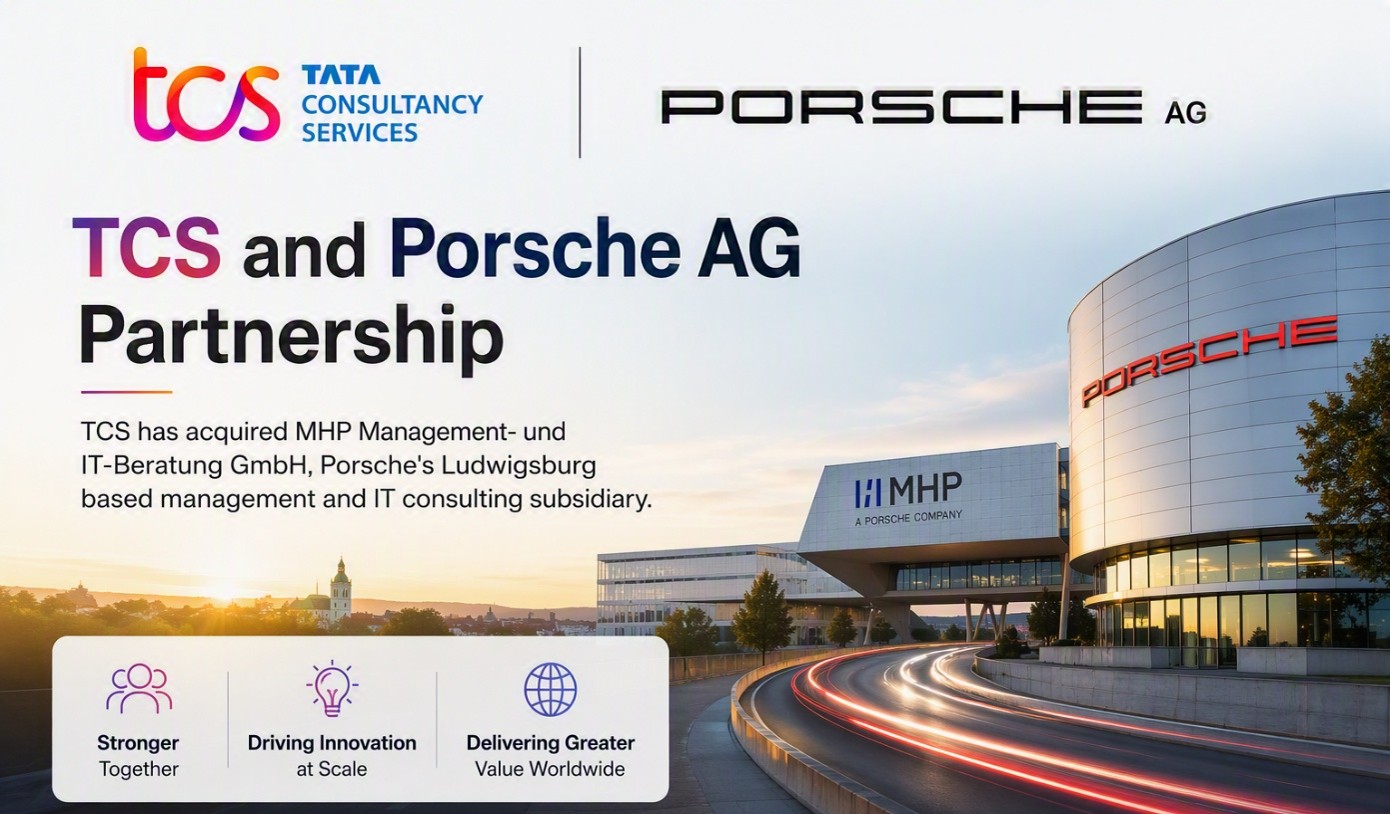
On August 24, 2026, Tata Consultancy Services and Porsche AG signed an agreement in Mumbai under which TCS will acquire 100 percent of MHP Management- und IT-Beratung GmbH, Porsche's Ludwigsburg-based management and IT consulting subsidiary, for roughly $373 million. The deal still needs regulatory and antitrust clearance and is expected to close in the coming months. Deutsche Bank advised TCS on the financial side, with Noerr providing legal counsel.
That price tag is really just the entry point. Alongside it sits a separate five-year strategic agreement worth about $1.46 billion, under which Porsche commits ongoing work to TCS and MHP across manufacturing, engineering, operations, and customer experience. As part of the arrangement, TCS is setting up a dedicated AI Mobility Centre of Excellence with MHP, aimed at turning AI use cases into scalable solutions across Porsche's product and value chain.
One point both companies were careful to spell out is that MHP keeps its name and keeps running as an independent consultancy inside TCS. It isn't getting folded into TCS's brand, so its 30-year identity in automotive and industrial consulting stays intact, at least for now.
This move sits inside Porsche's "Sportwagenschmiede 35" strategy, an initiative built around sharpening its focus on the core sports car business. Porsche AG Chairman Michael Leiters called it another step in that direction, describing the move as gaining a strategic partner in TCS rather than simply exiting a business.
It's not an isolated decision either. European automakers are broadly shedding non-core operations as they deal with the cost of electrification, US tariffs, and stiffer competition from Chinese manufacturers. Parent company Volkswagen Group is pushing to expand group-wide job cuts to as many as 100,000 positions, and peers like Mercedes-Benz and BMW are running similar cost programs of their own. Selling a profitable, 4,500-person consultancy isn't a sign MHP was struggling. It's Porsche choosing to keep its balance sheet close to what it actually builds: cars.
For TCS, the logic runs the other way. This is a deliberate push to deepen its footprint in automotive and industrial engineering across Europe, a region where Indian IT majors have been building a presence for years. TCS CEO K. Krithivasan framed the deal as combining TCS's AI, engineering, and business transformation strengths with MHP's automotive consulting depth, with the stated goal of industrializing AI at scale for Porsche.
MHP Group CEO Federico Magno described the move as giving MHP a stronger platform to grow, pairing its industry expertise with TCS's global reach and technology capabilities.
A few things stand out about why this deal makes sense for TCS specifically:
Instant client diversification. MHP's book covers automotive, manufacturing, aerospace, defense, and energy, giving TCS an established European base it would otherwise take years to build from scratch.
A real foothold in Germany. MHP sits near Porsche's Stuttgart headquarters, with operations spread across Switzerland, Romania, the US, China, the UK, and India. The DACH region has historically been tough for Indian IT services firms to break into, and this changes that overnight.
A proven playbook. TCS already runs a large technology partnership with JLR worth over £800 million, covering cloud, cybersecurity, and data services. This deal extends a model TCS has already tested in the automotive space.
A favorable price. At roughly 0.43 times MHP's 2025 revenue, the valuation looks conservative for a consultancy of this size and track record, suggesting TCS negotiated well.
Step back, and this deal fits a broader trend. Indian IT services majors are increasingly acquiring specialized European engineering consultancies to gain domain depth that's hard to build fast enough through hiring alone. TCS follows a path similar to those of Infosys, HCLTech, and Persistent Systems. Decades of automotive engineering knowledge, once locked inside OEMs, are steadily moving off their books and into global IT firms built to commercialize that knowledge at scale.
For the broader industrial software space, MHP's strength in automotive, manufacturing, and supply chain digitalization sits close to EAM, PAM, and OT/IT convergence work. Expect TCS to lean on that credibility to win digital twin and connected operations engagements well beyond Porsche.
For rival IT services firms, this raises the bar. Competing for major European industrial transformation mandates will increasingly depend on whether a firm has acquired real domain expertise, not just staffed up around it.
For MHP itself, staying independent inside TCS is a bet that its brand and client relationships in the DACH market are worth more when kept intact than when absorbed into TCS's own identity. Porsche and MHP have also confirmed they will keep working together closely after the ownership change, particularly on AI initiatives.
And for future OEM divestitures, pairing an acquisition with a large multi-year services commitment could become a common template going forward. It gives the buyer revenue certainty and gives the seller continuity, without having to run the function in-house anymore.
The $373 million price tag understates what's actually happening here. The $1.46 billion services commitment wrapped around it is what really locks Porsche and TCS into a five-year partnership on AI and engineering. For Porsche, this is capital discipline dressed up as a strategic partnership. For TCS, it's a calculated push deeper into European automotive engineering at a price that looks favorable on paper. Whether it pays off comes down to one thing: can TCS keep what made MHP valuable in the first place—its independence and three decades of trust in a market that's historically been wary of outsourced consulting?
The TCS-MHP deal reflects a broader shift in industrial technology, where engineering expertise, AI, digital twins, and connected operations are increasingly converging. For additional ARC perspectives on these trends, explore:
These insights provide broader context on the technologies and operating models reshaping automotive engineering, industrial AI, and digital transformation.