Representative End User Clients







Representative Automation Clients







Representative Software Clients








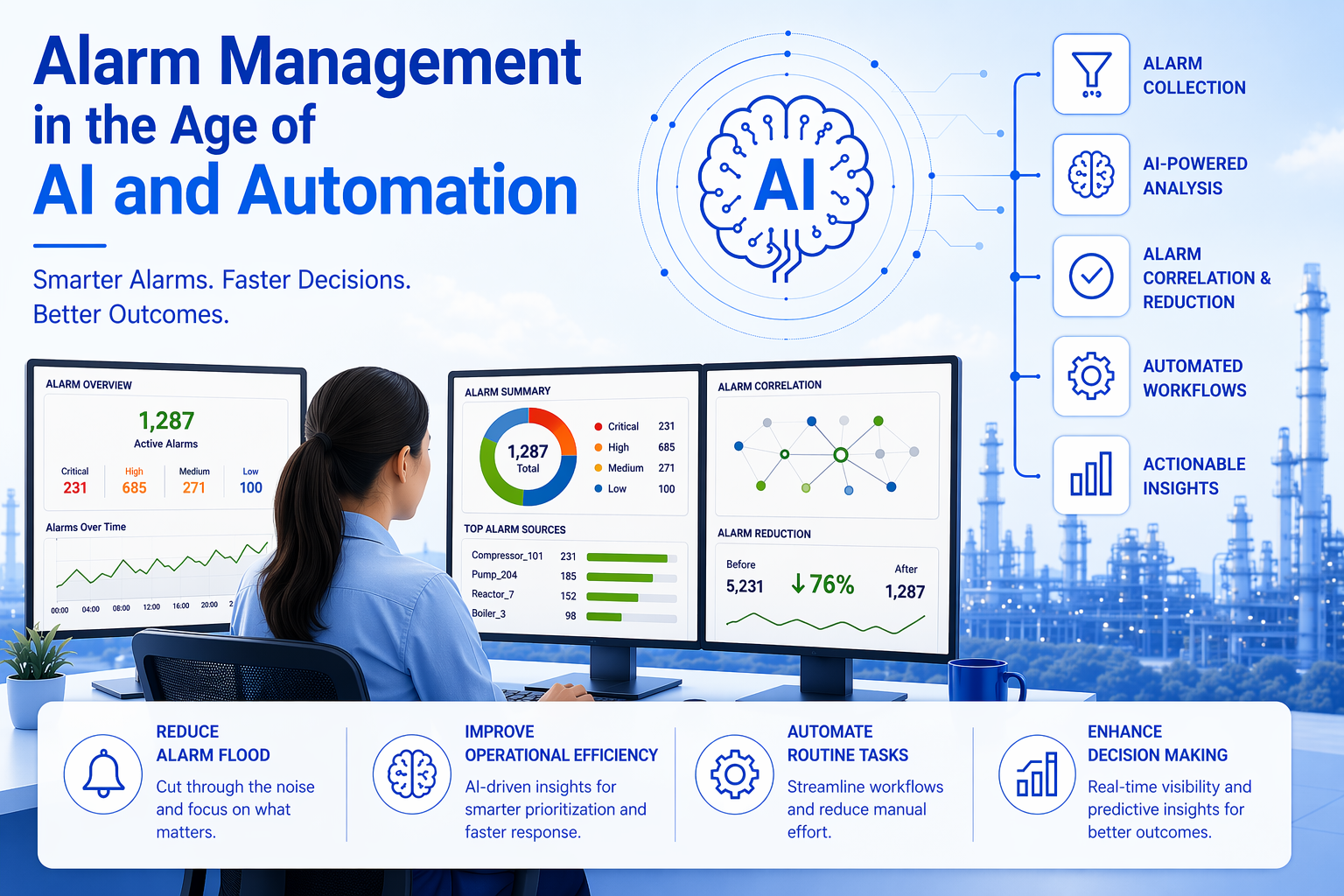
In many modern industrial operations, alarm overload has become a persistent challenge. Operators are often confronted with a high volume of alarms, many of which do not require immediate action. Over time, this creates an environment in which critical alerts can be overlooked or delayed.
This is not simply an operational inconvenience; it is a structural issue that directly affects safety, efficiency, and reliability. As industrial environments become increasingly automated and data-driven, alarm management must evolve from reactive alert handling to a more intelligent, lifecycle-driven approach.
In many facilities, alarm configurations have expanded over time without sufficient governance. As a result, alarms that were originally designed to support operators have become background noise.
Operators faced with excessive alarm volumes often:
Acknowledge alarms without evaluation.
Overlook recurring or nuisance alerts.
Struggle to identify critical events during process upsets.
In these conditions, alarm systems fail in their primary function: enabling timely and effective operator response. The issue is not simply the number of alarms, but their quality, relevance, and context.
Industrial operations today are significantly more complex, characterized by:
Higher levels of automation.
Increased volumes of real-time process data.
Greater system integration.
This has resulted in a rapid increase in alarm points. Without structured management, organizations face alarm floods, reduced visibility into underlying issues, and increased operational risk. Effective alarm management helps reduce this complexity by ensuring that only meaningful, actionable information reaches operators.
Traditionally, alarm management initiatives were driven by compliance requirements. While necessary, this approach often limited alarm systems to a regulatory role.
Leading organizations are now shifting their perspective. Alarm systems are increasingly viewed as:
A source of operational insight.
A tool for performance improvement.
A mechanism for early detection of abnormal conditions.
This transition from simple alarm handling to alarm intelligence enables organizations to extract greater value from alarm data and improve overall operational awareness.
Despite advances in AI and analytics, effective alarm management still depends on a structured lifecycle approach. This includes:
Defining a clear alarm philosophy.
Rationalizing and prioritizing alarms.
Implementing meaningful configurations.
Continuously monitoring and improving performance.
A key principle is that every alarm must require operator action. If no action is required, it should not be configured as an alarm. Applying this discipline ensures that alarms remain relevant and actionable.
Alarm rationalization consistently delivers some of the most immediate benefits. By reviewing and validating each alarm, organizations can eliminate nuisance alerts and significantly reduce alarm load.
In many systems, a small number of poorly configured alarms generate the majority of activity. Addressing these “bad actors” can:
Improve operator response efficiency.
Reduce alarm fatigue.
Restore confidence in alarm systems.
AI is increasingly being applied to alarm management, but its role should be clearly understood. AI can:
Identify patterns and recurring issues.
Improve alarm prioritization.
Support faster root cause analysis.
AI can also support a shift toward more proactive operations by detecting early warning signs of abnormal conditions.
However, AI is not a substitute for strong fundamentals. Without rationalized alarms, clean data, and defined processes, AI can amplify noise rather than reduce it. The most effective implementations use AI as an augmentation layer, enhancing established practices rather than replacing them.
The goal of alarm management is not simply to manage alarms, but to ensure that every alarm provides value.
Achieving this requires organizations to:
Focus on alarm quality over quantity.
Apply lifecycle-based management practices.
Systematically eliminate nuisance alarms.
Use AI selectively to enhance decision-making.
As industrial operations continue to evolve, alarm management is becoming a critical capability that directly influences safety, performance, and reliability. Organizations that integrate process discipline, data-driven insight, and intelligent technologies will be best positioned to move from alarm overload to operational clarity.