Representative End User Clients







Representative Automation Clients







Representative Software Clients








ARC Advisory Group’s annual Industry Forums, typically held in Orlando, Florida, always provide an excellent opportunity for the industrial world to come together to network and share learnings. This year’s Forum, held in hyperspace, continued that tradition.
Recent Forums have focused on the digital transformation of industry and infrastructure. According to at least one executive from a leading manufacturing company, these events have provided a “guidebook” for digital transformation. The online presentations at the 2021 ARC Industry Forum, Feb. 8-11th have revealed that targeted and effective application of digital technologies continue to lead to tangible business improvements at leading companies around the world. As we’re learning, digital technologies have also shown to be critically important for companies to function effectively with reduced staffs during the current global COVID-19 pandemic.
While the venue changed for this year’s Forum and everyone certainly missed the face-to-face contact and hospitality aspects of the previous events in Orlando, the Forum content has been as solid and informative as ever. The virtual, online environment – which eliminated many time, cost, and logistics hurdles - also enabled a record-breaking number of people to participate, both as presenters and attendees.
To kick off this year’s Forum, Accelerating Digital Transformation in a Post-COVID World, Andy Chatha, ARC’s president and CEO, stressed that this theme is particularly relevant for the time. He also mentioned that thanks to the virtual format, this year’s Forum features more global executive speakers and end user participation than ever before.
Before introducing the keynote speakers, Andy briefly shared some lessons learned collectively over the past year. These include:
Nick Clausi, Vice President of Engineering at ExxonMobil Research and Engineering Company, provided the first keynote presentation from his office in Spring, Texas. Mr. Clausi explained that his engineering organization has two primary missions: provide technical support for day-to-day operations; and develop and ultimately deploy advanced new technologies that advance the company’s competitiveness. “To that end, our company has been on a digital transformation journey, probably not unlike many of the other companies here today. That journey has been focused on leveraging the rapidly advancing digital capabilities, data analytics, and innovation to improve the performance of our people and our facilities.”
He shared some perspectives on what the past year has taught ExxonMobil about digital deployments and linked those perspectives to some of the company’s more aggressive digital transformation efforts: autonomous operations to help reduce complexity for the company’s process control operators, and open process automation (OPA), the industry-wide initiative that ExxonMobil executives first announced at the ARC Industry Forum several years ago.
Mr. Clausi revealed that the COVID pandemic accelerated the rate at which the company deployed digital technology and revealed some previously unrecognized value from those technologies. Examples of the former include deploying remote connectivity tools to support factory acceptance testing (FAT). The pandemic also accelerated the company’s deployment of robotics for inspections.
As an example of how the pandemic helped the company uncover previously unrecognized value from digital technology, he mentioned the company’s facility in Baton Rouge, LA, which has the world’s largest isopropyl unit. Isopropyl alcohol (IPA) is a key ingredient in hand sanitizers and disinfectant sprays, which both immediately became in short supply when the pandemic hit. Here, the company was able to leverage its remote connectivity tools with its advanced dynamic matrix control technology to rapidly and remotely update control modifications to go along with physical modification of the unit. This enabled the company to rapidly expand the IPA unit’s production capability to help meet the unprecedented and previously unanticipated increase in demand.
Another example relates to deploying a remote machinery monitoring capability developed by the company’s technical center in Malaysia. While working through an orderly shutdown at the company’s Beaumont, TX facility in preparation for Hurricane Laura, there were a reduced number of engineers onsite due to the pandemic. However, machinery experts located remotely in Malaysia had full visibility into the real-time data, enabling them to guide the site through the shutdown. In the process, those remote experts uncovered vulnerabilities that could have compromised an orderly restart.
According to Mr. Clausi, reflecting back on 2020, the key takeaway here is that, when it comes to digital technologies, “there’s a tendency to overestimate the risk, and underestimate the value. That’s a really important lesson for us to keep in mind as we pursue some of those more challenging digital technologies and applications.”
Mr. Clausi then discussed three projects that leverage emerging technologies such as artificial intelligence (AI), machine learning (ML), and orchestration to simplify complex operations for the company’s process control operators.
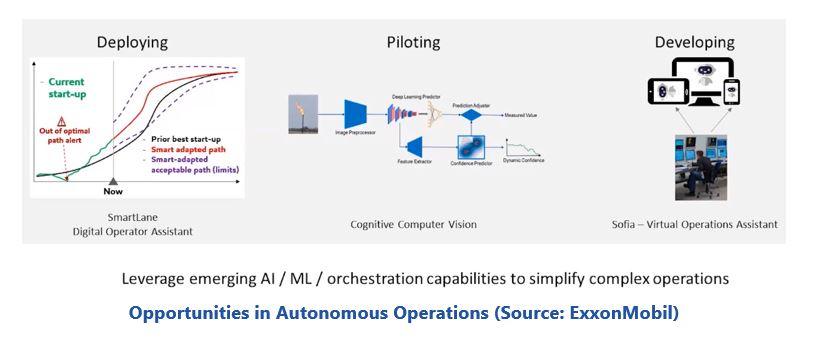
“The operators need to synthesize large quantities of data and manipulate potentially hundreds of variables to optimize an outcome. This makes this a rich area to leverage digital technologies.” The company is currently pursuing opportunities through a venture that it refers to as the intelligent, self-optimizing plant, or ISOP. “The goal is to take advantage of cognitive learning and adaptive capabilities based on AI and machine learning to automate, reduce human error, and make better decisions.”
ISOP examples include:
This provided Mr. Clausi with a logical transition into his next major discussion area: open process automation (OPA).
ARC Advisory Group clients can view the complete report at ARC Client Portal
If you would like to buy this report or obtain information about how to become a client, please Contact Us
Keywords: ExxonMobil, ADNOC, ARC Industry Forum, Digital Transformation, Remote Connectivity, Autonomous Operations, Open Process Automation, Artificial Intelligence, Connected Worker, ARC Advisory Group.