Representative End User Clients







Representative Automation Clients







Representative Software Clients








Sensors are at the front line of the Industrial Internet of Things (IIoT). In the process industries, intelligent field devices are now the norm, even if end users don’t always use the diagnostic information provided by these devices. In the discrete industries, smart discrete sensors with self-diagnostic and digital network capabilities are addressing key end  user requirements for reduced maintenance, increased overall equipment effectiveness (OEE), and the need to digitally capture the knowledge of a rapidly shrinking skilled workforce. The information provided by these sensors must get to the right people, at the right time, and in the right context to be effective. This is where the distinction between smart sensors and a smart sensing strategy come into play. In the case of smart sensing, network technologies can be of equal or greater importance than the smart sensor itself.
ARC recently conducted a survey on the adoption and usage of smart sensors in the discrete industries. We asked end users about the types of smart discrete sensors they found valuable, desired levels of functionality and diagnostics, and tasks and procedures associated with smart sensors. Our respondents tell us a story of accelerating smart sensor adoption and an increasing number of smart sensors as a percentage of total sensors on an average machine. Within ten years, respondents tell us that a little under 50 percent of all sensors on an average machine will be smart sensors. Today, these sensors are primarily valued for their ability to indicate relevant information about either the functioning of the sensor or drift in the target variable.
Many challenges still exist for those end users who wish to adopt a greater number of smart discrete sensors. With the accelerated decline in the qualified workforce, end users struggle to preserve the knowledge associated with sensors. The next generation of workers will need to have easier access to information about their sensors and machines and will have responsibility over a larger number of assets. The promise of driving increased performance from machines with intelligent sensors and the IIoT is making smart sensors a necessity.
Our survey focused on the adoption of smart sensors for the discrete industries. Sensors include proximity, photoelectric, linear and rotary position sensors, and other types of sensors used in discrete manufacturing operations. Process field devices like pressure transmitters and flowmeters were excluded in the scope of this survey. ARC's definition of a smart sensor is a device combined with a sensing unit and a signal processor that can be plugged into an industrial network. "Smart" sensors are smart if:
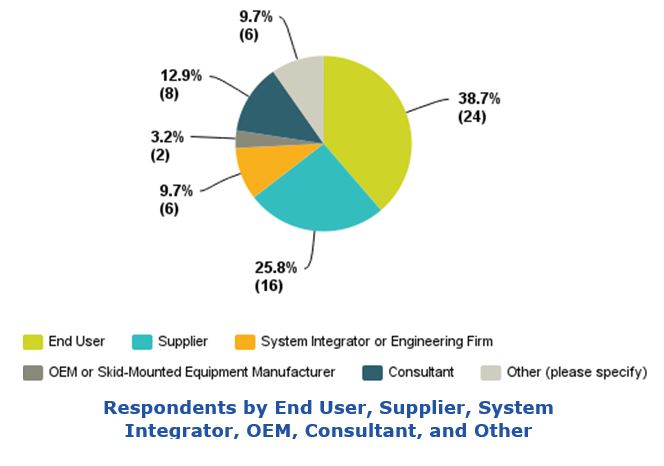 ARC received a total of 62 responses. Not all respondents answered all questions. Suppliers accounted for a little under 26 percent of total respondents. End users accounted for almost 39 percent of total responses. Other respondents consisted of OEMs and skid mounted equipment manufacturers, consultants, and system integrators. Respondents also possessed a good deal of experience. ARC asked respondents to provide their years of experience in specifying, designing, building, installing, operating, or maintaining machines and manufacturing equipment. Almost 42 percent of respondents had over 21 years of experience in the industry. ARC also asked if respondents were answering on behalf of their site, multiple sites, overall company, etc. Over 54 percent of total respondents said they were answering questions on behalf of their entire company.

Respondents came from a wide range of industries. The most well represented industries were electronics (18 percent), oil and gas (15 percent), chemicals (11 percent), food and beverage (11 percent), and automotive (10 percent). Other industries reported include building automation, aerospace, machinery, semiconductors, pharmaceuticals, and pulp and paper.

Most respondents (over 53 percent) were from North America. A little over 16 percent were from Western Europe, with around 10 percent from Latin America. We also had anywhere from one to a few responses from many other regions, including Eastern Europe, Middle East, China, India, and Japan.
The discrete industries use a wide range of sensors. ARC asked survey respondents how important it is to have “smart” versions of various sensors, from photoelectric to capacitive, inductive proximity, vibration, distance, and more. ARC asked respondents to rate the criticality of smart sensors by type using a five-point scale with 1 being zero criticality and 5 being most critical.
Most respondents viewed temperature and pressure sensors as being the most critically important, followed by vibration, level, flow, and distance measurement sensors. Color registration, color, capacitive sensors, and encoders were rated as least important. Photoelectric, proximity, and other sensors were ranked as medium importance. It’s interesting to note that most of the sensors in demand are those used more for process variables like pressure and temperature. Vibration sensors are used heavily in machinery condition monitoring applications.
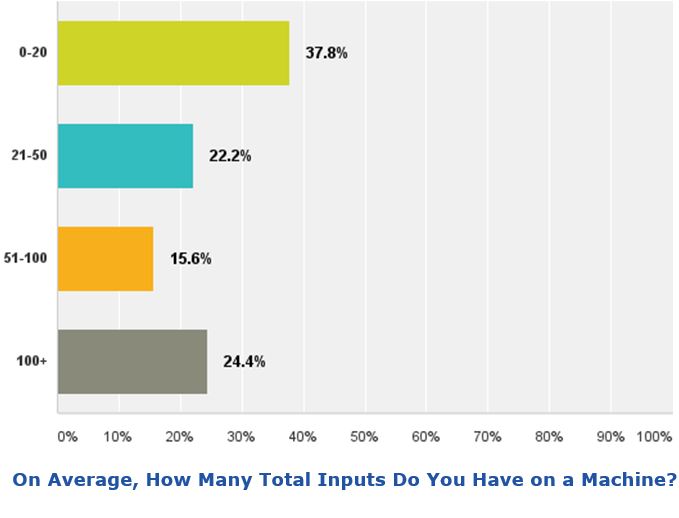
ARC asked survey respondents to tell us on average how many total inputs they had per machine. The trend revealed a very large number of smaller machines and a fair amount of very large machines. Almost 38 percent of respondents had smaller input machines ranging from zero to twenty inputs per machine. At the other end of the spectrum, close to 25 percent of total respondents had 100 plus inputs per machine. Over 22 percent indicated 21-50 inputs, so if you combine the machines of 0-50 inputs, that accounts for 60 percent of total respondents.
In addition to average number of inputs, ARC asked respondents what the average number of sensors was on an average machine. The overall average for all respondents was 43 total sensors per machine. ARC then asked respondents what the average number of smart sensors was for an average machine. The overall average was 9 smart sensors per machine. On an average machine of 43 sensors, that works out to just under 21 percent of total sensors per machine are smart.
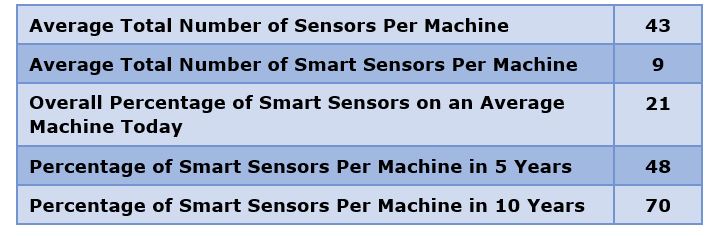
While the current percentage of smart sensors on an average machine is only 21 percent, at least for our population of respondents, our survey indicated that this percentage will increase greatly over the next five to ten years. On average, survey respondents told us that in five years, they expect that 48 percent of sensors on their machines will be smart. In ten years, survey respondents expect that 70 percent of sensors on an average machine will be smart.
Smart sensors can possess many functions and characteristics. ARC outlined several of these and asked respondents to rate the level of importance for each.
By far, the ability of smart sensors to allow end users to receive indication that the sensor is no longer operating, setup has changed, or sensor is no longer communicating to host, master or controller was the most critically important feature. Sixty percent of respondents indicated that this function in particular was of the most critical value. Smart sensors also enable end users to track and receive alerts that the target variable is drifting over time or has become lost. This function was rated second in critical importance, with over 37 percent of respondents ranking it most critical.

Being able to teach and/or configure sensors through a host, master or controller software tools (not locally with the sensor buttons) was ranked as a high value function by over 57 percent of respondents. Having a quick and automatic method to identify a sensor on a machine via operator station panel or HMI devices was ranked as high value by over 52 percent of respondents. Over 52 percent also said that having a quick and automatic method to identify a sensor on a machine via operator station panel or HMI devices was of high value.
Top rated medium value features and functions for smart sensors included a simplified supplier selection process to get the optimal sensing solution. Having smart sensors built to standard smart network specifications creates greater choice for end users in the marketplace and creates a more even playing field for balancing functions, features, and price. Having sensors able to compensate for machine wear and tear and performance degradation over time was also heavily ranked as a medium value function, as was having sensor upgradeable firmware to add new features as they become available.
Being able to capture, display and trend patterns over time of application yield, margin (dirty lens indication), etc. was ranked by almost 8 percent of respondents as having no value even though over 52 percent believed it had high value. Being able to track and receive alerts that the target variable is drifting over time or has become lost was also ranked by over 37 percent of respondents as having critical value, but 5 percent believed it had no value. Clearly these functions have value in certain applications, and differences in specific industry and application requirements can produce these results.

Functions perceived as having low value included being able to teach and/or configure sensors with the local buttons (not through a host, master or controller software tools). Eliminating teach inconsistencies (different procedures) between sensor families was also ranked by almost 18 percent of respondents as having low value. Ten percent of respondents saw low value in simplifying the supplier selection process.
ARC asked respondents how frequently they must do common tasks and procedures related to sensors, including repositioning, replacement, and maintenance. The most common tasks included the addressing of sensor maintenance tasks that are possibly due to degradation of performance over time, such as a dirty lens. Many respondents also indicated sensor replacement and repositioning of misaligned sensors on machines. Least frequent tasks included situations where sensor “reteach” is required, possibly due to degradation of machine performance over time. Smart sensors will require maintenance and replacement that cannot be avoided. However, knowing exactly what the problem is and being able to take proactive steps to address it can ultimately reduce the need to replace sensors and significantly reduce maintenance costs.

 ARC asked survey respondents the top three issues that they faced with their sensors and machines. We asked this question in an open-ended text format, so we received a wide range of issues and concerns. At the top, respondents ranked issues, such as sensor degradation, purchase cost, aggregating sensor data, ease of connectivity, data drift, (ambient) temperature, dirty sensor face, and no advanced warning of degradation. Calibration, configuration, ease of maintenance, spare parts, and lack of detectable drift were all cited as tier 2 issues. Tier 3 issues include cost, reliability, lack of a wide range of smart sensor product availability, recalibration, and overall lack of education in the workforce.
It is this lack of education in the workforce and the rapidly departing worker domain knowledge that continue to be major impediments to adoption of smart sensors. ARC asked respondents how they planned to address these domain knowledge issues as more of their experienced workers retire. How will that information be transferred to their successors?
Training is an obvious answer, and many respondents cited either internal on-site training, supplier seminars, “on the job” training, as well as remote, Internet-based training. At least one respondent also cited the requirement for keeping internal information documented and updated. As a path to digitization, smart sensors can streamline the process of management of change, but in many cases new work processes and procedures must be developed to adapt to the new digital solution, since the older processes were developed without the benefit of remote diagnostic capabilities, mobile plant maintenance devices, and digital documentation. ARC also advises end user clients to develop their own internal expert portals for specific domains of automation, including smart sensors and predictive maintenance.
When survey respondents were asked what they think the next generation of workers needs to know, replies showed us demand for an increasingly educated and trained workforce with the responsibilities of operations and maintenance workers blurring and overlapping. Maintenance and operating instructions are already being directly embedded in the new generation of smart machines. The future operators and maintenance personnel associated with these machines will have to have more advanced software and controls programming experience too. Computer literacy is definitely a requirement for the future.
When asked what they want to know about their machines that they don’t know now, respondents cited predictive failure capabilities, overall performance of the sensor, design information about the sensor, failure rate information, calibration status, and drift changes. Users also expressed concern that they are not fully utilizing the technologies already available in their smart sensors and machines.
Mobile tools like smartphones and industrial tablets are opening new possibilities for applications in industrial automation. ARC asked survey respondents to share their future expectations around mobile devices and apps to deal with sensor and machine diagnostics. Many indicated that they believed mobile device will help with troubleshooting tasks and make the process of remote monitoring easier. Mobile devices allow for in situ greater flexibility, providing the ability for in situ downloads, remote diagnosis and testing of a sensor, and so forth. Augmented reality solutions such as Microsoft HoloLens and Daqri Smart Helmet are also a natural outgrowth of more intelligent mobile technologies, and are increasingly being used to provide remote maintenance and operating and configuring tasks.
Survey respondents expect that machine intelligence will change significantly in the near future, as we move from smart machines to machines that can learn and incorporate artificial intelligence. As both machine and sensors get smarter and provide more data, more advanced analytical solutions will come along that will be able to turn the data into useful information with the ultimate goal of a truly predictive maintenance strategy, where failure of a sensor or a machine will no longer be totally unplanned; and there will be no unplanned downtime as a result.
Clearly, end users are increasingly adopting smart sensors at an accelerating rate. The age of the Industrial Internet of Things is a primary impetus behind the uptick in smart sensor adoption. Most are interested in smart sensors for their ability to provide diagnostic information about themselves and the manufacturing process. Many other tools are coming along that will make the use of smart sensors much easier and will facilitate the implementation of predictive maintenance strategies.
End users must also consider the work processes and procedures that will be required to get the real value out of discrete sensors over the lifecycle of the machine. The new generation of workers will also require better training that will increasingly be IT focused versus machinery focused. End users need to take care when selecting technology and suppliers of technology, but they must also look to their own organizations and ensure that technology is implemented in ways that will provide the economic value associated with it.
The new generation of workers will also have responsibilities that increasingly overlap between the worlds of operations and maintenance. Mobile tools in particular are ushering in the age of the “mobile operator.” With the pool of properly trained employees getting smaller, more cross training and streamlining of existing work processes will be necessary.
If you would like to buy this report or obtain information about how to become a client, please Contact Us