Representative End User Clients







Representative Automation Clients







Representative Software Clients









Asset Performance Management (APM) has become a primary enabler of digital transformation for asset management among industrial companies. Modern APM combines traditional practices with new digital technologies for transformation advances in reliability, maintenance execution, and business performance. Advanced technologies of today, including predictive maintenance (PdM), Industrial Internet of Things (IIoT), Artificial Intelligence (AI), and cloud computing have pushed APM limits and helped end users bring in many improvements such as lowering maintenance costs, decreasing unplanned downtime, and improving profit margins.
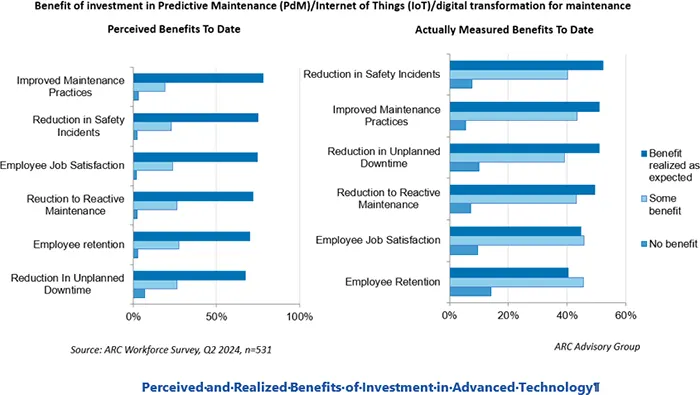
While business benefits are very well recognized, what remains to be understood is the impact of advanced APM technology adoption on the industrial workforce. With advanced APM technologies, the way people work and manage their assets is changing. Certainly, expectations are growing as well. Industrial companies are investing a significant amount of their time, money, and resources to adopt these newer solutions, but are their expectations met? How well are they able to realize the benefits out of their advanced APM investments? What is the impact on the workforce? To better understand this, ARC Advisory Group recently surveyed over 500 industry practitioners to learn about industry leaders’ expectations from their advanced APM programs and how the adoption of advanced technologies is impacting the industrial workforce.
Key findings from this research include:
ARC Advisory Group clients can view the complete report at the ARC Client Portal.
Please Contact Us if you would like to speak with the author.
Obtain more ARC In-depth Research at Market Analysis