Representative End User Clients







Representative Automation Clients







Representative Software Clients









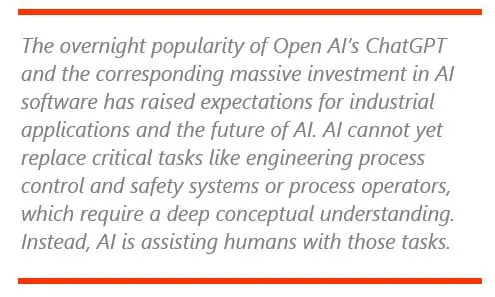
Before ChatGPT made its market splash, there was steady progress in machine learning applications using plant operating data, vision recognition systems, like facial and object identification, and robotics advancements that have collectively changed industrial management. With the flood of news reports, scientific papers, and marketing hype from software suppliers it is hard to keep track of all the diverse ways AI is providing value to industrial operations. Software applications are routinely labeled as containing AI, with no explanation of how it was employed. It may almost seem like superintelligence is taking over and nearly making humans redundant. The history of automation and digital transformation has clearly changed the number and types of jobs our economy needs. AI is changing the way we work.
If you are confused and uncertain about how this technology will unfold and the risks and opportunities it presents, you are not alone. The technology itself uses complex mathematics and programming and there is great disagreement amongst the top experts in this field about where this will lead us. Few of us will debug AI software programs but all of us need to know how the technology will impact us as it is clearly changing the world.
The term “AI” was coined in 1956, and only a relatively small number of people, mostly computer geeks, even paid attention back then. This report will evaluate how various AI-related technologies are progressing to benefit process control and operation of high consequence processes. While large language models (LLMs) are the hot topic today, industrial applications have benefited most from machine learning and vision recognition. AI applications like expert systems and fuzzy logic have embedded human expertise. LLMs have little regard for mathematics or physics constraints, but AI is broader than LLMs, and new techniques can train AI applications to be more scientifically reliable.
Expert systems and fuzzy logic are early AI applications that have embedded expertise, but AI can use the underlying neural network methods to train AI applications that can embed technical expertise. There is no question that industry is embracing AI with a range of successful applications and looking forward to benefiting from the language and generative AI breakthroughs. There is also progress with vision recognition and robotics, which are using neural network-based training techniques that are allowing robots to operate with improved autonomy in unstructured settings.
Transformer Architecture is a neural network architecture developed by Google AI in 2017. It revolutionized natural language processing (NLP) tasks by introducing a mechanism to attend to relevant parts of an input text sequence. This architecture was used by Open API to develop Chat GPT.
LLMs focus on language and text. Foundation models have a broader scope and are trained on a wider range of data modalities, which can include text, images, code, and even scientific data. This AI technology is just starting to infiltrate industrial applications. More established AI like machine learning applications transformed asset management. AI based visual recognition, and AI based autonomy for robots and vehicles are making rapid progress. At the end of April, China gave permission for Tesla to use full self driving technology on Chinese roads. BMW and Tesla are planning to use mobile robots for unstructured tasks in their factories. Robots and vehicles now are gaining a full suite of AI applications that allow them to autonomously navigate, see, hear, talk, smell, touch and assist with many manufacturing jobs.
Vision recognition has made huge progress in many fields. Camera images and video can be used to recognize faces for device security and have been used for other applications that might impose on privacy. Text-to-Image generation techniques use natural language processing to understand text descriptions and generate corresponding images. Neural Rendering techniques involve using AI to render 3D scenes from images or other data. The AI learns the underlying 3D structure of objects and environments from 2D images and can then generate new images from different viewpoints or lighting conditions. Open AI recently released Sora, which is a text to video application with stunning realism. https://www.youtube.com/watch?v=0DMJPgOHtiE
New AI applications are emerging as an optional process control algorithm. Yokogawa and JSR have built a real-time AI application that is said to control a distillation column without human assistance. https://www.yokogawa.com/us/news/press-releases/2022/2022-03-22/. In Brownfield projects the steps to implement an AI controller are as follows:
Create a model of the existing plant/process using a simulator
Design the AI controller and train it with data from the simulator
Tune the created AI controller with past and present data of the existing plant
AI control value assessment
Set up and verify the plant’s safety functions
Deploy the AI controller
Monitor the AI controller
Most of the text data LLMs use to train on are irrelevant for mimicking the behavior of engineers and control room operators. Even relevant data could be wrong or conflicting. There is a lot of research on how to train and use AI models for advancing science and solving perplexing problems in mathematics, physics, chemistry, and biology. There are some notable achievements in this regard and high expectations that AI will advance the state-of-the-art applications in chemistry, physics, and mathematics.
The training of large language models on huge data sets provided great value due to the broad knowledge base. When AI models attempt to train on narrow fields or even specific processes the available data can be much smaller and as a result the training can be less effective. This is where AI can converge with digital twins. As a result of the digital transformation processes, various digital twin models and existing processes have extensive operating and maintenance data.
Artificial intelligence (AI) is the field of computer science focused on creating intelligent machines capable of mimicking or surpassing human cognitive abilities. ARC defines industrial AI as a subset of AI technologies used in industrial settings to augment the workforce in pursuit of growth, profitability, more sustainable products and production processes, enhanced customer service, and business outcomes. Industrial AI leverages machine learning, deep learning, neural networks, and other approaches. Though some of these techniques have been used for decades to build AI systems using data from various sources within an industrial environment, leaps in compute and analysis power have vastly improved their capability. AI research related to performing engineering tasks include:
Expert systems were one of the first successful applications of AI in the 1970s and 1980s. They capture the knowledge and expertise of human specialists in a specific domain and use that knowledge to solve problems, diagnose situations, or make recommendations.
Back in the 1990s engineers at Foxboro Company developed an expert system that would choose from thousands of different control strategies for two product distillation columns. It used the Relative Gain concept developed by Edgar Bristol and simplified distillation column models to create control schemes that would be stable when simultaneously controlling both the top and bottom compositions. The expert system program was developed by a group of MIT computer scientists from a company called Reasonix. The program would create a drawing of the essential control strategy that would be the basis for building function blocks into an advanced regulatory control configuration on a DCS or PLC.
User Input: The user presents a problem or situation relevant to the expert system's domain. The inference engine analyzes the user input against the knowledge base. It might ask clarifying questions to gather more information. The engine uses reasoning techniques and the knowledge base to identify potential solutions or explanations. The system provides recommendations, diagnoses, or explanations based on its analysis. It might also suggest additional information needed for a more conclusive outcome.
Expert Systems are based on deep knowledge in a specific domain. They can explain their reasoning process (helpful for user understanding) and can act as a knowledge repository and training tool. Expert systems are limited to well-defined domains with clear rules and have difficulty managing new or unforeseen situations. Knowledge acquisition and maintenance can be time-consuming and expensive.
Fuzzy Logic is a mathematical approach that deals with degrees of truth rather than absolute true or false values. This allows for reasoning that is more similar to how humans handle uncertainty and imprecision in the real world. A fuzzy logic program option is programmed into the FBTUNE block of the Schneider Electric DCS system to tune PID controllers. There are many other applications.
Machine learning uses neural network algorithms that learn from text, images, videos, or numbers without explicit programming. The algorithm analyzes the data patterns and relationships between different pieces of information. Based on these patterns, it builds a model that can be used to make predictions or classifications on new, unseen data. Supervised Learning is where training is labeled. For example, an image dataset might have labels indicating whether each image contains a cat or a dog. Machine learning has been used extensively for industrial applications. Machine learning is a key part of AI that is used extensively for industrial applications. ARC has written many articles on the topic of industrial AI such as: https://www.arcweb.com/blog/industrial-ai-25-use-cases-sustainable-business-outcomes
ML algorithms can learn the normal operating patterns of equipment based on historical data. Deviations from these patterns, such as sudden changes in temperature or vibration, could signal potential issues. By analyzing historical data and identifying patterns that precede failures, machine learning models can predict when equipment is likely to fail. This allows for proactive maintenance, preventing unexpected downtime and reducing repair costs. Machine learning can help identify the underlying causes of equipment failures by analyzing historical data alongside real-time sensor data. This information can be used to improve maintenance strategies and prevent similar failures in the future.
The benefits of using machine learning for asset management are reduced downtime, because predictive maintenance minimizes unexpected equipment failures, leading to increased operational efficiency and productivity. Lower maintenance costs because proactive maintenance can help identify and address issues before they become major problems, reducing overall maintenance costs and improved asset lifespan. By understanding how equipment operates and implementing preventive measures, organizations can extend the lifespan of their assets.
Deep learning algorithms rely on artificial neural networks (ANNs) with multiple layers. These layers are interconnected, allowing the network to process information in a hierarchical way, progressively extracting higher-level features from the data. Deep learning has been used for identifying objects or scenes in images and videos and for converting spoken language into text. Deep learning is the engine that has made natural language (NLP) and LLM’s successful. NLP techniques include:
Automatically translating text from one language to another.
Condensing large amounts of text into a shorter version while preserving key information.
Sentiment analysis, i.e. identifying the emotional tone of a piece of text (positive, negative, or neutral).
Assigning grammatical labels (nouns, verbs, adjectives, etc.) to words in a sentence.
The ultimate evolution of AI is often referred to as Artificial General Intelligence (AGI). AGI would mimic human intelligence cognitive abilities. AGI could theoretically understand and reason across a broad spectrum of tasks. AGI would also be able to learn and apply knowledge to different scenarios. AGI does not currently exist.
Of all the human senses that AI needs for AGI, vision would be the most important, and advances in computer vision have been astounding since the 1958 work of Frank Rosenblat at Cornell University. Frank built the “Perceptron,” a device designed to mimic how the brain processes neurons. Rosenblat suggested the machine was capable of original thought which garnered a lot of attention. The New York times reported on the military interest and reported the Navy expects this electronic computer would be able to walk, talk, see, write, reproduce itself, and be conscious of its existence. This 1958 AI vision breakthrough is described in the video link below. The video also suggests that analog computers from a company called Mythic can perform calculations to assist with machine vision. https://www.youtube.com/watch?v=GVsUOuSjvcg.
Computer vision algorithms can process vast amounts of visual data much faster than the human brain. They can also analyze images with greater precision for specific features or patterns. Machines excel at identifying and classifying objects within images and videos. This can be useful for tasks like facial recognition, self-driving cars, sorting trash, and automated inspection systems in manufacturing. AI applications are not restricted to the visual spectrum and have begun using sensor fusion applications for infrared, near infrared, ultraviolet, RADAR, LiDAR, and ultrasonic sensors. Humans excel at understanding the context of a scene and interpreting visual information based on past experiences and knowledge. Humans develop situational awareness using binocular sight, hearing, smell, taste, and touch. Such sensor fusion took a lifetime for humans to learn, and organizing training for computers is hard to do.
Sensor fusion could combine information from multiple sensors to provide improved situational awareness. Computer vision could use two or more cameras to exceed the advantages that humans have with binocular vision and to provide redundant information in case of failures or blocked vision due to weather or other obstructions. High resolution cameras provide rich visual details, while LiDAR offers accurate in-depth information. Combining them with appropriate training creates a more complete picture of the scene. Using multiple sensors allows the system to function even if one sensor is impaired by environmental conditions. RADAR can see through fog or smoke. By fusing data from various sources, the computer vision system can make more accurate and reliable decisions, especially in complex environments. Redundant cameras or sensors create the issue of “which device to trust.” Process control and safety systems routinely use triple redundant sensors for critical applications and it is not trivial to estimate the true value when sensors fail.
Several companies offer computer vision software that can recognize objects in photographs. Amazon Rekognition and Microsoft Azure Cognitive Services Computer Vision are cloud-based services, Google Cloud Vision is a cloud-based API that offers image detection and Clarifai is a company that offers a variety of computer vision APIs, including object recognition.
AI can describe images and video with text and identify a wide range of objects and actions in 3 dimensions. AI can be used to create images and video from text. One phenomenally successful application is the ability to create images of proteins from DNA sequences. In 2020, an artificial intelligence lab called DeepMind unveiled technology that could predict the shape of proteins from the DNA sequence of the 4 base pairs in a protein. In the past it took a typical PhD student several years to identify the folding structure of just one protein. This AI application has suggested the structures for nearly all cataloged proteins known to science. This amounted to over 200 million protein structures. Testing indicates this as a huge breakthrough in chemistry.
Some robots are programmed for extremely specific tasks and sequences without any need for AI. This changes with robots that need to navigate freely and adapt to unfamiliar locations. Such robots need vision and other sensors for situational awareness. Robots need fast and precise servos and motors to maintain balance and traverse over obstacles. Sentient humanoid robots may need the fusion of vision, hearing, speech and language skills, smell, touch, and other actuation devices to provide services in unstructured environments.
In principle, future robots could operate complex facilities as they have autonomous navigation skills to move through an industrial process and climb stairs and ladders. Robots can have the mechanical strength to open valves and use tools that improve leverage. We have already seen autonomous forklift trucks and many forms of robotic devices with sensors and servo motors used in discrete part manufacturing. The AI embedded in robots is certainly evolving at a very fast pace. On the other hand, operating facilities might be specifically designed to accommodate mobile robots and present valves and buttons, so they are easy to operate.
Executive Overview
AI Technology Today
AI That Understands Context
AGI for Engineering and Process Operation
Challenges of AI in Process Control
Recommendations
ARC Advisory Group clients can view the complete report at the ARC Client Portal.
Please Contact Us if you would like to speak with the author.
Obtain more ARC In-depth Research at Market Analysis