Representative End User Clients







Representative Automation Clients







Representative Software Clients








 The Sitech Asset Health Center (SAHC) at the Geleen site in the Netherlands delivers smart asset management services to the Chemelot cluster of chemical companies, startups, and service companies. These include DSM, OCI, Borealis, Arlanxeo, Fibrant, and AnQore. SAHC's goal is to deliver optimal plant performance and uptime and aims to reach “zero surprises” in plant operations. It does this by applying a well-designed asset strategy and best practices for asset management plus "fit-for-purpose" asset health monitoring and analytics. SAHC is a Living Lab, part of the Dutch Smart Industry initiative and co-financed by Sitech and European, Dutch, and local funds.
The five-year program running at SAHC has obtained almost €1 million in funding for a total initial investment of €2.5 million and is considerably ahead of schedule. This article discusses the approach SAHC applies and documents a few use cases and associated benefits.
The Dutch “Smart Industry” is one of the European national initiatives for implementing the EU’s goal to increase innovation in industrial products and production. In high-wage countries like The Netherlands, increasing the complexity of production and associated technology is one of the few levers available to increase competitiveness.
Smart Industry has both a top-down and bottom-up component. The national top-down process provides a concept, objectives, and some funding, which is nested within a Smart Society concept. Smart Industry involves designing smart processes, producing smart products, and delivering smart services enabled by technologies such as IIoT, Big Data, cybersecurity, cloud computing, blockchain distributed databases, and skilled people. Smart Industry aims to use high-value information, exploit customer intimacy, and use highly cooperative value chains to produce flexibly customized and individualized products of very high quality in a highly automated way. Smart innovation corresponds to networked innovation ecosystems.
Ten regional FieldLabs across the country embody the objective to co-innovate in networks composed of – often dozens - of SMEs, industrial players, technology and service providers. SAHC, a so-called Living Lab, is a local satellite of the Field Lab CAMPIONE, aiming to accurately and precisely predict when maintenance is actually required 100 percent of the time. Sitech refers to this as “predictable maintenance.” The approach is part of the smart industry action agenda. Smart Industry creates many opportunities for SMEs to participate and share their innovation capacity in an institutionalized way.

Predictable maintenance is both in the interest of the chemical plants and of Sitech as a maintenance service provider. By increasing reliability and availability and reducing maintenance cost and effort for its clients, Sitech would decrease cost and increase both productivity and output for all parties. Sitech had already decided to apply smart technologies and approaches, when the company had the opportunity to partly finance its experiments by participating as a Living Lab.
More precisely, the goal of SAHC is to provide optimal performance of its clients in:
This implies higher performance when possible at lower cost, but not necessarily the best performance at any cost.
To do so, Sitech provides smart services by gradually improving predictive and prescriptive capabilities. This requires creating a digital culture in the company and innovating to create smarter and better performing asset management  solutions.
The program running at SAHC has accelerated the implementation of these technologies and approaches. It currently has 36 pilot projects involving 40 employees and 25 partners. The pilots are small to stay focused, must improve predictive capability, and be based on a business case in a plant. Smart Industry funding reduces risk. The company uses an iterative, agile scrum approach to speed up projects. Once proven successful, an approach is scaled up and applied throughout the site to increase its impact. Most pilots are successful and subsequently scaled up to cover all relevant assets and clients.
Sitech uses formal asset performance management strategies to define priorities using Bentley’s AssetWise Reliability. The company applies a reliability-centered maintenance (RCM2) analysis in combination with SAP for a detailed cost breakdown of plant stops. Once targets are determined, the first step is to collect data using a "fit-for-purpose" approach. This could range from manual inspection or using available data in an historian, to adding (wireless) sensors or instruments. Based on real-time data, single or (less frequently) multi-variable models create early warnings, which are visualized and subsequently used to plan an action.
Based on the result, the models are improved or the procedure automated. To keep cost in proportion to value, the company prefers simple solutions and adopts increasing complexity for high-risk, high-value assets. Solutions can range from simple, manual or online single-variable trends, to complex multi-variate analyses and predictions based on machine learning. The modeling can be mathematics-based (MathWorks’ MATLAB) or first principles (AspenTech’s Aspen Plus), and requires profound knowledge of modeling and process engineering, according to project manager, Maurice Jilderda.
Today’s technology helps in the process:
 As failures are mostly random, it's not possible to accurately predict their future frequency. This makes a purely RCM-based approach insufficient. Therefore, Sitech applies root cause analysis (RCA) to understand the causes of failures. This enables the organization to be more proactive in avoiding failure and finding clues in real-time behavior that would predict failures. At ARC’s recent ARC European Forum, the company reported it saves time finding root causes in its experiments by using Trendminer’s software to find similar or deviating conditions in similar or different equipment in historical data to compare with a situation under study.
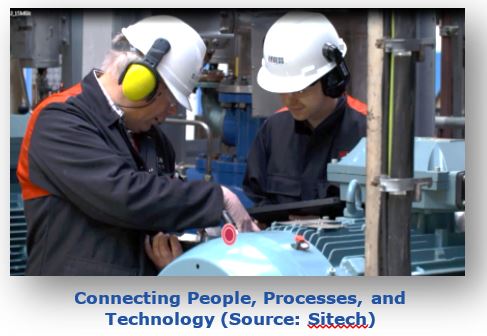
“Technology is the easy part,” commented Mr. Jilderda, reminding us it is only a part of the solution. To make changes effective, people need to change their way of working, which is not easy for anyone. Consistent with continuous improvement methodologies, the high-level process is to detect an anomaly, design an ideal process to handle it, plan for action, execute it, and "close the loop" to sustain the new approach by automating or executing it consistently. The technology and the process need to make sense to people, so Sitech takes time to involve, train, and coach people. Through coaching, the company shows it understands that human learning takes time and repetition or demonstrating by practical application that the theory or technology delivers value.
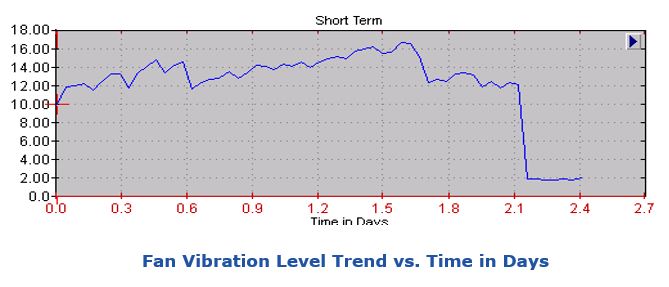
When remote online monitoring of temperature and vibration of 60 assets in a single plant was commissioned, it showed that one fan displayed excess vibration. A specialist recognized fouling and immediately requested a cleaning procedure, which brought the fan’s vibration values back down to normal values. The pilot project avoided equipment damage, an unwanted production stop, and the associated maintenance and opportunity costs.
Monitoring the fouling of heat exchangers that limits throughput above a certain threshold, a popular predictive maintenance application in the process industry, typically yields major benefits. In the example provided by Sitech, the heat exchanger fouling is monitored in real time. The company executed a turnaround in 2016 when the fouling reached the maximum tolerable value. Sitech uses indicator dials for real-time values to simplify interpretation.

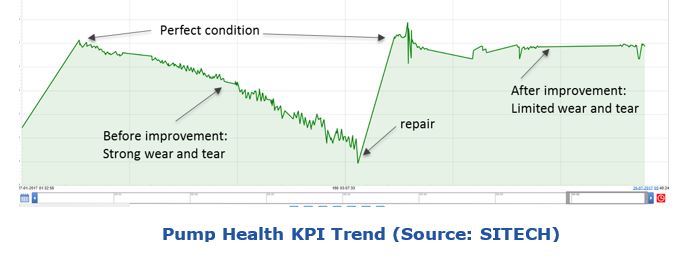
A third example of a pilot project is monitoring of the condition of a reciprocating pump. From multiple variables, the company calculates an overall, easy-to-understand pump condition KPI. Applied to historical data, the KPI trend has a maximum when repaired, and a minimum when close to failure. Based on this calculation, Sitech was able to accurately predict when the pump needed revision. During the next plant stop related to other maintenance work, the pump was serviced, and several mechanical issues found: leakage of a plate, and two out-of-spec valves. If this failure had not been predicted, the plant would have had to shut down unexpectedly, resulting in at least €30,000 of production losses, and an additional €3,000 price tag for rush repair. The model also showed that a recent change in valve type resulted in major improvement in its useful service life!
There are fifteen Smart Manufacturing and IIoT initiatives in Europe. This results in fragmentation, but also diversity. The Dutch Smart Industry initiative has the strength of both top-down strategy and bottom-up initiative and contribution from local players. Other countries could use this approach to help ensure success. The European Commission has initiated a coordination effort to create more synergies among the initiatives and pool resources.
Users in the process industries should consider applying modern approaches to asset excellence and build fit-for-purpose smart asset services guided by a strategic asset framework. Sitech and other experts in maintenance of process industry assets indicate time and again the importance of deep process knowledge to complement data and natural sciences to reach excellence. Sitech’s experience also confirms the importance of the human factor in these types of initiatives.
If you would like to buy this report or obtain information about how to become a client, please Contact Us
Keywords: Smart Maintenance, Zero Surprises, Asset Analytics, Optimal Performance, Predictive Analytics, Asset Strategy, Reliability-Centered Maintenance, ARC Advisory Group.