Representative End User Clients







Representative Automation Clients







Representative Software Clients








KEYWORDS: Siemens, Eigen Engineering Agent, TIA Portal, Generative AI, Automation Engineering, Machine Builders, PLC Engineering, HMI Engineering, Drive Configuration, Industrial AI
Automation engineering is becoming a constraint on industrial innovation. Machine builders, system integrators, and manufacturers must deliver more complex machines under shorter development cycles, while skilled automation engineers remain in short supply. This creates a widening gap between engineering demand and capacity. Much daily work still involves repetitive but critical tasks, including project setup, hardware and network configuration, PLC block creation, code testing and documentation, HMI preparation, and drive parameterization. These tasks are essential, but they reduce time for architecture, process know-how, commissioning strategy, and customer-specific optimization.
AI has not yet closed this gap. Many industrial AI deployments remain limited to documentation, search, code suggestions, or isolated productivity aids. Siemens positions Eigen Engineering Agent against this limitation: the issue is not whether AI can generate text or sample code, but whether it can understand the automation project, follow customer standards, execute tasks in the engineering environment, and produce outputs engineers can validate.
This ARC View examines how Siemens Eigen Engineering Agent addresses these challenges, where its capabilities align with automation user needs, and why machine builders are likely early beneficiaries.
Automation engineering is well suited for agentic AI because many workflows are structured, tool-based, and context-dependent. Generic AI can explain concepts or draft sample code, but automation engineers need support for tasks spanning multiple objects, dependencies, and standards. In the TIA Portal, a change to a device, PLC block, tag, HMI screen, or drive parameter can affect the broader project. A useful engineering agent must therefore understand project structure, object relationships, controlled changes, and verification needs.
Machine builders are a strong fit. They reuse machine modules, adapt standard code to customer requirements, and deliver variants under tight deadlines. They also must reduce engineering hours, maintain coding standards, onboard engineers, and support legacy or poorly documented logic. An engineering agent can reduce repetitive work, improve consistency, and help apply company-specific knowledge more systematically.
Siemens’ Eigen Engineering Agent is a generative AI assistant connected to the TIA Portal. Siemens describes it as a shift from AI that suggests actions to AI that can execute automation engineering tasks end-to-end. The agent works with the actual TIA Portal project context, including project structure, devices, PLC blocks, user-defined data types, HMI screens, and related objects. This project awareness reduces the need to convert generic AI output into usable automation logic.
According to Siemens, the agent plans, uses tools, reflects on results, and returns outputs for engineer review. It combines contextual project understanding, industrial domain knowledge, and engineering-specific capabilities. It supports natural language interaction, document uploads, project-context access in TIA Portal, and a deployment approach focused on data privacy and sovereignty. Siemens states that conversations are stored locally, and that customer code and prompts are not used for model training. Eigen Engineering Agent is available as part of the Siemens Xcelerator portfolio as standalone software, offered through the Siemens marketplace and via direct sales.
Siemens recently added two capabilities that move the agent further upstream: ECAD integration and standards-compliant project generation. ECAD integration connects electrical design data with automation software development. Standards-compliant project generation uses plain-language machine descriptions to create ready-to-use automation projects that follow defined engineering standards. According to the company, both capabilities are included in the standard subscription at no additional cost.
Siemens groups the agent’s capabilities around core automation engineering domains, aligning them with user needs for higher throughput and consistent quality.
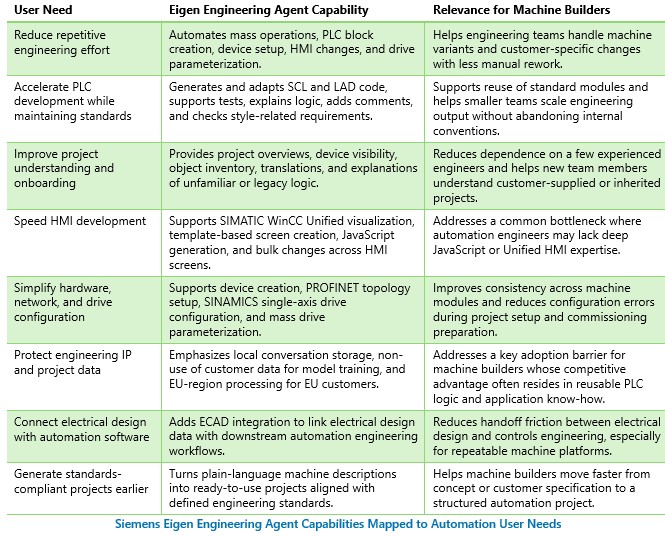
For machine builders, the main value is the combination of project context, automation-domain knowledge, and task execution. Eigen Engineering Agent can help generate reusable logic, document and modernize legacy code, apply consistent changes across objects, and accelerate HMI and drive configuration.
The new ECAD and standards-compliant project generation capabilities extend this value upstream. They move the agent beyond implementation support toward earlier design-to-engineering handoffs. For machine builders, this can reduce data re-entry, improve consistency, and shorten the path from customer specification to a structured TIA Portal project.
Siemens claims Eigen Engineering Agent can deliver up to 50 percent higher engineering efficiency, two to five times faster execution for selected workflows, and up to 80 percent higher solution quality. Examples provided to ARC include cutting the time to perform a mass parameter change across 66 PLC blocks from 6 minutes to 1.5 minutes and reducing analysis and documentation of 200 lines of SCL code from 35 minutes to 11 minutes. Siemens also cites pilot customers such as Prism Systems for reusable logic block generation and Techcab for interpreting and rewriting legacy PLC code in SCL.
These examples are use-case evidence, not universal benchmarks. Results will depend on library maturity, engineering standards, machine complexity, documentation quality, and validation practices. Still, they show where agentic AI can deliver value: repetitive changes, code generation, documentation, migration, and project understanding.
ARC sees Siemens Eigen Engineering Agent as part of a shift from engineering copilots toward industrial agents. A copilot suggests; an agent can work across tools, data structures, and project constraints to complete defined tasks under engineer supervision. In automation, this matters because engineering environments are constrained, object-based, and standards-driven. The closer AI operates to the project model, the more likely its output can be reviewed, compiled, tested, and reused.
Users should still treat engineering agents as productivity and quality tools, not substitutes for engineering judgment. PLC logic, motion sequences, safety-related behavior, networks, and HMI interactions must be validated against machine function, customer requirements, standards, and commissioning realities. The best use cases keep the engineer in control while the agent prepares first drafts, executes bulk operations, explains legacy content, and generates tests or documentation for review.
For Siemens, the strategic significance is clear. By offering generative AI in TIA Portal and extending it upstream into ECAD integration and standards-compliant project generation, Siemens strengthens its automation engineering environment and differentiates around engineering productivity. For Siemens-standardized users, Eigen Engineering Agent becomes an extension of the existing toolchain. For mixed-platform users, value will be strongest where TIA Portal is a major part of the installed base.
Siemens Eigen Engineering Agent addresses a growing automation challenge: limited engineering capacity, faster machine delivery requirements, and repetitive work that constrains innovation. Its strongest value proposition is not generic code generation, but project-aware task execution inside and increasingly upstream of TIA Portal. ECAD integration and standards-compliant project generation strengthen its relevance by linking design inputs with downstream automation engineering. For machine builders, the agent can support faster variant engineering, better reuse, improved onboarding, and more consistent execution. Users should begin with bounded use cases such as code explanation, documentation, mass changes, HMI scripting, reusable block generation, and structured project generation, then expand as validation practices mature. If Siemens continues to improve capability depth, transparency, and lifecycle integration, Eigen Engineering Agent could become an important step toward AI-assisted automation engineering at scale.
ARC Advisory Group clients can view the complete report at the ARC Client Portal.
Contact Us if you would like to speak with the author.
Obtain more ARC In-depth Research Market Analysis.