Representative End User Clients







Representative Automation Clients







Representative Software Clients








 Huge piles of abandoned waste coal from historical mining operations in Pennsylvania pose a threat to the state’s water quality and public safety. While technologies are available to enable companies to burn the waste coal to produce electricity, due to the current availability of relatively low-cost shale gas, challenges remain to make this type of electric generation commercially viable.
Scrubgrass Generating Power, located on a 650-acre site in northwest Pennsylvania, sells power generated from waste coal to the PJM grid. The 87 MW plant also helps reduce pollution by burning waste coal from abandoned sites before acids can leach into the groundwater.
Over its 25 years of operation, the plant has eliminated more than 15 million tons of waste from the land, saving the state more than $20 million dollars.
Initially, the company operated under a 20-year fixed power agreement that enabled it to operate competitively while paying off the construction bonds. This agreement ended in 2011, forcing the plant to compete with gas turbine plants that could take advantage of relatively low-cost shale gas from the Marcellus and Utica Shale regions.
When the power purchase agreement ended in 2011, the plant entered a dynamic pricing merchant/market operating mode, forcing it to compete with cost-advantaged gas turbine plants. This made it almost impossible to operate profitably; and if it couldn’t operate profitably, it would be forced to shut down.
Jeff Campbell, Engineering Manager, Scrubgrass Generating, summarized the situation at the recent OSIsoft User 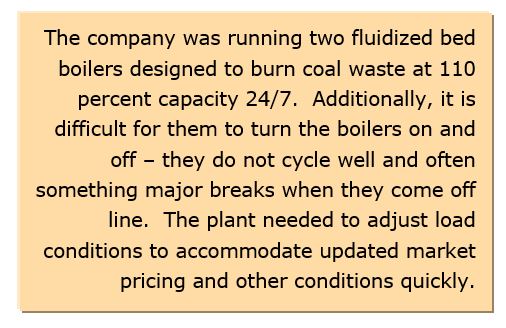 Conference. “Without the fixed power purchase agreement, the company cannot compete with low-cost power and loses money. We needed to improve our operations and operate differently.”
The company reviewed the financial numbers and estimated that if it continued to operate as a merchant plant under the same conditions, the plant would lose as much as $5 million per year, forcing it to be closed.
To avoid operating at a loss, the plant would need to ramp up production when market prices went up and stop operating when market prices dropped below an optimal point. However, its two fluidized bed boilers do not cycle well.
The team needed to add financial data streams to its plant system and build a performance equation that could predict the optimal operating point based on current market prices and conditions. This financial data was not readily available using its current systems, so no one knew how well the plant was operating until much later, when it was too late to do anything about it.
To determine costs, the plant needed a single platform that integrates process, market, and financial data and performs real-time cost calculations. With the support of the financial organization, Scrubgrass leveraged the existing PI System and integrated the needed data streams to the PI System. By integrating the financial information to operations, they could obtain real-time updates and operate profitably.
The operators and engineers needed a cost management tool that showed real-time production cost and optimal run points based on market prices and energy costs. Mr. Campbell determined that if the plant combined its PI System operational data with production and real-time market power cost data, the company could adjust loads to be able to operate profitably. Mr. Campbell noted, “Engineers need more than just heat rates and flows – they need to know production costs to operate profitably.”
Campbell reasoned that by combining financial and market information in the PI system they could build a cost management tool that would give the operators a cost-driven picture of plant operations.
To calculate real time cost Scrubgrass consolidated six data sources:
The plant had a lot of plant information available from the DCS system. Maintenance costs per MW of power were calculated using historical and real-time data and incorporated into the cost management data to predict the boiler’s operation based on curves that describe how the boiler runs. (If run hard, fluidized bed boilers wear out faster.) Commodity prices of coal and limestone costs were also integrated. Commodity prices and maintenance costs do not change as often as energy prices, so are updated every couple of months.
With the old system, there were discrepancies between the approximations that finance provided based on assumptions and actual costs and margins (revenue minus production costs), which are determined on a five-minute interval. As a 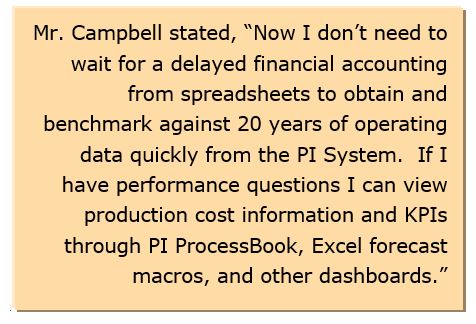 result, the plant would find out actual costs too late to adjust operations.
Now, Scrubgrass has one version of the truth based on detailed production costs that show the operators current commodity costs and production costs for fuel, limestone, ammonia, maintenance, etc. The plant can determine when production costs are high (such as when burning waste coals with higher sulfur content), and make appropriate operating decisions. To determine optimal loads, the company benchmarks good historical data (e.g., golden month) against current conditions, combined with financial and market data.
Mr. Campbell used forecast graphs to show the owners that the plant could operate better than the forecast data predicted. This provided enough confidence to continue plant operations.
According to Campbell, “Instead of bringing in two points - full load heat or low load heat - if we run at the optimal point using the cost management intelligence, we can run the plant profitably.”
The technology is also used to generate price vs. system load trend charts. The price and system load information come from two different data sources that are merged. Previously, the team would spend two to four hours getting data from two different data sources. Now, they can do this in 20 seconds, plus 10 minutes to review the data to make operational decisions about when to run and at what capacity. They can also determine operations for specific weather conditions and forecasts. Scrubgrass determined that by keeping a second burner online during one specific week, it could make an extra $160,000.
Scrubgrass can now perform long-range operational forecasts that help the company schedule outages, fuel, and manpower using gas prices, system loads and boiler curves in the PI System.
The PI System consists of a single PI server, three interfaces to the DCS, many HTML interfaces, and 63 tags running performance calculations used to determine the actual costs of power per hour. PI Web integrates the web files/intelligence (gas prices, PJM information, system loads, etc.). PI DataLink is used to upload and download tags. PI ProcessBook is used for visualization for operators and business management alike.
Real-time financial and market data is important to the business but also important to help plant operators make profitable operating decisions.
Scrubgrass went from a plant paid to generate power at a fixed cost, to a market-driven plant that can track costs and market conditions to make operating decisions in real time based on real-time data. The company can now determine when it is more profitable to generate electricity, or to fulfill its commitments by purchasing on the open market.
In today’s highly competitive world, companies need to get business information to the right people in the right time to be able to run efficiently and profitably. Other manufacturing companies should consider including business and market information and cost management tools to enable plant workers to make more effective and profitable business-driven decisions.
If you would like to buy this report or obtain information about how to become a client, please Contact Us
Keywords: Industrial Cost Management, Business Intelligence, Power Plant Data, Power Generation, Financial Plant Data, Scrubgrass Generating, PI System, ARC Advisory Group.