Representative End User Clients







Representative Automation Clients







Representative Software Clients









KEYWORDS: Manufacturing Execution System, Manufacturing Operations Management
Despite decades of investment in Manufacturing Execution Systems (MES), many initiatives continue to underdeliver against expectations. The challenge is not a lack of adoption. According to Rockwell Automation's 2026 industry insights 1, based on feedback from 1,560 manufacturing and industrial operations decision-makers across 17 countries, 93 percent of manufacturers have MES in place. However, only 28 percent have deployed MES enterprise-wide, and just 23 percent report full integration with Enterprise Resource Planning (ERP), Product Lifecycle Management (PLM), quality, and operational technology (OT) systems.
These findings suggest that the industry's challenge has shifted from MES adoption to MES scalability, integration, and value realization. ARC believes the root cause is less about technology capability and more about a persistent disconnect between MES design assumptions and manufacturing reality.
Manufacturing environments are rarely as standardized, deterministic, or data-ready as implementation teams assume. Variations in materials, recipes, workflows, quality requirements, operator actions, and exception handling remain inherent aspects of manufacturing operations, particularly in process industries and other complex production environments.
As manufacturers place greater reliance on execution-layer technologies, the stakes are rising. MES is no longer expected to simply capture production events or support traceability. It is increasingly expected to connect planning with execution, provide operational context, improve decision-making, and serve as a foundation for Industrial AI and advanced analytics initiatives.
Manufacturers do not fail to realize MES value because of missing functionality. They fail because technology is often deployed before processes, data, and governance are ready to support it. When this front-end work is skipped, companies do not digitize best practices. They digitize inconsistency.
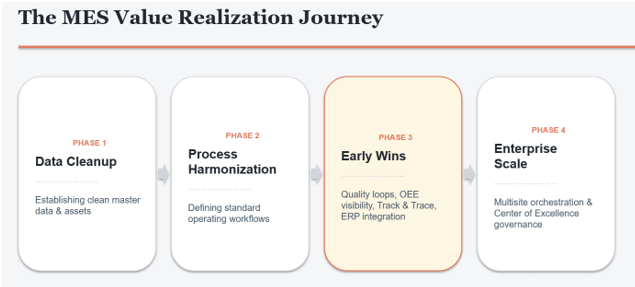
ARC's research indicates that successful MES programs consistently share several common characteristics. They begin with process reality rather than technology ambition and establish strong data governance before attempting to scale automation. They emphasize operational fit over feature comparisons, balance enterprise standardization with local flexibility, and pursue incremental value realization rather than relying on transformational promises. Equally important, they recognize that human judgment remains essential even in highly automated environments and treat MES as an operational transformation initiative rather than a standalone software deployment project.
At the same time, emerging trends such as composable architectures, cloud-native deployments, Industrial AI, and new cybersecurity requirements are increasing the strategic importance of MES decisions. As manufacturing operations become more connected and data-driven, organizations must ensure that their MES strategies are grounded in operational realities rather than technology assumptions.
Many MES programs begin with the assumption that manufacturing processes are more standardized, deterministic, and data-ready than they actually are. In practice, this assumption often proves inaccurate, especially in process industries and other environments where recipes change, materials transform during execution, and exception handling is part of normal operations.
This disconnect helps explain why many MES initiatives fall short of expectations. Too often, software is expected to impose structure on operations that have not yet been sufficiently defined. In some cases, the challenge is compounded by earlier ERP implementation decisions. Manufacturers frequently simplify routings, operational models, and process definitions during ERP deployments to reduce implementation complexity. While these shortcuts may be acceptable for planning and transactional processes, they often create gaps when MES is later introduced and requires a more detailed representation of manufacturing operations.
ARC believes manufacturers can close this gap only when they begin with process reality rather than system ambition. This requires understanding workflows, exception paths, genealogy requirements, quality checkpoints, operator responsibilities, and the relationship between ERP and MES process models before architecture or supplier decisions are finalized. Any disconnects between enterprise planning processes and manufacturing execution requirements should be addressed upfront rather than deferred to the implementation phase. When this front-end work is skipped, companies do not digitize best practices. They digitize inconsistency.
ARC Advisory Group clients can view the complete report at the ARC Client Portal.
Contact Us if you would like to speak with the author.
Obtain more ARC In-depth Research Market Analysis.