Representative End User Clients







Representative Automation Clients







Representative Software Clients









KEYWORDS: Industrial AI, Manufacturing Operations, Low-code, Data Governance, Change Management, Digital Twin, AI Assistants, Manufacturing Execution Systems (MES)
At Hanover Fair 2026, Industrial AI clearly moved beyond experimentation into execution. The conversation is no longer about whether AI matters, but how it is embedded into real operations. What stood out was not just the ubiquity of AI - from copilots to agent-based systems - but the convergence of data, automation, and workflows into a unified execution environment. The real shift is architectural: from isolated tools to contextualized, connected systems where AI can operate reliably. In this new phase, competitive advantage is defined less by access to technology and more by the ability to operationalize it, through strong data foundations, modular platforms, and disciplined execution.
The conversation around AI has clearly shifted from experimentation to execution. The real differentiator is no longer the AI itself, but the ability to embed it into operations through strong data foundations and contextualized workflows.
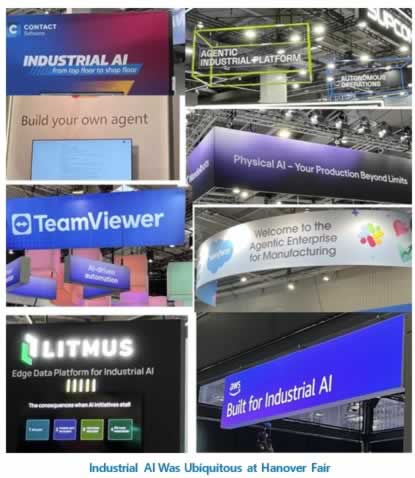
Walking the floor at Hanover Fair this year, one impression was impossible to ignore: AI has moved from promise to presence. It wasn’t confined to a few innovation corners or visionary keynotes - it was everywhere. From agentic orchestration layers and domain-specific copilots to early signals of physical AI, nearly every booth, demo, and discussion was framed through the lens of intelligence.
But what stood out wasn’t the volume of AI messaging. It was the shift in mindset.
This shift aligned almost perfectly with recent survey data from ARC Advisory Group. According to their latest Robotics and AI survey, 57 percent of European manufacturers have already implemented AI in some form, while another 40 percent plan to do so within the next three years. In other words, the industry isn’t experimenting anymore - it’s committing. The timing of the messaging at the Fair reflected that shift with striking precision.
The industry is no longer asking whether AI matters. That question is settled. Adoption is already widespread and still accelerating. What’s emerging now is a far more demanding question: how does AI actually become part of industrial execution? That distinction matters because it marks the transition from experimentation to real competitive impact.
ARC Advisory Group clients can view the complete report at the ARC Client Portal.
Contact Us if you would like to speak with the author.
Obtain more ARC In-depth Research Market Analysis.