Representative End User Clients







Representative Automation Clients







Representative Software Clients








 Executive Overview
Artificial intelligence (AI) is hot. Billions in venture capital have been invested in AI firms, some of them focused on solving digital supply chain problems. Machine learning, a subset of AI, is particularly hot. Interestingly, neither AI nor machine learning is a new technology in supply chain management (SCM). However, partly because this technology is hot and partly because there is so much more data becoming available for analysis, we’re seeing a new focus on using these techniques to improve supply chain applications. End users stand to benefit.
Key findings include:
Artificial intelligence is hot. Crunchbase reported that over $4 billion in venture capital has been invested in AI firms over the last year in the US alone. In the supply chain realm, the branch of AI known as machine learning is a particular focus for development. The focus on machine learning is most pronounced in the supply chain planning realm where  one director of planning solutions said, “The adoption of machine learning is the key driver in the ‘arms-race’ between software vendors to achieve differentiation.”
Perhaps last year’s biggest catch phrase was the “Internet of Things” (IoT). IoT is centered on the idea that there is a tremendous amount of sensor data that could be used to run value chains more effectively. This year, the catch phrase is “digitization.” “Digitization” involves a focus on emerging technologies that stand to fundamentally change the way we run our businesses, including our supply chain operations. These technologies include Blockchain, additive manufacturing, drones and robots, and artificial intelligence and machine learning. Not all these newer and emerging technologies are at the same level of maturity. AI, however, is rapidly moving up the supply chain maturity curve.
AI in the supply chain realm is less of a “science project” than in many other areas. To teach a computer how to recognize a picture, you expose it to terabytes of data and feed it hundreds of thousands of images. Those images have had to be preclassified by humans (i.e., This is a picture of a “dog”) which itself is incredibly costly. Supervised learning occurs when humans are in the loop to help the machine learning. In contrast, in supply chain management, many of the problems are more structured, humans are usually not needed to classify the outputs, and supply chain software companies already have cadres of operational research PhD’s working for them. These problems can be solved with unsupervised learning, a much more affordable approach to solving problems.
Any device that perceives its environment and takes actions that maximize its chance of success toward some goal is 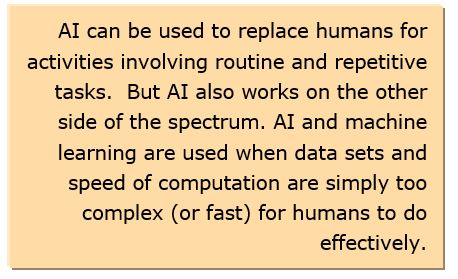 using artificial intelligence. This includes a vast range of technologies – like traditional logic and rules-based systems – that enable computers to solve problems in ways that at least superficially resemble thinking. The advanced statistical and optimization techniques that power supply chain planning applications are a form of artificial intelligence as the systems are fed data on the state of a current supply chain situation and then use math, statistics, and heuristics to improve schedules and forecasts.
But most operations researchers would not consider heuristics and commonly used forms of statistics to be AI. ARC Advisory Group recently spoke with supply chain application suppliers about their work in this area. Many of the product managers were modest when taking credit for their activities in this area. If they were not able to label their solution as being based upon a computational technique generally associated with AI or machine learning, they were apt to say their solution has “characteristics” of AI, but is not truly an AI application.
In short, the scope of AI is disputed. As machines become increasingly capable, many tasks that were once seen as requiring intelligence, are now seen as routine and these tasks (and the math that powers them) are often removed from the AI domain. In fact, the bar is set so high that for some of the PhDs we talked to, AI seemed to be whatever hadn't yet been done.
In this report, we will refer to AI-based applications as the set of techniques that are using advanced computational techniques in relatively new ways to improve supply chain processes. These include natural language processing, neural networks, pattern recognition, and gradient boosting.
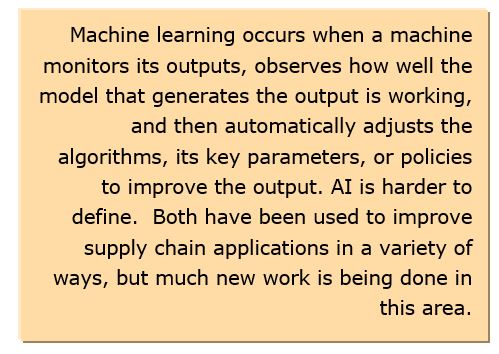
Machine learning, a subset of AI, is easier to identify. Machine learning occurs when a machine monitors its outputs, observes how well the model that generates the output is working, and then automatically adjusts the algorithms, or its key parameters or policies to improve the output.

Machine learning to improve supply chain processes is not new. Some interesting examples of how these technologies have been used to improve supply chain operations follow.
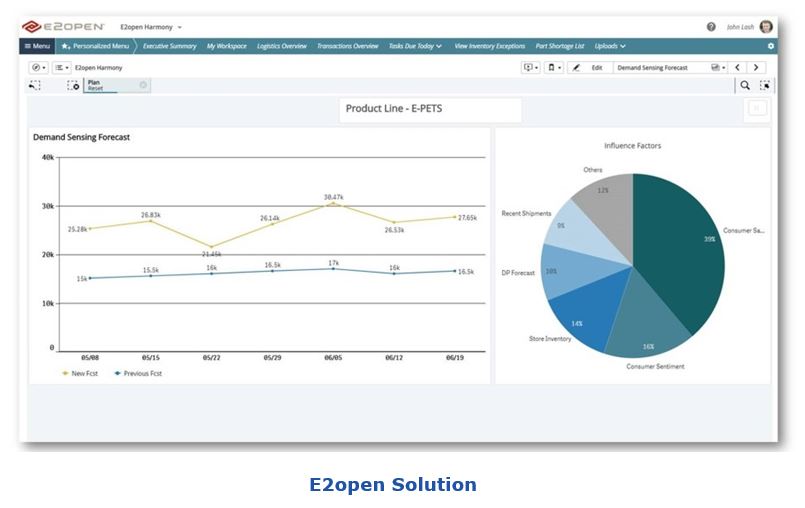
Machine learning drives continuous optimization as it dynamically adjusts forecasts based on new input data. The purest example of machine learning applied to supply chain planning comes from the E2open SCM platform. E2open has been doing machine learning to improve demand planning for over a decade. Machine learning was applied to demand management after companies began to leverage additional data sets such as their retail customer’s point of sale, recent shipments of products from their warehouses to their stores, the retailer’s orders, syndicated data, and store inventory. Many of these data sets are accessed daily, or even several times a day, so the dynamic nature of demand is captured to a much higher degree than traditional forecasting techniques. In short, demand planning is often based on Big Data.
The application works as follows. The engine makes many forecasts simultaneously in different planning horizons. So, there can be a forecast for demand for liquid detergent in a 100-ounce container to the Walmart store in Tuscaloosa tomorrow, one week out, and one month out. There can also be a forecast for how much of that detergent will be needed at the distribution center in Cullman, Alabama tomorrow, one week, and one month from now. Other forecasts are being done for other big retail customers and channels.

For the forecast of what is needed in the Tuscaloosa store tomorrow, it may be that point of sale is the data source with the highest influence factor, and the algorithm weights it accordingly. For a forecast of how much of that detergent will be needed in the Cullman warehouse in a month, a different algorithm is used that weights the data sets such that the statistical forecast is most important, recent shipments the second most important, customer orders third, and so forth.
Then every day, all forecasts, at all locations, across all time horizons, are done again.
Why all the forecasts? Different forecasts are used in different time horizons by different groups in the company. So, if 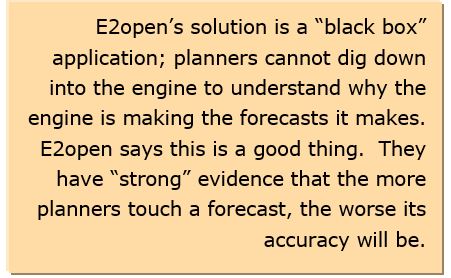 a factory has a frozen two-week production schedule, and the new schedule starts on October 16th, the factory planner will use the aggregated daily forecasts of the actual 14 days from October 16th through the 30th to create the forecast for demand over this specific time period and based on the projected inventory, determine what products they need to produce for the next two weeks. All other forecasts are ignored until the next production run needs to begin, when they once again use the most recent forecast pertinent to their needs.
But other departments use different forecasts in different time buckets. Thus, on that same Day 0 (October 16th) the transportation department might find it very helpful to know projected shipments to all the distribution centers on October 19th to create their private fleet plan for the 19th. In this case, the deployment lead time is three days, so the daily forecasts between Oct 16th and the 19th are aggregated to determine how much inventory will be at the DCs on Oct 19th and how much will need to be shipped on the 19th to maintain service commitments.
While E2open offers a pure example of machine learning applied to demand planning, many other supply chain planning (SCP) companies also offer solutions that allow continuous improvement to their forecasts. In this case, these solutions look at the sales behavior of particular SKUs. A fast-moving product not being promoted with no seasonality effects uses one algorithm for forecasting. An extremely slow-moving product with intermittent demand patterns uses a different algorithm. When the classification for that SKU changes, a different algorithm is used to forecast it. In this case, the demand planning model is not changing, but pattern recognition is applied to the inputs to allow for better forecasting outputs. JDA and Logility have had this type of solution for close to twenty years.
3CE, another SCM software supplier, has built an AI solution that uses natural language processing, information retrieval, deep learning, and specialized domain knowledge to build an expert system that automates the process of  Harmonized System (HS) commodity classification and HS code verification. This is an incredibly difficult problem.
The HS, a commodity description and coding system that forms the basis upon which all goods are identified for customs, is used by customs authorities worldwide. Using the right HS code allows companies to pay the correct tariffs, which is necessary to avoid government fines. In some cases, these fines can run into the millions of dollars. The HS code allows companies to calculate the true landed cost of products and identify promising selling and sourcing opportunities abroad. The problem, is that there is an incredible gap between how products are described commercially and how they are expressed in the national customs tariff schedules. This has resulted in error rates of 30 percent, according to several government sources. Worse, every country or trading bloc has its own taxonomy beyond the international six-digit level.
HS codes are arcane. What a regular person would describe as “baby food;” in HS speak is known as a “homogenized composite food preparation;” and a “hair blower” is an “electrothermic hair dressing apparatus.” Before you can classify “rayon” you have to know whether this is an “artificial” or a “synthetic” fiber. And if you were classifying an automotive part, like a car alarm, you might think you would go to the section of the HS code focused on automobiles, but no – this is an electronic signaling device.
Traditionally, HS classification has been a manual exercise performed by highly-trained experts. When a big importer loses someone on it trade classification staff, it has lost domain knowledge that is difficult to replace. Smaller companies often rely on custom brokers to do this, but if the custom broker classifies an item incorrectly, the importer of record is still legally liable.
 Many global trade management systems do come with a search engine. But these were not designed for the specific task of classifying products. A person types in the keyword, “electric toothbrush” for example, and in response they get an overwhelming number of potential answers. One government HS search tool responded with 222 potential code matches to “electric toothbrush,” none of which are correct. This can be problematic if you need a quick answer.
But in many cases, a keyword search returns no hits at all. Worst of all, all too often, a keyword search returns just one item, but it is the wrong item.
3CE has built an expert system that uses AI to read and understand everyday commercial goods descriptions and reason its way through the classification process. The tool can classify any product reliably and is simple enough for an amateur to use. While all big shippers have experienced professional trade experts on staff, they should not be spending their time on the routine classifications that make up about 80 percent of all classification work. Instead, they should focus on the 20 percent of more problematic classifications. The system allows shippers to describe products in their own words, checks to see if there is enough relevant detail to assign an HS code automatically, and if not, asks relevant questions until a single code is reached.
 So how does 3CE’s AI work? They start on the natural language processing side by creating a model of the domain and turning the arcane classification argot into the kind of language people use. To improve the targeted searches, the system uses transaction history to make assumptions. Night vision goggles could be classified in a couple of different ways. But since “night vision goggles” are more often a commercial-grade device than a toy, they take you to the commercial device classification first.
But the company’s natural language and information retrieval experts are not experts in classification. From a generic model – for example, there are eight classes of fertilizer – they proceed to using domain classification experts. These experts help the system understand things like how the legal notes attached to many products should be considered when classifying a product. These trade experts turn an intuitive system into a true “expert system.” But this is not a hard-coded decision tree. HS codes change all the time, but every time there is a change 3CE does not need to change the decision tree structure. This AI approach makes the system more flexible and adaptive.
 Another aspect of many forms of AI is that the systems get smarter over time. This system does have features that do this. First, the solution automatically flags transactions that are unknown; essentially, when the system cannot identify an article. These transactions are assessed and treated by their ontologists and industry domain experts. Ontology within computer science deals with questions concerning how entities may be grouped and related to each other within a hierarchy, and then subdivided according to similarities and differences.
Secondly, they use deep learning to further improve the system’s results. Deep learning, is a branch of machine learning that can be applied to natural language processing. Deep learning discovers representations in data without presupposing any relationships among them and forms them into conceptual hierarchies that can be applied to problem solving. When it comes to natural language processing, deep learning discovers multiple layers of language representations that correspond to different levels of abstraction; these levels form a hierarchy of concepts. In their case, since we are dealing with flagged events, this is supervised learning.
How well does this work? 3CE’s system is robust enough that it was the only machine to take place in a World Customs Organization classification competition. It didn’t win, but it did achieve a score of 93 percent. But in this business, that is success! Government experts only averaged 77 percent accuracy. Experts from the private sector fared worse - averaging just 68 percent.
If a shipper does get audited, the system provides an audit trail that shows how goods were classified with a logic tree that explains why the goods were classified that way. In many jurisdictions, this audit trail demonstrates “good faith” and means even if a declared good was misclassified, the company would be given credit for exercising diligence, and would likely avoid the most severe penalties (if they received any at all). Many shippers, if audited, have no ability to explain why they classified goods as they did.
Resilinc and riskmethods are two well-funded young startups with industry leading customers. They have a similar approach for detecting supply chain risks. riskmethods software, for example, continuously monitors risks by monitoring more than 300,000 online and social media sources for real-time news events that could adversely affect its customers supply chains. A customer’s supply chain is mapped, for example, material flows for a critical component might be 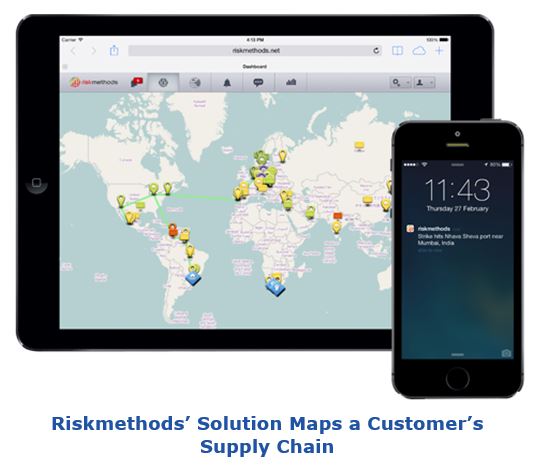 mapped through a Tier 2 supplier‘s factory, to an outbound port, to an inbound port, to its arrival at a Tier 1 supplier’s factory.
If a supplier’s ability to deliver is likely to be affected, the solution includes an Impact Analyzer module that allows a company to blow out its bill of materials and find other qualified suppliers.
VC-funded Resilinc uses similar techniques but adds geocoding functionality. A company’s supplier’s plants and logistics hubs are geocoded across its multi-tier supply chain. This allows a company to draw a circle around an event like an earthquake and answer questions like: “Which of our suppliers are located within 100 miles of the epicenter? Within 200 miles?” A company can also look at suppliers located within the flood plain of a river and ask questions like: “Are all our key suppliers for a particular component located in that flood zone? What happens if they all go down all at once?”
For both solutions, the events are detected in part using AI techniques like logistics regression to prevent false positive from overwhelming the people in the risk control tower. To detect whether a key supplier had filed for bankruptcy, for example, a series of slightly different names for the supplier could be mapped into the engine. “Acme,” “Acme Inc.”, “Acme Incorporated,” “Acmer” (sp.), and so forth. Similarly, the term “bankrupt” can have several synonyms. AI is used to score a term that indicates a potential risk and only elevate a “risk” for a person to validate if it is likely to truly be a risk. Over time, as false positives are elevated - or if true risk events are not detected - the system is “trained” to do better.
The next frontier will be using social, news, event, and weather (SNEW) feeds to proactively determine ETAs with enough lead time so on-time arrivals are not affected. Several companies are working on this, but TransVoyant, which has done classified work for the government, seems to be getting the most attention.
SNEW data has some exciting possibilities for supply chain planning. JDA, which has partnered with TransVoyant, envisions being able to improve planning-to-execution handoff optimization. For example, a transportation management system (TMS) grabs orders and creates optimized plans of how shipments should be routed in the coming days. Eventually, these plans are executed. Now JDA can take all the JDA TMS-planned moves and send them to TransVoyant. The TransVoyant application can view origins, routes, and destinations and predict that certain loads will not arrive on time because of things like road construction, a very large sporting event, or weather. A large shipper might send TransVoyant thousands of shipments for a planning horizon and perhaps only 1 or 2 percent are flagged as being at risk. The JDA TMS solution can then dynamically reoptimize those loads.
While this is an exciting possibility, caution is advised. Unlike riskmethods or Resilinc, TransVoyant has not yet identified reference customers. Secondly, significant architectural issues are likely to be associated with moving relevant alerts from the detection system to the planning system.
Finally, it’s not easy engaging in dynamic re-optimization in a way that does not totally disrupt the initial plan. If hundreds of loads are changed because of a replan, hundreds of carriers would have to be called to cancel planned moves, and hundreds of new tenders issued. Not all TMS solutions are capable of “threaded” dynamic optimization that replans in a way that leaves most of the initial plan untouched. Similarly, if this kind of solution is used for better supply planning, the schedule has to be able to peg the goods produced to specific customers. Not all supply planning solutions can do this.
AI embedded in supply chain applications is already providing real benefits in some applications. In others, AI has potential to improve supply chain processes, but the progress has been slow. Several factors associated with AI affect where these technologies have the best potential to improve supply chain management.
Demand planning is a good application for machine learning because the measure of success – the forecast accuracy – is clear. To learn, the application needs a clear measure of success.
But it’s not always easy to define what “success” is. Consider a situation in which a manufacturer learns of a shortage of a key component. Customers have already been promised products that depend upon that key production input. The supply chain planning engine needs to be rerun to generate a new supply plan.
But in this case, the objective can become much more subjective and hard to define:
It turns out many problems are hard to define precisely enough to allow for machine learning.
 Some SCP solution suppliers are looking to “solve” this problem using pattern recognition to see how planners resolved similar problems in the past and then suggest a similar resolution the next time the problem arises. The idea is that the solution will suggest a resolution, but people make the choices.
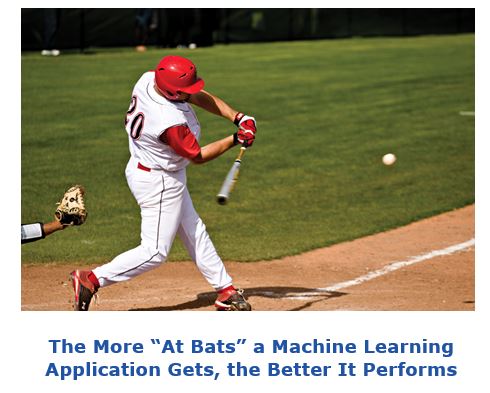
But this type of solution may be difficult to achieve. The more “at bats” a system has, the faster it gets smarter. If you are doing daily demand plans and have new daily data on how well yesterday’s forecast did, the system can improve quickly.
In the replanning problem described above, significant component shortages may only occur a couple times a year. And the resolution used in June may be completely different than December’s. It may take hundreds, but more likely, thousands of at bats before the machine can begin to unravel why a planner did one thing in one situation and a different thing in the next.
As previously mentioned, machine learning is used to improve forecasts. A demand forecast is made, a machine learning engine ingests data on how accurate that forecast was, and then the machine autonomously applies better math to improve the next forecast.
But ideally, a forecast is based on demand, not sales. In the consumer goods supply chain, that means the forecast needs to understand both the sales and the lost sales that could have been achieved if inventory had been in stock on the store shelf. The goal is to stock to true demand - or as close to it as we can get - so the retailer doesn’t miss out on sales.
Some suppliers have a solution for calculating lost sales, but this is based on a store forecast. The store forecast tells you what the sales should have been; if the sales don’t occur, store systems check to make sure the inventory was available to complete the sale. If the inventory was not available, it was a lost sale.
But this is circular reasoning. A demand forecast is made, and then to check the accuracy of that forecast one must rely, in part, on that same forecast.
Compounding the problem, stores often have poor inventory accuracy surrounding in-stock positions.
The definition of what a lost sale is changes in an omni-channel environment. For example, if a customer goes to the shelf and the product he or she wants to buy is not present, a store associate might suggest that it can be shipped from their ecommerce warehouse. Manhattan Associates is doing some interesting product development around calculating lost sales in an omni-channel environment. However, these calculations still depend on forecasts.
In short, the objective measure of success - critical to improving forecasts - is not as true a measurement as we might like in demand planning. But in this case, even a less-than-perfect objective measure still leads to improved predictions. While a clear measure of success is needed for machine learning, these measures don’t have to be perfect. What really counts is that using them improves the predictive power of an application.
Another issue associated with figuring how and where to leverage AI surrounds the scarcity of AI and developer talent capable of leveraging AI platforms. A newly minted PhD with a machine learning background commands an annual salary of several hundred thousand dollars. Experienced professionals that have worked in companies like Amazon or Facebook go for several million dollars. These professionals have choices; machine learning startups, the financial industry, or fast growing technology companies are likely to be more interesting to these specialists than the supply chain domain.
The team that develops new AI-powered applications will consist of systems data engineers, analysts, and the mathematicians that create the core model.
Some companies have internal capabilities in this area. Multinational consumer goods companies have data scientists that have focused on using these technologies in marketing; large process manufacturers have data scientists and engineers that have used these techniques to improve production processes. But, at these companies, it can be difficult to “borrow” this help because the supply chain function is not seen as being as strategic.
Drag/drop model design, data mixing, and analytics deployment are helping to address this skills shortage. Oracle, for example, is designing its AI solutions with this in mind – you simply won’t see the underlying math.
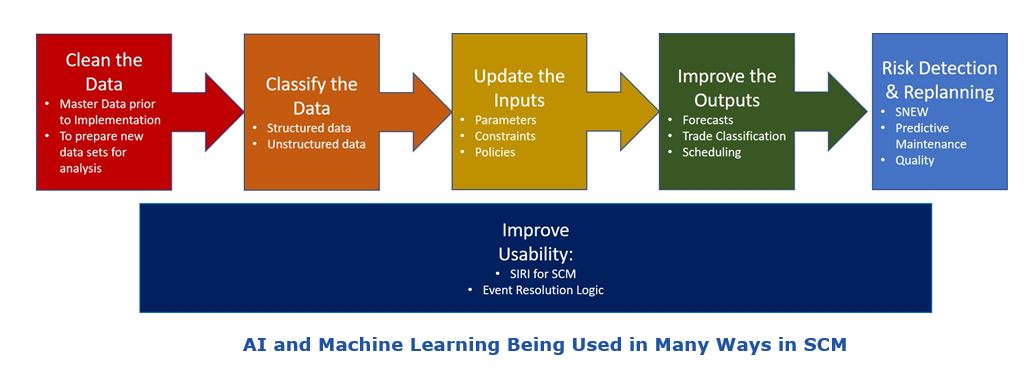
We need a data infrastructure that can get and consolidate the data, clean it, classify it and route it into the AI application. In fact, this problem is big enough that companies would be well advised to start by inventorying the internal sets of data they have, determining if that data could potentially be used productively by new machine learning applications, and then begin the process of collecting and cleaning that data. That process can take two years and cost millions of dollars with no guarantee the data will ever contribute to improved capabilities.
One ARC analyst attended a machine learning conference at which a leading entertainment company was seeking to improve its ability to forecast how many impressions a digital advertisement would get. They hired top talent, spent millions of dollars on infrastructure, developed a complex model, and then discovered that a simple statistical model already in place had 85 to 90 percent of the predictive power of the machine learning model. In short, a lot of money was spent but resulted in only small improvements to their forecast.
Machine learning has been little used to improve supply planning. This is in large part because it is more difficult to access and use PLC and machine sensor data than it is for demand planning solutions to use data that has been cleaned and harmonized by a DSR. On the supply planning side, there are platforms for doing this. OSIsoft, for example, has some reference customers here, so we know that more is possible. The combination of SNEW data and operational data is the next frontier where AI/machine learning will be used to improve supply chain planning.
Based on ARC research and analysis, we recommend the following actions for companies:
If you would like to buy this report or obtain information about how to become a client, please Contact Us