Representative End User Clients







Representative Automation Clients







Representative Software Clients








KEYWORDS: Dynamic Digital Twins, Autonomous Plant Operations, OmegaLand V4, Dynamic Simulation, Non-Steady State Operations, Abnormal Operation Response, AI-Enabled Operations
It has been nearly 200 years since modern industrial plants began operating, and approximately 50 years since distributed control systems (DCS) were introduced into plant operations. Over this period, the process industries have achieved significant growth through improved efficiency and increased scale.
Today, however, industry faces a new set of complex challenges, including environmental impact reduction, uncertainty in supply chains, cybersecurity threats, and labor shortages. Addressing these challenges requires initiatives that simultaneously enhance productivity, sustainability, and resilience. One promising approach is the advanced application of AI and automation in industrial processes. With the ongoing convergence of IT and OT, extending AI utilization—already commonplace in office environments—to plant operations has become a natural progression.
The ultimate goal of automation in process industries is to enable plants and operations to achieve higher levels of autonomy, minimizing human intervention while allowing systems to learn, adapt, and make decisions independently. This shift allows operators to focus on higher-value tasks that require optimization and creativity.
To realize autonomous plant operations, it is essential to transform the vast amounts of raw data obtained from sensors and ICSS (Integrated Control and Safety Systems) into meaningful information that supports sound decision making. At the core of this information-processing foundation lies the digital twin.
A digital twin reproduces the state and behavior of a real plant (physical space) as a model in a virtual space and connects the two bidirectionally. Among digital twins, dynamic digital twins, which are built using dynamic simulators based on physical and chemical principles, play an especially critical role in autonomous operations.
Unlike black-box predictive models, dynamic digital twins provide transparency by structurally explaining causal relationships in process behavior. This enables integrated dynamic analysis of real-time data, operational history, and non-steady events. As a result, they support not only situational awareness but also future prediction, early detection of abnormal signs, and virtual validation of optimal control strategies.
In particular, online simulation functions that synchronize with real plants allow high-speed, high-accuracy validation while reflecting actual operating conditions in real time. These functions act as the “nervous system” that supports advanced autonomous operations. In addition, the ability to reproduce diverse abnormal scenarios in virtual space significantly enhances the efficiency and quality of training data generation for AI and machine learning models.
In recent years, non-steady operations have become the norm rather than the exception. Load fluctuations, production plan changes, equipment condition variations, and rapid changes in external environments make it increasingly difficult to maintain safety and efficiency using conventional steady-state–based operational management. Under these conditions, dynamic digital twins have become indispensable as a foundation for real-time state understanding and appropriate decision making.
Dynamic digital twin–based operational enhancement has already entered the operational phase in some domestic process industries. For example, ENEOS Materials Corporation has achieved stepwise operational enhancement by applying AI and plant data utilization to processes where autonomous control is effective from the perspectives of labor productivity, energy efficiency, and quality. Mitsui Chemicals, Inc. has successfully applied operational support combining dynamic simulation and AI to large-scale boiler plants, improving decision making during non-steady operations.
These examples demonstrate that dynamic digital twins are no longer merely a future vision but are already generating tangible value in real plant operations.
Omega Simulation is a joint venture between Yokogawa Electric Corporation, a global automation company, and Mitsui Chemicals, Inc., a leading Japanese chemical manufacturer. Leveraging deep understanding of user perspectives and experience, the company has developed and provided “OmegaLand” as an automation product and solution centered on dynamic simulation technology. Recently, OmegaLand, a simulation environment for plant operations, has been renewed as OmegaLand V4, a dynamic digital twin platform designed to support autonomous plant operations.
The environment surrounding plant operations is undergoing significant change, and expectations for autonomous operations are growing rapidly. Dynamic digital twins are a key enabler of autonomy. Achieving autonomy requires first visualizing plant conditions as numerical data, identifying operational issues, and progressively optimizing operations while resolving these issues. Through this accumulation, operational knowledge is formed and refined, providing a foundation for transitioning from automation to autonomy in a step-by-step manner.
Omega Simulation has globally deployed OmegaLand—an integrated dynamic simulation environment based on its proprietary technology—to users across industries such as oil and gas, LNG, chemicals, and renewable energy. Traditionally, OmegaLand has been used primarily to support the development of operator training simulators (OTS).
OmegaLand V4 has evolved beyond OTS to comprehensively support autonomous operations, enabling issue identification, solution development, efficient field deployment, and ongoing operation within a single dynamic simulation environment.
Plant operations can be categorized into five states: shutdown, non-steady, steady, abnormal, and emergency.
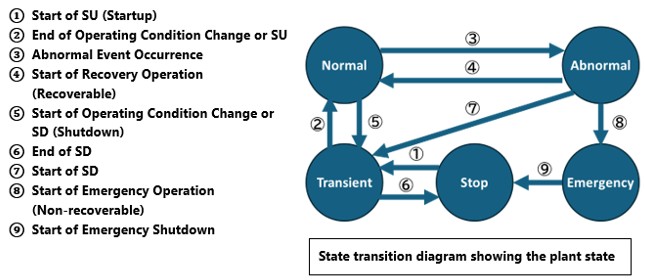
OmegaLand V4 supports autonomous operations in the non-steady, steady, and abnormal operating states, where the system proactively leads decision making and execution rather than merely automating predefined actions. In emergency states, safety instrumented systems ensure that plants transition safely and reliably to shutdown.
A stable operating condition in which key process variables—such as temperature, pressure, flow, level, and composition—are maintained within narrow ranges. In this state, critical quality- and environment-related parameters are visualized and managed. Stability and efficiency are ensured by combining conventional control methods with AI and advanced technologies, while early detection of abnormal signs is enabled through anomaly detection.
Operations such as startup, shutdown, and load changes. Traditionally dependent on operator experience and tacit knowledge, these operations are increasingly being formalized within systems through guidance-based support and automation of DCS operations.
Operations that respond to detected abnormal signs. The system supports rapid and accurate operator decision making by presenting avoidance measures through early detection and root-cause estimation.
Operations addressing emergencies such as explosions, fires, or critical failures. In these cases, safety systems prioritize certainty and immediacy to safely shut down the plant.
As demonstrated by the previously introduced cases of ENEOS Materials corporation and Mitsui Chemicals, Inc., dynamic digital twins are playing an increasingly important role in enabling autonomous plant operations. Building on these trends, OmegaLand V4 maximizes the value of investments in dynamic model development by providing a dynamic digital twin platform that comprehensively supports autonomous plant operations. By tightly integrating dynamic simulation with control systems, OmegaLand V4 enables end-to-end workflows—from solution development and validation to execution and evaluation.
OmegaLand V4 enables systematic verification, optimization, and training using virtual plants across steady, non-steady, abnormal, and emergency operations. This approach allows both pre-deployment validation and post-deployment continuous improvement.
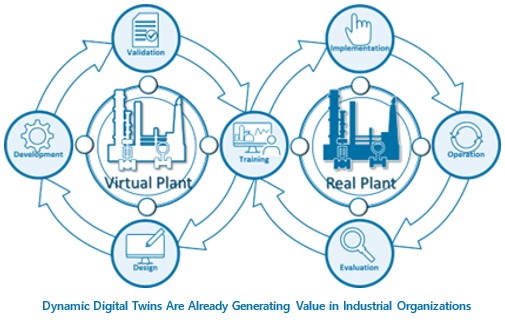
Steady State Operations: Real-time visualization and monitoring using high-accuracy dynamic models, quality estimation through hybrid physical–AI soft sensors, and automatic steady-state optimization.
Non-Steady State Operations: Scenario-based validation of startup and shutdown procedures, AI-based guidance development, dynamic optimization for load changes and scheduling, and operator training prior to deployment.
Abnormal Operations: Design and validation of response procedures through abnormal scenario reproduction, standardization of procedures, AI development using simulated data, and operator training.
Emergency Operations: Dynamic risk assessment and verification of SIS logic, including time-response and interaction effects, combined with OTS-based emergency response training.
OmegaLand V4 delivers the following value as a dynamic digital twin platform for autonomous operations:
This ARC View has discussed why autonomous plant operations are increasingly required in response to challenges such as environmental impact reduction, growing operational complexity, and labor shortages. It has also presented the role of dynamic digital twins as a core enabling technology, together with the concepts and value of OmegaLand V4 as an implementation platform.
Autonomous plant operations are not simply about increasing the level of automation. Their essence lies in enabling plants to continuously make safe and rational decisions by accurately understanding their current state and anticipating future behavior across a wide range of operating conditions, including non‑steady and abnormal situations. To achieve this, dynamic digital twins—capable of reproducing actual plant behavior based on physical and chemical principles and of explaining causal relationships—play a critical role.
Centered on such dynamic digital twins, OmegaLand V4 provides a platform that extends the use of dynamic simulation beyond traditional operator training to a broad range of applications, including day‑to‑day operational improvement, evaluation of non‑steady operations and abnormal responses, safety assessment, and human resource development. Through online simulation tightly integrated with control systems, virtual plants are evolving into practical assets that directly support operational decision making.
Moreover, the ability to accumulate operational knowledge as formalized knowledge through verification and evaluation in a virtual plant—and to continuously reflect that knowledge in plant operations, AI applications, and personnel development—offers a realistic and step‑by‑step path from automation toward autonomy. Dynamic digital twins are expected to become an increasingly important common decision‑making foundation for plant operations. OmegaLand V4 is positioned to play a key role in shaping this future by providing the platform that supports and accelerates this evolution.
ARC Advisory Group clients can view the complete report at the ARC Client Portal.
Contact Us if you would like to speak with the author.
Obtain more ARC In-depth Research Market Analysis.