Representative End User Clients







Representative Automation Clients







Representative Software Clients








To paraphrase Stephen Elop, former CEO at Nokia: The advantages you enjoyed yesterday will be replaced by the trends of tomorrow. While this applies for all industries, it is particularly relevant for participants in today’s global automotive industry.
 Thanks to digitalization and autonomous driving, cars will become much more flexible, while electrification will help them adapt better to urban environments. Digitalization in general and cyber-physical systems in particular are driving major changes in automotive production.
Seamless data exchange between automakers, suppliers, dealers, and drivers will benefit all parties. The constant data exchange creates a connection between the owner and the brand that endures throughout the vehicle’s lifecycle - from the first 3D digital model to the end of the vehicle’s useful service life (at which point an increasing percentage of its materials will be recycled for use in new vehicles and the cycle begins all over again).
The key findings of the report include:
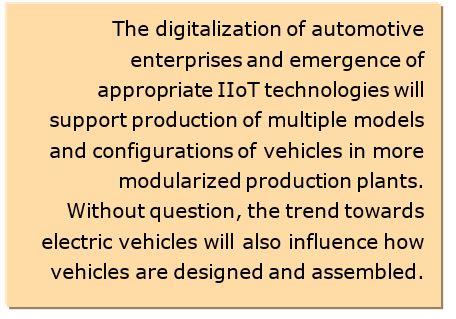
The digitalization of automotive enterprises and emergence of appropriate IIoT technologies will support production of multiple models and configurations of vehicles in more modularized production plants. Without question, the trend towards electric vehicles will also influence how vehicles are assembled.
Mobility patterns are starting to change. However, whether people are using their own vehicle, sharing one, or taking advantage of mass transportation; consumers will ask for a better “individual” experience for themselves, their passengers, or others on the road. 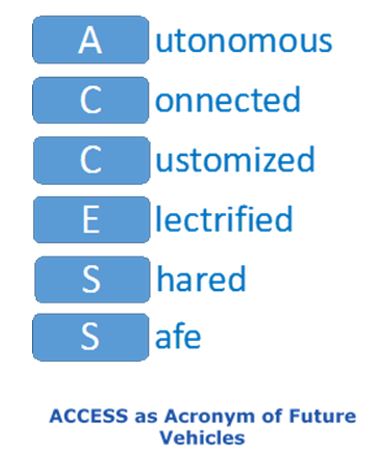 Customers are demanding quality, safety, simplified driving, individualized features and capabilities, and – increasingly – reduced air emissions. Thus, we’re seeing increased need for “mass customization” of vehicles.
The shift from assembling more-or-less standard cars to more customized, design-to-order cars is a major challenge for big automotive manufacturers and their suppliers. The trend toward fewer vehicle platforms continues, with more variations between individual vehicles. Therefore, future production concepts will have to be even more modular and flexible.
Digitalization is gaining momentum. This includes employing a “digital twin” for an increasing percentage of parts, components, and processes. From initial product planning to post-sale service, data are compiled to improve processes, shorten time-to-market, improve vehicle quality and support, and enhance customer experience and loyalty.
While safe, fully autonomous, connected, customized, electrified, and shared cars are still on the horizon; in many respects, the smart, cloud-enabled, digital factory of the future is already here.
With information now available everywhere all at once, product development can be performed globally to further integrate suppliers into the process and help meet customer demands for new features.
Today, over 75 percent of car components come from suppliers such as Bosch, Denso, Continental, or MAGNA. To a large degree, this leaves only the body and engine to the automotive manufacturer to provide.
Automakers’ core competences lie mostly in developing and communicating the overall brand image, creating vehicle designs that support this image, developing the production concept, and performing final assembly. They delegate most everything else to their suppliers.
For some time now, suppliers have served as an extended workbench and low-cost reservoir for labor for the vehicle manufacturers. Industry experts suggest that two-thirds of the major innovations have come from these component suppliers. ABS and airbags, distance detectors, automatic transmissions, LED systems, and many fundamental developments were commercialized by suppliers such as Bosch, Denso, Magna, ZF, Continental, or Hella.
Several trends and developments in the automotive industry suggest that the horizontal integration between component suppliers and the vehicle producer will only increase. Automakers are starting to define themselves as mobility providers and aligning their business models accordingly. To comply with the more stringent emissions and mileage regulations, automakers and suppliers are being forced to collaborate to develop further innovations.
The trends toward electric and autonomous vehicles and the requirements posed by new production concepts leads to the emergence of new suppliers, many bringing innovations from other industries. The digital cross-linking between the suppliers from different industries and vehicle producers also paves the way for big productivity gains.
Most industries in a globalized world must deal with pressures to reduce costs and increase product individualization. Product variability and complexity are increasing, significantly reducing the number of products that can be mass produced. This is especially true in the automotive sector.
Labor accounts for around 20 percent of total costs in automotive assembly plants. However, across the entire automotive value chain, the cumulative labor costs can be more than 60 percent.
Consider that auto workers in Germany are paid $35.00 to $55.00 per hour, $12.00 to $15.00 in Eastern Europe, and $10.00 in China. In contrast, the cost for a robot-hour is just $3.00 to $6.00. Clearly, this contrast plays heavily on an automaker’s relative competitiveness.
The pressing need to reduce costs (especially labor costs) while simultaneously increasing quality are the main drivers for increasing both use of robots and automation in general along the complete automotive value chain.
Today’s automotive manufacturers strive to build lighter weight vehicles to meet the increasingly more stringent vehicle emissions and fuel efficiency standards.
One solution is to reduce the weight of the individual components that go into the vehicles. To this end, a whole range of new materials, such as composites, have been developed. These materials must withstand the specific requirements of the automotive industry, including mechanical properties, ease and cost efficiency of production and assembly, durability, and crashworthiness.

Vehicle manufacturers and suppliers need to integrate these new materials into their production in a cost-effective manner. Established manufacturing technologies must be improved and new production methods (like additive manufacturing) implemented. The chart provided by VDI, the German engineering association, clearly shows an ongoing shift towards less conventional steel and more lightweight materials, especially composites.
Using composite materials that are stronger yet lighter than steel for everything from small components to large body panels enables companies to create vehicles that weigh less and therefore require less fuel and generate fewer emissions.
According to Daimler CEO, Dieter Zetsche, who spoke at the Paris Auto Salon 2016, future vehicle powertrains will emit no emissions. To this end, a higher percentage of vehicles every year will be electric-driven.
While diesel-powered internal combustion engines had been gaining popularity in recent years due to their relatively high efficiency compared to their gasoline-powered counterparts, this trend took an abrupt “about face” in 2016. The Volkswagen “Dieselgate” affair in which the company (uncharacteristically) attempted to cheat on its US EPA emissions tests, no doubt contributed to this. In Athens, Mexico, Madrid, and Paris diesel engines will be banned from 2025 onwards. Politicians in both Norway and the Netherlands are considering nationwide prohibitions of diesel motors. India wants to completely ban combustion engines starting in 2030. China, the biggest automotive market with the highest growth rates will introduce a minimum quota for electric cars in 2018. This is in response to that country’s unprecedented smog in its major urban and industrialized areas.
Air pollution and climate change concerns currently make the internal combustion engine a “machina non grata.” A technical comparison shows that, in many respects, the electric motor is superior to the internal combustion engine:

As the chart shows, the electric motor is cleaner, more compact, lighter, simpler and easier to integrate into vehicles than the internal combustion engine. While combustion engines will no doubt continue to co-exist with electric motors for some time, the change will affect both car manufacturers and their many suppliers of combustion engines and components.
Increased modularization and flexibility will be required along the supply chain and in final assembly.
In the automotive industry as well as other industrial sectors, we’re still seeing high demand for systems that increase both productivity and flexibility. This is true for the manufacturers doing the final assembly as well as for all suppliers along the value chain.
To varying degrees, initiatives and associations such as Industrie 4.0 (Germany), Industrial Internet Consortium (US), l’entreprise du Future (France), or the e-F@ctory Alliance (Japan) all address the challenges arising from those trends.
The graphic gives an overview of some challenges and trends in the automotive industry that affect automation production in some manner.

Several different approaches have emerged to help automotive manufacturers and their suppliers adapt to this new environment.
The vertical and horizontal integration in automotive includes integrating suppliers, dealers, and end user customers, as well as the core processes within a company. While not yet achieved, full integration offers tremendous potential for improvement, especially when it comes to reducing the development times and handling the complexity involved in producing highly customized vehicles that conform to each customer’s specifications (essentially, batch lots of one.)

Instead of point-to-point supplier relationships, networks will be implemented and internal departments (development, planning, purchasing, production and logistic) will cooperate even closer via digitization or, in some cases, even merge. (Think about IT/OT convergence).
Lean management and production approaches are based on continuous data and process flows, avoiding waste, standardizing processes, and reducing inventories of components, work in progress, and finished products to a minimum. In this environment, the ability to produce just what the customer asks for, calls for high flexibility.
Lean management approaches and Industrie 4.0 (I4.0) share several key characteristics, including:
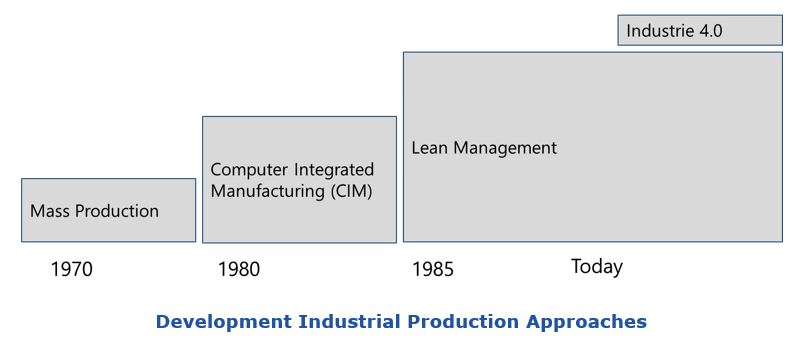
However, I4.0 has evolved quite a bit further relative to the self-organization of production using cyber-physical production processes (CPPS) and far greater importance of IT. This enables self-organizing and self-controlling approaches such as agent-based systems that have been known in principle for a long time.
We’ve seen elements of the digital factory making their way into the automotive industry for quite a while. According to the VDI 4499 guideline, “digital factory” refers to a comprehensive network of digital models, methods, and tools (such as simulation and 3D visualization), integrated via consistent data management. The goal is to employ a holistic approach for planning, evaluating and continuously optimizing all structures, processes, and resources of the “real” (physical) factory in conjunction with the product.
The digital factory approach aims to enable a complete digital representation (“digital twin”) of the entire physical automotive value 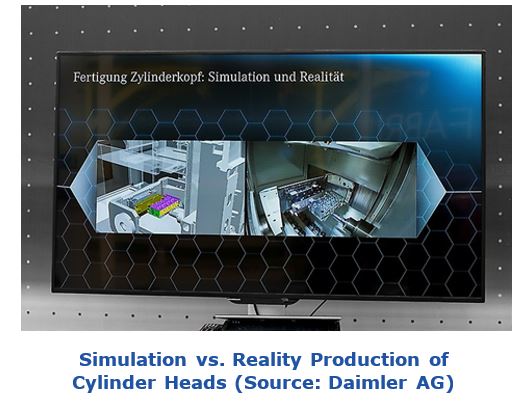 chain. This seamless integration of data along the value chain will be critical for maintaining competitiveness in the automotive industry. Digital process chains in automotive production are characterized by agility, scalability, mobility, modularity, recombination opportunities, and learning ability. These all require complex digital capabilities and in-depth understanding of how they interact. Changes in processes have always been tested on real assembly lines. In the future, assembly workers will run through new work steps or model changes in a virtual environment before changes are integrated into actual production. This will increase efficiency, since model changes and production conversions can be anticipated earlier. The goal is synchronous, real-time mapping of all processes in the virtual and real world.
Automobile manufacturers and suppliers are working hard to achieve a true virtual model of the real world. Maserati, for example, already uses Siemens solutions to create a complete virtual twin for planning, building and optimizing a new factory in which to produce its car Ghibli. The entire car design and associated production areas (body, paint, assembly) were first created virtually in 3D models. The processes were refined over time, using the digital twin to optimize the manufacturing process in minute detail.
Implementing smart production systems involves several industrial key technologies. Here, we look at common approaches and the main enablers of the change in automotive final assembly. Those include:
Sensors and information technology/information and control technology (IT/ICT) are key for I4.0 and smart production. Across industries, sensors and software are building the foundation for further development
Sensors provide real-time capability, reliability, and embedded intelligence. Robotics increase flexibility and provide mobility, but require intuitive programming, mobility, intelligent controls, and the ability to work cooperatively with humans.
New production and automation systems connect machines and other assets with production systems, but must support interconnectivity of assets and machines, additive manufacturing, decentralized control, and self-configuration.
Embedded digital technology and other appropriate IT helps make machines “smart.” Third-party providers increasingly offer solutions or extensions to further increase value. In automotive, the key information technologies that apply include:
In addition, new intra- and inter-logistics solutions are required for I4.0 in automotive. Highly flexible production processes require a completely integrated supply chain; ideally with a stable, reliable, and secure network. RFID and internet technologies are already being used to implement these types of networks. In the future, more autonomous systems will emerge to support logistics and optimize production and business processes.
Across industry, effective data and information exchange require open standards that transcend vendor- and device-specific barriers. Openness and transparency are required for horizontal and vertical integration and seamless data exchange among all stakeholders.
In automotive, standards that support the following requirements are particularly important:
The automotive industry is driving automation suppliers to tear down barriers. Many associations and committees are working to harmonize standards in the automotive sector. These include the International Electro Technical Commission (IEC) and International Organization for Standardization (ISO). In addition, the global Internet Engineering Task Force (IETF) standard and W3C consortium play equally central roles. Other relevant standards bodies include the Object Management Group (OMG), OPC Foundation, Organization for the Advancement of Structured Information Standards (OASIS), and the Institute for Electrical and Electronics Engineers (IEEE).
Most automobile companies have experienced challenges connecting new devices to existing networks, due to largely vendor-specific solutions, standards, and protocols. In Europe, you typically find Profinet networks for which Siemens is the main automation supplier. Rockwell Automation’s EtherNet/IP dominates North America, while Mitsubishi’s products and CC-Link based networks are prominent in Japan and many Asian countries. Because more and more components from different suppliers are installed in existing infrastructures, the complexity and costs of integration have increased over the years. That’s why, for years, car manufacturers and their suppliers have been pushing automation suppliers towards more openness in their systems and products. This requires more harmonized standards. All along the automotive value chain, companies strive for increased freedom of choice of automation components and reduce their dependency on specific automation suppliers.
Based on the long-standing demands of automation end users and suppliers alike, the OPC Foundation has been working to increase data communications interoperability between different supplier’s automation products and software applications. The OPC Foundation’s latest Unified Architecture (UA) open communication standard is well-positioned to help fulfill the promise of IIoT. This is enabled through the standard’s flexibility and ability to scale many manufacturing levels because of its multiple code options, including Java, ANSI C/C++, and Microsoft .NET code. OPC UA also provides multi-platform capabilities, so you can have clients and servers on different platforms with many types of applications.
OPC UA’s extensible data stack enables automotive companies and their legacy plants to realign plant floor communication by moving away from custom drivers and network card communication.
For years, true real-time industrial Ethernet has been a dream, and not just in the automotive industry. Deterministic Ethernet and Time-Sensitive Networking (TSN) provide a real-time infrastructure for realizing IIoT solutions in automotive and other industrial applications. The key is meeting the technology demands by implementing high-bandwidth, open, and standards-based solutions for real-time systems.
IEEE 802.1 TSN promises to bring real-time deterministic behavior to IEEE-standard Ethernet, eliminating the need for vendor- or protocol-specific implementations.
Industrial suppliers such as ABB, Bosch Rexroth, B&R, Cisco, General Electric, KUKA, National Instruments, Parker Hannifin, Schneider Electric, SEW-EURODRIVE, and TTTech are promoting the use of OPC UA and TSN as a unified means for providing cloud integration for industrial devices. This is one path to the future for TSN, but ARC expects it to be used with existing industrial network protocols as well. This will result in continued differentiation based on protocol support in the industrial market. Organizations such as the AVNU Alliance and the Industrial Internet Consortium (IIC) offer suppliers the means to evaluate interoperability of differing implementations and should be pursued by suppliers looking to build products compatible with the standard(s).
Because TSN addresses only layers 1 and 2 of the OSI network stack, ARC believes that the industrial network protocol organizations will continue to play an important role in defining capabilities and guaranteeing interoperability. ARC envisions that associated organizations, such as Profinet or PROFIBUS International and ODVA (EtherNet/IP), will continue to play an important role in certifying TSN products that support their respective protocols.
Connecting machines to other machines (M2M) and with other systems like drones or autonomous guided vehicles via industrial  networks or cloud-based solution is a hot topic in automotive. This makes IT security an equally hot concern. Even if machines are not connected via the Internet, cybercrime poses a risk across the automotive value chain and must be addressed.
To optimize automotive production, cyber-physical systems (CPS) must be able to communicate with each other seamlessly and in real time. This M2M communication requires uniform standards to enable efficient interplay of hardware and software components. However, developing uniform standards for M2M solutions is particularly challenging due to the large number of different suppliers, technologies, system components, and protocols currently in place in most automotive factories around the world.
Many car manufacturers are already reaching their limits relative to complexity and production flexibility to manage variants. The automobile factory of the future must therefore be adaptable and capable of meeting rapid changing requirements to be able to produce any vehicle types with minimal effort. Cyber-physical systems offer the promise to reach those targets.
CPS can be characterized by the flexible linkage of real (physical) objects and processes with information (virtual) objects and processes via open global information networks. CPS integrate computing, networking, and physical processes. Embedded computers and networks monitor and control the physical processes, with feedback loops in which physical processes affect computations and vice versa.
Ideally, enough is known about a product or part during development so the resulting CPS will be able to respond autonomously to the necessary changes and requirements during the actual production operations. While CPS offer significant potential benefits across all production operations (press shop, body shop/construction, paint shop, final assembly), CPS have the potential to deliver the most value during final assembly, when everything comes together.
Opportunities also exist for the cyber-physical system at one plant to communicate with different production sites and suppliers to automatically optimize global production. CPSs demand a meshed, net-like communication between ERP, MES, and the automation level. Adaptive, self-controlling, self-monitoring, self-configuring and self-optimizing cyber physical production systems are the likely successors to today’s manufacturing execution systems (MES). However, numerous challenges must first be met. These include:
If these challenges can be met, CPS offer significant potential benefits in automotive production, including:
Once again, however, integrating CPS into the Internet or using cloud services requires an appropriate, safe, and secure infrastructure. The following graphic provides a schematic representation of what this infrastructure could look like.

This infrastructure and the potential benefits it could provide also require complete and easily comprehensible documentation for all parts and processes, safety-critical or otherwise. This documentation must be kept up to date over the entire lifecycle of the process and/or asset.
Use of analytics is growing across industry. For more than a decade, business intelligence (BI) platforms and enterprise manufacturing intelligence (EMI) solutions helped users discover and understand the underlying reasons and details about what happened and why. Now, with the industrial space becoming much more dynamic, manufacturers are turning to advanced analytics and machine learning to support predictive and prescriptive solutions.
The automotive industry uses analytics in a number of applications. They benefit by applying analytic techniques to support continuous improvement initiatives, plant performance monitoring, decision support, predictive maintenance, generating KPIs, process control, and quality control. Analytics can also be used to identify and correct production anomalies, improve control, and make continuous improvements.
A modern approach built on data collection and analysis enables manufacturers and suppliers to develop new techniques that result in greater efficiencies, better yields, more consistent product quality, and increased production flexibility. It can also reduce time-to-market for new products. Together, analytics and Big Data provide multiple views of information that enable managers, operators, and engineers to collaborate and work together using real-time data and analysis in an information-driven environment. Artificial intelligence, or machine learning, underlies many now-common consumer products. In the automotive industry, we’re seeing considerable interest in using these technologies to avoid downtime, optimize asset maintenance, production operations, supply chain, product design, field service, and other areas.
Since production still centers around humans, advanced assistance systems are becoming increasingly implanted in production. For 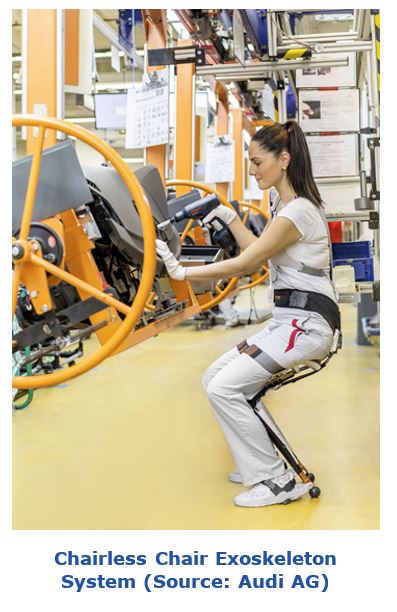 several years now, we’ve seen use of approaches like pick-by-light, pick-by-voice, and AR/VR tools.
As mentioned before, many companies already use “data-glasses” for check and control tasks, maintenance tasks, or work instructions. Ergonomic assistance systems, like the “chairless chair” exoskeleton system used at Audi help protect employees’ health while helping increase productivity. Smart watches have already found their way into production. BMW is using smart watches via vibration and/or lighting displays to inform workers when the next car to be produced will be especially complex due to special accessories.
In automotive, touchless gesture control is already used for quality control. Here, sensors compare the as-built component or assembly with the 3D model of the component or assembly stored in the quality management system. Using these tools, if the employee identifies an error, the component or assembly is rejected and the coordinates are stored and documented in the quality management system. If the quality is perfect, a wiping gesture is sufficient to mark the component as fault-free in the system.
Mobile, intelligent workbenches that provide both information and ergonomics already accompany employees in production.
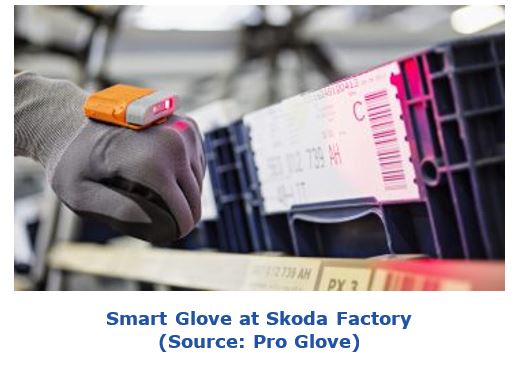
In the future, we’ll see many more types of smart assistance systems developed and implemented into production processes, whether intelligent gloves or other wearables or other systems for improving ergonomics and efficiency.
Virtual technologies are gaining increasing importance in the automotive industry, especially for product development and final assembly. Virtual technologies have been developed largely in response to today’s increasing number of different models, versions, and variations; combined with pressure to reduce product development times in automotive.
 There are distinct differences between augmented reality and virtual reality (VR). While VR immerses the user in a total virtual world, AR involves a live direct or indirect view of a physical, real-world environment whose elements are augmented (or supplemented) by computer-generated sensory input such as graphics or sound.
Working methods and the sequence of work steps depend highly on a vehicle's particular equipment and features. To help manage this growing complexity, employees must be supported efficiently in their work activities. This requires advanced instructions that show the employee how to perform – step by step - the tasks that will be required for a specific job, supplemented with related information such as the tools to be used, assembly configurations, and test specifications.
Volkswagen, for example, developed a display system for information that also provides the information on tablets and shows the worker the next work steps directly. The company calls this system MARTA (Mobile Augmented Reality Technical Assistance). Other industry manufacturers, such as Continental, already use 3D glasses or helmets to help improve maintenance and assembly.
To increase flexibility while helping ensure continuous, safe, and efficient part and material flow in this time of increasing wages, automotive manufacturers are increasingly looking to use autonomous material handling approaches such as airborne drones or unmanned aerial vehicles (UAV) and automated guided vehicles (AGV).
In automotive, with its often massive production sites, just-in-time processes, and high costs associated with idle production lines, 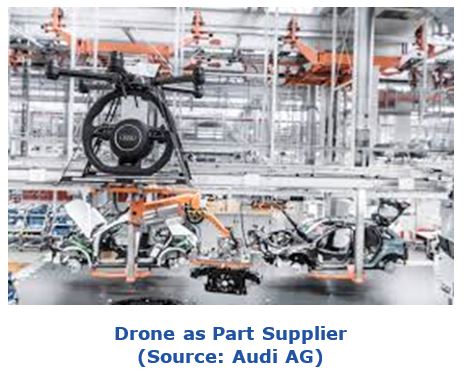 UAVs could support intra-plant transport as well as supplier-to-plant emergency deliveries.
UAVs could potentially be employed to transport parts or utilities to individual manufacturing stations. Large-scale areas could also benefit from on-site express delivery of items crucial to maintaining operations, such as tools, machine parts, and lubricants. To date, Audi has performed preliminary tests at a pilot plant in which the company uses drones to transport spare parts.
UAVs are easy to deploy and can follow pre-defined flight paths, or will even fly autonomously. As long as operations are limited to private premises (such as within automotive assembly complexes or warehouses), only minimal regulations apply.
However, while drones are gaining the ability to fly autonomously and deal with obstacles or other drones, significant technology gaps remain for more widespread use in automotive production.
Automated guided vehicles (AGV) are already common in automotive production. Driverless systems have been in use for a long time, but autonomous driving transport units, without ground tracking, have just recently become possible. These can support a more decentralized material flow control and self-steering logistics systems. These approaches offer advantages in terms of scalability, increased robustness, and reduced planning times.
Automotive is the largest market in the RFID area and accounts for around 45 percent of the complete market. In Europe in particular, companies make heavy use of RFID technology to produce individualized cars. Large car makers are already mature RFID users, but tier 2 and 3 suppliers are still catching up, creating opportunities for the automation suppliers. Significantly, the automotive industry has initiatives to use RFID across the complete value chain, which means that technology and semantics will ultimately be standardized.
In large-scale automotive manufacturing, RFID is often connected to the control system, which includes track & trace, product & material flow, production control, and intralogistics applications. In smaller job shops and tier 2 or 3 suppliers, tool management is a key application for RFID.
The automotive industry is looking at cloud-based technologies from multiple perspectives. These include self-driving cars, pay-per use modes, car sharing, leveraging the after-sales market, and production. Here, we focus on production.
In addition to the pressure to reduce costs, two other factors drive adoption of cloud-based technology in automotive: the huge number of geographically dispersed stakeholders, and the drive to standardize production along the lines of so-called “blueprint” plants.
During the design process, machine builders, carmakers, and the tier 1 to 3 suppliers can collaborate more effectively via a private cloud to reduce ramp-up times dramatically. In the future, it’s likely that pay-per-use 3D design software “in the Cloud” will enable even more companies to participate in this process.
During the production process, the standardization of plants and (automation) equipment in combination with cloud-based technology offers opportunities for internal/external benchmarking, remote support, predictive maintenance, and machine learning.
For the supply chain, cloud-based technology could further advance lean structures and help synchronize production and logistics. Here, it is especially important that all stakeholders set up the infrastructure (RFID, barcodes, QR codes) and standardize on the semantics of the data.
Right now, most automotive industry participants still own their machinery. But we anticipate that leasing models will become popular, as they already are in other capital-intensive industries, such as oil & gas. This would provide machine builders with opportunities to employ cloud-based technology to run and monitor their assets.
Robots, which represent the epitome of automation in many discrete manufacturing plants, already play an important role in the automotive industry. Typically, robots are used mainly in fully automated body construction and producing electronic components. However, new robots increasingly incorporate more haptics technology, enabling them to “touch” and “feel.” This makes them more sensitive and ARC expects their use to increase to support future modular production concepts.
Advances in sensor technologies, artificial intelligence, haptics, and real-time connectivity within the factory make human-robot interaction (HRI) possible. Collaborative robots – so-called cobots – autonomously learn new work steps/processes and how to interact safely with their human colleagues. This can enable both humans and robots to work together in close physical proximity without being separated by physical cages. Cobots can be used in multiple functions – from providing single parts, to loading machines, to autonomous assembly. This can free human workers from having to perform tedious repetitive tasks.
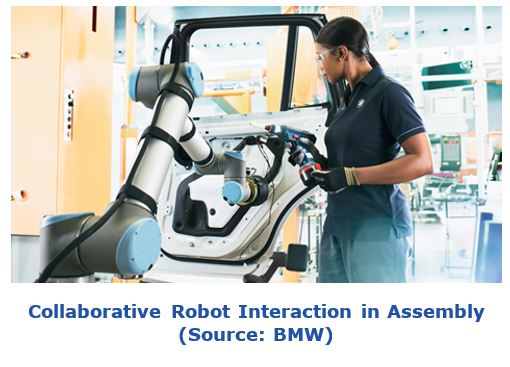 Robots will also become mobile and navigate on their own along the assembly lines or within manufacturing cells. New robots will be used where conventional robots had been prohibited in the past due to their size, immobility, and low-level protection mechanisms. These changes will open enormous potential for more efficient assembly, although this will require absolutely reliable safety mechanisms.
Robots are getting smarter due to astonishing improvements in robot programming, which goes hand in hand with smarter sensors and devices integrated into the new generation of robots. Due to the new materials being used in automobiles, robots will be able to take over new tasks, such as gluing composites (as opposed to having to weld steel or aluminum).
According to the International Federation of Robotics, by 2018, the number of industrial robots sold in the US is likely to increase on average by at least 5 percent per year, bringing the total to 31,000 units. At least half of these robots will be installed by automakers and their suppliers. Currently, the US automotive industry ranks third when it comes to robotic density (the number of industrial robots per 10,000 employees), after number two Japan and number one Germany.
Since 2013, for example, BMW has been using sensitive robots in its Spartanburg plant in the US. Here sensitive robots are working side-by-side with human workers to assemble car doors.
The use of additive manufacturing in automotive is evolving from producing relatively simple concept models for fit and finish checks and design verification, to producing functional parts used in test vehicles, engines, and platforms. This represents a shift in adoption towards higher-value applications and represents a step towards acceptance of additive manufacturing for producing automobiles for end customers.
Today, most additive manufacturing technologies involve significantly longer processing times compared to traditional technologies (metal stamping, plastic injection molding). However, additive manufacturing has an advantage over subtractive manufacturing (milling, lathing, laser cutting) when it comes to producing low-volume parts or those with elaborate geometries and complex internal structures, or for one-off manufacturing projects.
While traditional manufacturing methods require expensive tooling, additive manufacturing does not; making it relatively cost-effective at low volumes and allowing manufacturers to begin production sooner. Finally, there’s less material waste because the process is additive, rather than subtractive. New materials, innovative finishes and shorter lead time allow 3D printing to be integrated more closely into the manufacturing process. However, more standardization is needed, especially for 3D printing formats.
At a recent ARC Industry Forum, we learned that Local Motors, a particularly innovative, if small-scale, automotive company uses 3D printing to produce a drivable plastic car (less the powertrain) in around 44 hours. In addition, some large car companies already use 3D printed parts to increase the strength and safety of their products, 3D-printed components can also make them lighter and stronger. It will also make them cleaner and even more fuel-efficient.
For mass-customized production in automotive to succeed, cycle times must decrease and the surface problematics of those parts solved. As additive manufacturing continues to mature, it will play an increasing role in future production concepts. This will improve the efficiency of production, reduce the number of factory workers required, and lessen the waste produced by the industry.
All automotive manufacturing companies increasingly rely on software to automate processes, manage supply chains, and facilitate research and development. As a result, the threat of cybercrime within the industry has risen significantly. All stakeholders should be vigilant in implementing cybersecurity measures to ensure their businesses remain efficient and innovative.
Targeting the supply chain has become increasingly attractive to cyber-criminals. Attacks against automotive manufacturing companies tend to be specifically targeted and planned with the intent to steal intellectual property (designs and customer lists), or interrupting operations. Even small- and medium-sized manufacturing businesses should not assume that their size precludes them from threats and avoid being lulled into a false sense of security when it comes to cybersecurity. Mastering IT security issues provides a foundation for successful implementation of the digital enterprise and Industrie 4.0.
Operational safety is another critical issue for the automotive industry. While the IEC 61508 standard provides guidelines for electrical and electronically programmable, safety-critical systems, it does not cover a self-organizing or self-learning system, such as cyber-physical production systems. In the automotive industry, ISO-Norm 26262 provides appropriate guidance for implementing fault-tolerant mechanisms and fault-detection to help ensure functional safety in electrical and electronic systems. However, it is much more challenging to prove compliance with emerging systems than for traditional monolithic systems.
Given the increasing pace of change and increasing complexity in today’s global automotive industry; to stay competitive, automotive companies must move fast to explore, adapt, and implement new technologies and approaches into their products and production.
Small, innovative, and flexible automotive manufacturers that are using the latest technologies like additive manufacturing in small, modularized production sites, are already building completely customized cars in relatively short timelines. While these companies still represent a niche in automotive production, they clearly represent a disruption that the large auto companies cannot ignore. (Already, we’re seeing newer, innovative automotive companies like Tesla surpass the market value of some of the traditional industry giants).
Digitalization is the main driver for changes in automotive production. By incorporating many of the latest technologies and manufacturing methods (advanced analytics, cloud technologies, additive manufacturing, etc.) and collaborating closely with giants in the digital world, today’s automotive industry serves as a role model for other industries that face similar challenges.
If you would like to speak with the author, please Contact Us