Representative End User Clients







Representative Automation Clients







Representative Software Clients








Keywords: Digitalization, Industrial IoT, Data Platforms, Industrial Data Fabrics, FactoryNext, L&T Technology Services (LTTS), Overall Equipment Effectiveness (OEE)
Just about every manufacturing company is embracing digitalization today. The benefits are substantial, but many end users struggle with how to successfully implement digitalization programs. Digital transformation isn’t a product that can be bought and installed, it’s a systemic and pervasive transformation of an entire manufacturing enterprise through the implementation of several different pieces of technology that require planning, use cases, development of the right KPIs, and it requires expertise to tie it all together to realize true success from a lifecycle perspective. A large part of any digitalization program is dealing with the data, which requires implementation of industrial data fabrics and industrial IoT data platforms.
Hyperscalers, automation suppliers, and software providers offer a wide range of useful technologies, applications, and even services to assist end users on their digital transformation journey, but in many cases end users need a more consultative approach to make digital transformation work. That requires considerable engineering and application expertise in addition to a vendor agnostic approach to software that allows the service provider to tie together a complete digital transformation solution with applications and components from multiple vendors, both new and existing.
L&T Technology Services (LTTS) represents a new generation of service providers that combine its deep engineering expertise with increasingly sophisticated software capabilities to provide a vendor neutral framework to help end users realize success. LTTS is combining its expertise in advanced software, AI, and technology with its services expertise and partner ecosystem to create successful digital transformation programs for manufacturing end users. As part of this effort, LTTS has launched the FactoryNext that combines LTTS’ engineering and software expertise, enabling end users to make informed decisions.
The basic idea underlying industrial digital transformation is to use data and technology to increase flexibility in production processes, enhance the organization’s ability to address customer needs, and improve competitive positioning. Industrial companies still need to modernize their operating practices and technologies to compete successfully in today’s more dynamic and continuously evolving marketplace. Some companies are already succeeding in their transformation.
“Digital Transformation” is a huge umbrella that encompasses people, processes, and technologies, and it requires a systematic lifecycle approach to make it successful. With the inherent but not always obvious difficulties encountered in implementing digital transformation, the confusing messaging from suppliers and the media, and the often-misguided expectations associated with digital transformation initiatives, it’s no surprise that many companies may have trouble launching initiatives or sustaining ones they may have already started.
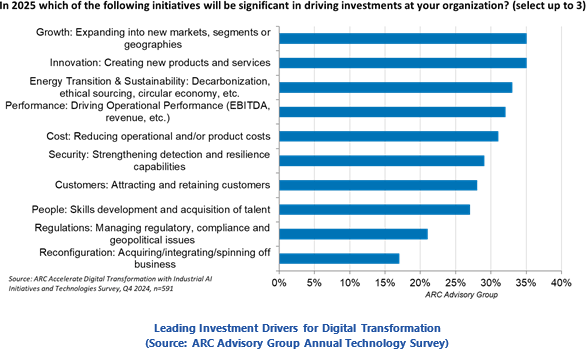
End users invest in digital transformation programs for different reasons and with different goals in mind. Industrial companies are under pressure to achieve high levels of performance and to compete effectively in the marketplace. This translates to goals such as increasing revenue, decreasing energy use and carbon footprint, or decreasing time to market. To meet these goals, digitalization and technology modernization programs are often necessary. The challenge for companies is to keep the business goals in mind, and not let obstacles encountered on the digital transformation journey derail the needed progress towards the goals.
As part of the large Indian engineering and technology firm Larsen & Toubro, L&T Technology Services (LTTS) specializes in providing engineering and software solutions to a wide range of industries around the world. LTTS consultancy, design, development and testing services across the product and process development lifecycle cater to all major industries including transportation, industrial products, telecom & hi-tech, medical devices, and the process industries. LTTS specializes in an array of advanced technologies, including 5G, industrial AI, collaborative robots, digital factories, and autonomous vehicles.
LTTS provides engineering services across the entire “design to shop floor” value chain, such as product conceptualization, design & development, testing, value analysis & value engineering, product maintenance, manufacturing support, aftermarket support, and plant engineering services. As an engineering service provider with experience in designing many of the processes, plants, and systems in the world of manufacturing, they bring this expertise to their software and solution capabilities.
As part of its software expertise, LTTS has developed FactoryNext, a framework that is designed to work with best-in-class technologies from major providers to create a fully orchestrated digital transformation solution. LTTS FactoryNext is an end-to-end framework that spans the entire manufacturing value chain. FactoryNext provides a path to digitalization by enabling users to connect, automate, manage, optimize and ensure safe and secure operations. FactoryNext includes connectivity technologies, advanced data engineering, integration of best-of-breed solutions, a unified visualization environment, and security, enabling real time data-driven decisions across operations.
At the heart of FactoryNext there are four key pillars. Factory Connect ensures seamless connectivity and data engineering across the entire operations. It includes machine connectivity and a data nucleus for data ingestion, validation, transformation and storage, ensuring that data is clean and ready for sharper insights and smarter decisions. FactoryConnect also includes networking capabilities for private 5G, LTE, Wi-Fi 6, and more to ensure high speed secure data exchange across all levels, including edge, IIoT data platforms, and the cloud.

FactoryManage facilitates autonomous factory operations in the areas of production, quality, maintenance, and energy. FactoryManage includes a lot of LTTS AI software expertise, including virtual manufacturing assistants, AI-based computer vision applications, maintenance assistance, AI driven energy optimization, and a Predictive Quality Manager application. FactoryManage can also encompass digital twins from products to plant level twins.
FactoryVU is a unified environment for visualization and real time monitoring. FactoryVU acts as a remote command and control center, handling functions such as operations management, IT/OT infrastructure and asset monitoring, SOC functions, and serves as the operations data lakehouse.
FactorySecure safeguards operations with an IT and OT security framework. A secured OT network. Firewalls, diodes, secure edges and advanced threat and vulnerability management options. FactoryNext leverages AI powered manufacturing solutions outcome-based digitalization or innovations like robotics, guided drones, and smart edge to enhance KPIs in safety, sustainability, quality, delivery, and cost while connecting and optimizing the entire value chain for sustainable real time safe and autonomous operations. LTTS FactoryNext helps end users leverage existing IT and OT investments and expand their digital footprint.
While LTTS does offer its own software and applications, much of the technology that goes into FactoryNext implementations comes from LTTS’ large network of technology partners. LTTS’ partner network includes hyperscalers like Microsoft and Google as well as IoT platform providers like PTC/ThingWorx and ignition. Major automation suppliers like Rockwell Automation and Siemens are partners, as are leading OT cybersecurity providers like Palo Alto Networks.
LTTS has FactoryNext labs in India as well as the US. These labs help LTTS to simulate use cases right from the sensors to the drives, servo drives, IoT gateways, hardware gateways, software gateways, PLC controllers, and other devices from all the major suppliers incorporating all major communication protocols. LTTS labs make it easier to demonstrate proof-of-concept and standardize things before users deploy to actual sites. The lab also includes various historians, databases, and cloud infrastructure from hyperscaler partners such as Microsoft Azure and Google. The lab incorporates security such as firewalls and secure remote access capabilities from security partners like Palo Alto Networks. The lab provides the infrastructure to test and validate solutions. Bench testing support is also provided there because they can integrate with the actual hardware available in the lab.
LTTS deployed FactoryNext at a major global CPG manufacturer who wanted to improve overall equipment effectiveness (OEE). Micro stops in the manufacturing process were reducing OEE. LTTS worked with the end users to find root causes of major downtime in the production line. LTTS developed a line stoppage data document to track individual machines and overall line downtime. LTTS also made modifications in the line & machine PLC logic, observed the line throughput, and implemented improvements in alarm management and notification.

LTTS developed OEE dashboards and reports for senior management. By working with the customer, LTTS was able to determine the top 5 factors impacting OEE and was able to roll this out on hundreds of machines with PLCs from a wide range of suppliers. All of this resulted in an improvement of over 5 percent in asset utilization and OEE, 95 percent accurate in identifying bottlenecks of the production line, and simplified fault tracking.
Successful digital transformation programs should support the organization's overarching goals and metrics, including financial measures such as growth, return on investment, margin, and cash flow, as well as environmental, social, and governance goals like reductions in energy usage, waste, water consumption, and emissions. LTTS aims to achieve this with FactoryNext by addressing business issues first and leveraging its deep knowledge of manufacturing processes. With thousands of consulting projects, plant design, system design, and implementation experience, LTTS has the engineering expertise required to implement successful digital transformation projects.