Representative End User Clients







Representative Automation Clients







Representative Software Clients








Artificial intelligence (AI) in manufacturing is moving from the conceptual phase to real life applications. In a recent ARC survey, 55 percent of respondents believe AI will fundamentally disrupt the way we manufacture, while another 40 percent think that it will change production in one way or another. Past technologies have taught us to focus on lifecycle  costs rather than on the upfront investment. To improve the bottom line without disrupting manufacturing operations, lifecycle costs need to be taken into account from the beginning.
Is AI the silver bullet that will put manufacturers back on the path to productivity gains? In this ARC View, we share ARC observations of the market for AI in manufacturing and look at the Siemens service offering for AI with a focus on implementation and lifecycle costs.
When AI first appeared on the industrial scene, it promised to provide the next jump in productivity. ARC’s Capex Index has tracked productivity in terms of revenue/assets for many years, and the past eight years this index has shown a gradual but steady decline (see chart). We appear to have reached a point similar to the late 1980s when the economist Robert Solow observed: “You can see the computer age everywhere but in the productivity statistics.”
Digitalization experienced a boost during the corona crisis. Many companies invested in their IT infrastructures to 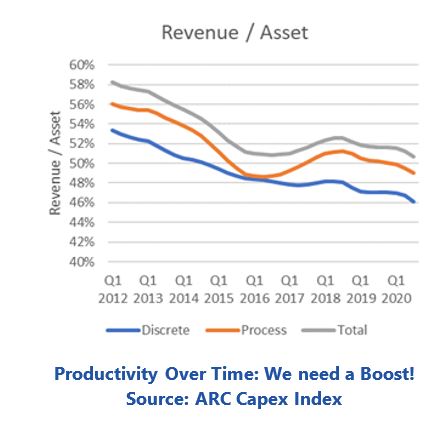 enable or improve workers’ remote access to sensitive company information. The result was that both machine-to-machine and northbound connectivity to the IT layer were greatly improved, which helped to nudge some companies further along their paths of digital transformation. For applications like AI-driven predictive maintenance, these infrastructure improvements also helped to lower implementation costs.
While industrial production plummeted during the crisis, there was an upside: plant engineers had time to innovate as resources were available to re-think production rather than focusing on daily operations. Some manufacturers took the opportunity to implement new technologies such as analytics and AI.
Economic stress is often a trigger for innovation as companies search new ways of doing business or producing. In a recent ARC survey, a large share of respondents reported that stress does indeed drive innovation (see chart).
Artificial intelligence in manufacturing is no longer new and the industry has moved beyond the hype stage to 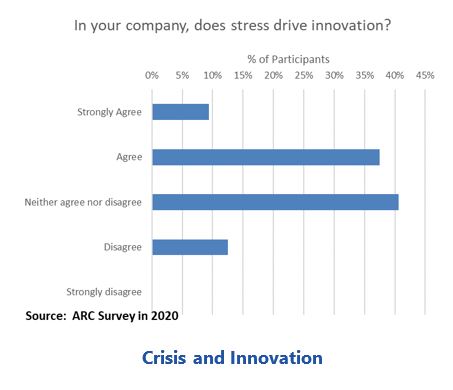 implementation. Acceptance of AI is growing and, according to ARC data, users and machine builders are working to implement AI on a broad scale. However, most are having difficulty scaling up a model to a large number of machines and applications. Others are struggling to move their proof-of-concept models from the laboratory to the plant floor. Experience shows that there are three crucial steps in new technology adoption: proof-of-concept, (industrial) implementation, and lifecycle management.
Siemens began to explore the potential of AI in manufacturing early, often together with clients on projects. In 2018, Siemens introduced an AI module for its SIMATIC S7-1500 platform, a first step in productizing AI technology. The company has a team that develops AI applications for manufacturing, offering support for AI over the entire lifecycle, from proof-of-concept to deployment.

Establishing proof-of-concept (PoC) in AI is the key challenge. Large IT vendors, automation suppliers, and countless (AI) specialists have developed and implemented models in prototype to prove the feasibility of AI for specific applications. Proof-of-concept challenges include:
In industrial use-cases, PoC should link with a clearly defined use case and non-technical expectations, such as reducing unplanned downtime, increasing quality, or support with programming.
ARC’s research in AI from 2020 shows that unclear use cases have been a significant hurdle. In various interviews in parallel to the survey, many experts mentioned the human factors as another key roadblock. As companies begin to 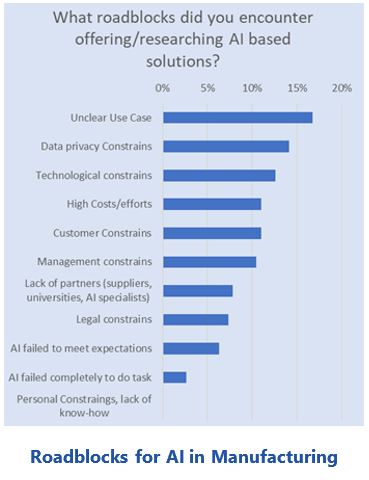 implement AI in applications, the nature of challenges will shift. Implementation not only has technical issues, but also privacy concerns and cultural challenges that require data scientists and plant floor engineers to work together. These factors can significantly increase costs. Implementation of AI for many users is a first-time experience, so the collaboration with an experienced partner can lower implementation costs significantly.
To overcome the technical hurdles, Siemens focuses on a micro services-based architecture. A micro service is a short piece of code that performs one dedicated task very well. These tasks may include data cleansing, smoothing, connecting to a device, or possibly AI tasks such as a neural network for anomaly detection. Micro services are endemic to the edge runtime as well as to the cloud and allow a fast implementation and scalability of AI solutions. As micro services are shared and connectivity is established, the architecture allows AI to run on edge devices, while leveraging the cloud for processing power and a data lake.
This standardized “backbone” of edge runtime, (Mindsphere) cloud and micro services helps to lower technical challenges when implementing. An engineer can focus on a specific problem, while the underlying architecture helps reduce programming complexity. For example, setting up a secure connection or performing a fast fourier transformation can be accomplished with almost no coding.
In industrial environments, errors can quickly become dangerous and costly, so testing and monitoring are crucial starting from implementation. Siemens takes this aspect into account from the beginning, thanks to the company’s vast amount of industrial experience.

During implementation, there is always the inherent threat of a culture clash when IT meets OT. AI typically resides in the IT space and is right at the forefront in IT/ OT integration. Clashes may include distrust on both sides, often fueled by little understanding of the other side’s needs. In particular, shop floor automation is influenced by AI, so OT has to accept that IT might influence its space. The fear of change, changing responsibilities between IT and OT, or job loss may even lead some to actively sabotage AI projects. Here, AI models need to be robust against outside changes to cultivate trust in the technology.
From an end user perspective, automation lifecycle costs typically amount to four to five times the initial investment. These costs include in-house or outsourced maintenance and software updates, and AI is no exception. In Model 1 in the graphic below, the predictive power of an AI model appears to increase over time, but in reality, this is usually not the case. Data cluttering and changes in incoming data, input material and environmental factors, can slowly deteriorate the predictive power (Model 2). A sudden change in production can drastically reduce the model’s predictive power (Model 3). While some of these changes are obvious, such as product changeovers, others may go unnoticed, such as variations in quality of raw material, environmental changes (humidity, temperature), or change in operators. These changes are often hidden from explicit knowledge, either because they are not represented in connected IT systems or because they were not recognized at all.
Once it is up and running, an AI model needs continuous monitoring and maintenance, just like any other equipment. To enable an efficient lifecycle model, this should be considered right from the beginning.

In ARC’s view, users should consider model performance management right from the start to quickly adopt and redeploy any model exposed to gradual or structural changes. As this is often new terrain, an “as-a-service” model may be the right choice to avoid problems down the road. Of course, these models need to consider the plant lifecycle and any supplier needs to be able to support this over the long run.
Siemens approaches this by integrating AI monitoring components into the productive workflow and micro-service architecture. Features include:
Testing is a key application for AI in manufacturing, accounting for about 20 percent of all current AI applications on the plant floor, according to ARC research. Early adopters include innovative semiconductor and electronics companies that apply AI to production technologies.
Siemens applied the concept described above (micro-service based, lifecycle model for AI) to the quality inspection of printed circuit boards (PCB) in one of its manufacturing plants. The goal was to move from a reactive, time-consuming procedure that depended on workers’ experience, to a proactive, automated model that uses data from a data lake. The result was not only lower production costs, but also a future-proof application that is independent of individual workers’ experience.

In this application, contaminated test points caused the false-positive failure to increase, resulting in unnecessary scrapping of good PCBs. According to the company, the project used Mendix and Siemens Edge Platform. As a direct result, the pseudo-failure rate dropped by 60 percent and overall annual savings are estimated to reach a 6-digit figure.
Artificial intelligence can offer many benefits when applied to manufacturing applications. At the same time, it can also generate high costs over the lifecycle of equipment, so AI projects should consider lifecycle costs from the beginning. While the proof-of-concept is still a key focus for many end users, make-or-break problems often appear later in the lifecycle, during integration or when servicing installed equipment.
During these challenging phases, it helps to have an experienced industrial expert nearby, such as Siemens, that considers not only the lifecycle costs, but also helps to move quickly from proof-of-concept to real-life benefits. The smoother the adoption, the easier non-technical challenges can be solved.
ARC Advisory Group clients can view the complete report at ARC Client Portal
If you would like to buy this report or obtain information about how to become a client, please Contact Us
Keywords: IIoT, Artificial Intelligence, Siemens, ARC Advisory Group.