Representative End User Clients







Representative Automation Clients







Representative Software Clients









Industrie 4.0, intelligent factories, the Industrial Internet of Things (IIoT) – this is the future of industrial manufacturing. Making production facilities and intralogistics more flexible, autonomous, and efficient requires appropriate communication networks and comprehensive connectivity. The new 5G mobile network communication standard is opening up new prospects in this area. One of the benefits of 5G is the significantly greater bandwidth that allows much more data to be transmitted much faster than previously. Estimates start at ten gigabits per second, which is about 10 times more than with 4G. In addition, 5G will have a substantially lower latency and greater reliability than current mobile network technologies.
The last few years were pivotal years for 5G as mobile network operators (MNO)/communication service providers (CSPs), network infrastructure vendors, software vendors, system integrators, and industrial enterprises began to stake their claim in the technology. Industrial companies that deployed private LTE and/or non-standalone (NSA) 5G networks for test cases or trail purposes have already started to realize the benefits of 5G.
Network operators are increasingly seeking ways to grow revenue and cut costs in a low-growth environment, which is made more complicated by the demanding requirements of 5G services, including high speed, low latency, and reliability. Network operators therefore need to evolve their networks offerings with new automation and technologies, such as virtual radio access network (RAN), edge networking, and network automation, to meet the demands of the 5G era. Also, some global network operators have started diversifying their revenue streams by tapping new business models, such as service offerings related to pay TV, media, entertainment, advertising, consumer, manufacturing, and Industrial Internet of Things (IIoT), to seek growth beyond core telecoms services.
5G technology is still evolving with each new specification release. As more tangible use cases are deployed, more users will appreciate the benefits of 5G. Awareness and knowledge of 5G are gaining momentum in the global market. However, there is wide variation across the globe in terms of intentions to upgrade to 5G and the willingness to pay more for it.
Operators and industrial enterprises require access to sufficient radio spectrum in suitable frequencies, in the sub-1 GHz frequency bands and 5G mid and high or millimeter wave (mmWave) bands. Spectrums for private use by enterprise companies are auctioned in some countries, such as China, France, Germany, Japan, and the US. The evolving global ecosystem includes network operators, infrastructure vendors, operation technology (OT) companies, semiconductor manufacturers, software vendors, cloud providers, system integrators, technology associations, and industrial user companies. In general, the ecosystem aims to develop associated standards, technology architectures, equipment, chipsets, end-devices, software, and services that take advantage of 5G technology.
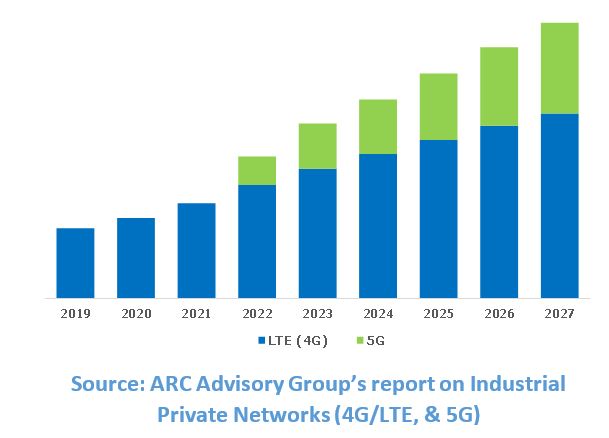
According to ARC Advisory Group’s recently published report Industrial Private Networks (4G/LTE, & 5G), the deployment of private mobile networks has witnessed double-digit growth and has become an important market. Many enterprise users have deployed private LTE networks and laid road maps for adapting 5G standalone (SA) networks. We believe that this growth trend will continue for at least the next 5 years.
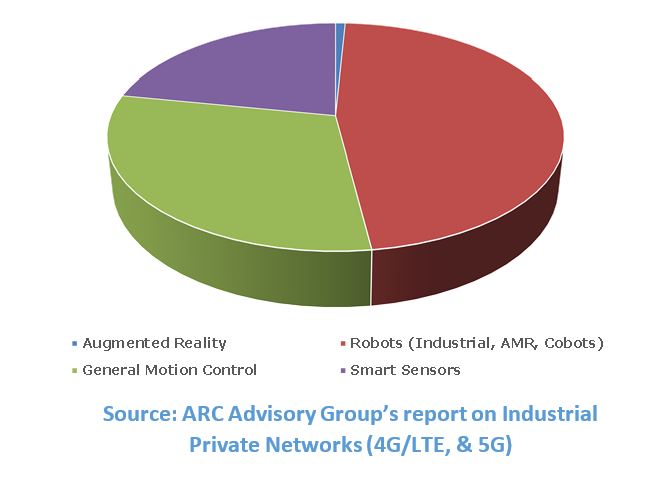
Looking at process and discrete manufacturing side, the demand for private LTE and/or 5G networks will be driven by the need for data and speed for connecting equipment, assets, systems, and production operations to perform analytics and transform manufacturing/production processes and increase efficiency. Critical applications that will drive demand for private networks include remote operations and monitoring of process control and SCADA systems and assets; end-point metering in gas, electricity, and water industries; asset or equipment tracking in mining applications; mobile robots and automated guided vehicles (AGV) employed on manufacturing shop floors; augmented reality; remote access; maintenance; and such other applications that enable mobile and remote workforces.
For the European Industry Forum on May 18-19, we have added a whole session on 5G private networks in industry. Join us at ARC’s European annual Industry Forum to learn more about how transforming factories, cities, and infrastructure will benefit technology end users and suppliers alike. Discover what your peers and industry leaders are doing today and what steps they are taking to prepare for the future.