Representative End User Clients







Representative Automation Clients







Representative Software Clients








Keywords: Predictive Maintennace (PdM), LTTS, First Principles Models, Database Models, Industrial AI, Asset Health, Condition Monitoring, Vibration Monitoring, Unplanned Downtime
For the industrial manufacturers, unplanned downtime continues to be a major concern. ARC estimates that unplanned downtime costs the industrial and manufacturing sector over a trillion dollars a year in lost revenue. Early detection of potential asset failures can be extremely helpful to organizations trying to minimize unplanned downtime. Most failures occur because of some fault in the equipment or the process. Accurately predicting when an asset will fail, or when it does not need maintenance at all, can eliminate the cost of unplanned downtime while also reducing operational costs significantly.
Predictive maintenance (PdM) employs advanced modeling and machine learning (ML) technologies to analyze hundreds of process parameters over time and compares these to historical asset data. This helps manufacturers estimate wear and degradation of assets or its parts and forecast asset failure in advance. This helps improve lead times, providing operators with better information sooner so that they have more time to address the issues to avoid imminent asset failures.
While manufacturers understand the benefits of PdM, not all manufacturers are able to reap its benefits. Successful implementation of PdM programs remains a major challenge. For a successful PdM program, it is imperative that the ML algorithms are trained on clean data, the right amount of data, and the right type of data.
The industrial sector has significantly advanced in terms of maintenance strategies in just the past few years. Reactive maintenance, which entails repairing equipment only when it fails, remains a viable strategy only for non-critical assets. Several strategies are available now where the use of various data sources, AI and analytics combine to offer recommended actions to users. Asset performance management (APM) helps asset-intensive enterprises extract the most value from their asset investments, and the rapid incorporation of new digital technologies such as AI, cloud computing, edge computing, and digital twins have further increased the value proposition of APM.

PdM exists under the discipline of APM and is focused on predictive outcomes to determine when assets will fail and when they might require attention based on previous patterns of data related to the asset, its components, and the process the asset is helping to control. While many suppliers have pushed PdM solutions for the past couple of decades, it is really the rapidly advancing science of Industrial AI that has accelerated adoption of PdM in the past couple of years.
While modern technologies have pushed predictive maintenance forward, it has also resulted in increasing project complexity and end users often find it challenging to keep PdM projects going successfully. With the wide variety of products, technologies, and projects to choose from, end users are trying to better link their APM initiatives with business goals such as higher profitability and better margins. End users must be able to tie quantifiable ROI to each APM initiative to deliver projects that result in higher ROI.
Most end users are looking for an APM strategy based on the criticality of the assets. Determining the criticality level of assets is not a simple task. Furthermore, planners need to consider additional factors, such as age of the asset, availability of resources, and budget information, when deciding on the maintenance strategy, making such decisions more complicated than ever before.
A subsidiary of one of India’s largest engineering conglomerates Larsen & Toubro, Larsen & Toubro Technology Services (LTTS) provides engineering services across the entire “Design to Shop Floor” value chain, such as product conceptualization, design & development, testing, value analysis & value engineering, product maintenance, manufacturing support, aftermarket support, and plant engineering services. LTTS has been addressing asset reliability challenges for customers in various domains and industry segments for many years. This includes plant engineering, process engineering, discrete automotive manufacturing, and industrial product manufacturing. Many of the team members and experts at LTTS have operational knowledge from fieldwork and understand the associated challenges. Other affiliates within the L&T group have also accumulated experience and domain knowledge regarding the production of industrial products and machine behavior.
Many LTTS customers raise numerous concerns about asset failures and unplanned downtime despite having preventive maintenance programs and schedule-driven maintenance plans in place. Customers report frequent unplanned shutdowns and difficulties assigning maintenance teams swiftly to specific work orders, especially when such tasks are critical. Since 2016, LTTS has worked on developing AI-driven maintenance solutions, including predictive maintenance and condition-based maintenance. LTTS combines its capabilities in software and services to offer end-to-end PdM solutions that integrate sensors, machine learning models, and visualization tools for manufacturing customers, from site assessment to post-deployment support.
LTTS can select sensor OEMs for several types of requirements. The company can choose hosting technology from different vendors and solution providers and apply their own machine learning model and visualization on top of those. Because LTTS is vendor agnostic, they can develop those same visualizations on existing IIoT platforms as well, such as PTC ThingWorx or Ignition. Even if the customer does not have an existing platform, they may not need it. LTTS can develop it. LTTS can deliver it as a complete package in an on-premises environment or in the cloud.
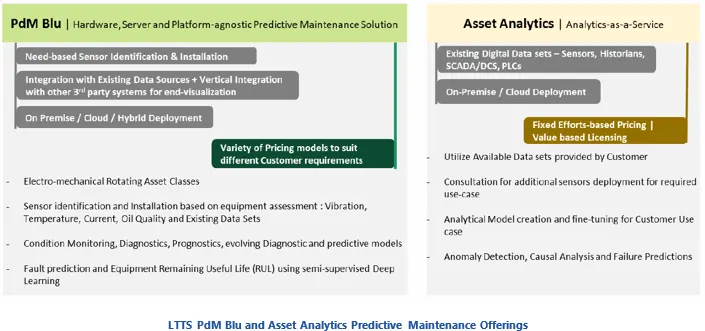
LTTS has two primary offerings for PdM. PdM Blu is an end-to-end solution for predictive maintenance that combines sensors, machine learning and visualization. Asset Analytics is an analytics-as-a-service offering that targets predictive maintenance. Both offerings incorporate third-party sensing technologies in conjunction with LTTS software and services expertise for a wide range of industries from discrete and hybrid manufacturing to continuous processes.
LTTS’ PdM Blu solution is an end-to-end predictive maintenance system combining sensors, machine learning models, and visualization. PdM Blu features hybrid models using first principles and data-based approaches. Unlike some other PdM solutions, PdM Blu has reduced reliance on failure history and can provide results quickly without the need for enormous amounts of historical data, with typical models requiring a 3-4 weeks of learning period on continuous field operational behavior of an asset. Using this approach, LTTS claims 95 percent accuracy in fault detection after the model has been fine-tuned on field data.
PdM Blu is both hardware and software agnostic, capable of working with a wide range of sensors, gateways, components, and asset performance management (APM) software. PdM Blu is available both as a subscription model as well as a Perpetual model and further LTTS has flexible pricing plans for users looking to pay for PdM solutions from the OPEX budget versus the CAPEX budget. The LTTS team also has domain understanding of asset behavior, which is enhanced through customer interactions and consultations. They conduct site assessments, understand the processes, and formulate questions regarding parameter changes observed during specific failures.
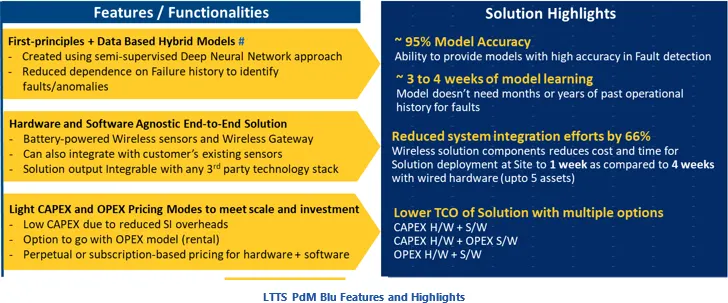
PdM Blu provides comprehensive predictive maintenance without requiring user development. LTTS uses patented prediction modeling technology based on open-source technologies. For asset analytics, they utilize off-the-shelf platforms, Power BI, or other data science tools to create, access, analyze, and build models.
With PdM Blu, LTTS can help end users develop and implement reliability and maintenance KPIs and assist users in understanding insights from machine learning models, including remaining useful life, asset health index scores, failure alerts, and anomalies. LTTS can also provide root cause analysis services to determine why failures occur in the first place. LTTS can also extend condition monitoring support framework for continuous monitoring and reporting services through its partner ecosystem where it is required.
LTTS Asset Analytics is an AI-driven failure prediction and analytics-as-a-service for real-time monitoring and insights. The offering is licensable machine learning models tuned for specific end user assets. LTTS is capable of calculating the remaining useful life in weeks or days, as well as providing an asset and plant health score. This score includes a health zone classification indicating whether an asset is in normal working condition, unsatisfactory condition, or critical condition where failure is imminent. These classifications, following ISO standards, enable the maintenance team to concentrate their efforts on assets with critical or crucial health conditions.

LTTS realizes, however, that ML models developed for assets evaluated in the lab may not perform immediately with the same efficiency when deployed for assets operating in the field due to different operational usage history and remaining life. The base asset model must therefore be benchmarked with field operating conditions, as certain faults might not be detectable because of varying usage across production systems, industry segments and customers. In the field, LTTS fine-tunes the models to make them understand what the base good operating signature is versus a failure signature. Once the model is trained and deployed, it will continue to ingest the real-time data and then start giving near real-time alerts.
PdM Blu incorporates a combination of both first principle and data modeling approaches, which LTTS refers to as hybrid modeling. This approach is patented by LTTS, with multiple patents both in granted and pending status. It is a good example of how LTTS can combine its expertise in both engineering services and deep software expertise to create a unique solution that directly addresses end user maintenance challenges.
LTTS understands that assets contain critical components, such as induction motors, gearboxes, bearings, and more. Multiple businesses within the larger L&T corporate universe are already involved with customers where they assist with things like product design, including the design of gearing and motor components. LTTS’ deep engineering expertise also means that the company understands physics-based first principles required to develop good first principles-based models.
LTTS starts with a highly lab trained model for an asset and then provides the model with real world data. There are two ways that LTTS generates datasets in their lab. First LTTS has certain physical components and assets running continuously in the lab. These physical assets are sensorized to collect current, vibration and surface temperature parameters. LTTS also introduces certain failures or faults into those components to train the model, which is then able to identify certain common mechanical or electrical failures in the component itself. Those failure signatures are identified and stored in the PdM Blu library so the model can identify certain failures right out of the box.
A major US bottling company deployed PdM Blu for 14 assets, about 200+ sensors were identified by the LTTS team and recommended to be retrofitted. The solution included continuous monitoring of 100+ components of the assets. During the first eight months of deployment, LTTS was able to confirm to the customer that potentially 17+ hours of unplanned downtime was prevented because of the insights and the updates that the LTTS model provided to the operating team. This was approximately equal to $300K of savings.
A global electrical OEM major in Japan who is also a major pump manufacturer partnered with LTTS to provide predictive maintenance and analytics solutions for a large pump installation at a Japanese municipal wastewater treatment plant. In this case, LTTS offered subscription-based pricing and cloud-based hosting. LTTS monitored the entire solution and the reporting and LTTS’ in-house experts provided notifications of impending faults and failures, as well as what actions to take to avoid them.
As asset management subject matter experts are becoming scarce, technologies such as PdM, that can replicate the intuitive maintenance approach of experts, are key to success with APM initiatives. Rapid advancements in industrial AI, including new modeling approaches, are making PdM solutions more effective and more accurate.
LTTS has taken a unique approach to modeling that incorporates both their software and engineering expertise and approaches like LTTS PdM Blu and Asset Analytics can help end users sustain APM and predictive maintenance programs that they have started, or they can be a great way to jumpstart a new asset management or PdM program. The hybrid modeling approach adopted by LTTS makes predictive maintenance more accessible to a wider range of customers from different industries and applications that may have previously found predictive maintenance strategies to be out of reach.
ARC Advisory Group clients can view the complete report at the ARC Client Portal.
Contact Us if you would like to speak with the author.
Obtain more ARC In-depth Research Market Analysis.