Representative End User Clients







Representative Automation Clients







Representative Software Clients









Digital transformation efforts across industry inherently involve escalating connectivity requirements. This is true not only in terms of an overall increase in the number of points connected, but also in the push to provide ultra-reliable wireless connectivity to remote, mobile, and previously orphaned installations that lack existing network infrastructure. Many customers are looking to 5G and private wireless technologies to serve these demanding applications, but the timelines associated with standards certification and product rollouts translate to continued need for multiple technologies to be deployed.
In a recent webinar on Making Sense of Wireless Options for Mobile Industrial Applications, the Director of Cisco’s Ultra-Reliable Wireless Backhaul (formerly Fluidmesh) business, Umberto Malesci, provided details of these escalating requirements as well as the challenges and opportunities posed by new wireless developments, such as 5G. Umberto started the discussion by pointing out that autonomous applications are already widely deployed across numerous industries. Examples include metro railways, where driverless systems have been the norm for the past two decades, as well as the extensive use of autonomous robots, machinery, and vehicles in the mining industry to improve safety and reduce personnel requirements. Autonomous cranes and robotic vehicles are also becoming the norm in the automation of shipping ports, where they are used to transfer containers from ship to shore. Dark amusement park rides, where visitors jump on an autonomous vehicle and strap on AR goggles or other immersive video technologies, were also cited.
Autonomous operations are of tremendous interest across industries due to the opportunity to lower cost, standardize operations, reduce personnel requirements, improve safety, and respond to the “new normal” for post-pandemic operations. This is particularly true in areas such as enabling video security, automated and autonomous vehicle control, live video and audio streaming, and providing robust wireless backhaul for user WiFi connectivity. Constant, ultra-reliable connectivity is a primary enabler driving these capabilities, one that maximizes throughput, minimizes latency, and enables continuous mobile roaming and seamless handover. Video provides a core visualization capability for autonomous solutions where no human observers are present, but also escalates bandwidth requirements.
The need for ultra-reliable mobile communication is no more apparent than in transportation infrastructure applications. Rail passengers, for example, expect seamless WiFi connectivity to be available from when they enter the station to when they board, travel from station to station, and disembark – regardless of how many different providers’ networks or enabling wireless technologies are required. This sentiment was echoed by Josh MacKinnon from global neutral host communications infrastructure provider BAI Communications, whose Station of the Future initiative focuses on communications infrastructure within transit stations.
Angelo Abagnale, Manager of Telecom Infrastructure and Services for Hitachi Rail, highlighted how the company is evaluating the potential adoption of public radio infrastructure as part of their Zero Infrastructure initiative, one of the company’s five innovation pillars. The realities of the application requirements, however, makes the company anticipate employing a hybrid infrastructure rather than one that relies fully on the public network. Potential use of this hybrid wireless infrastructure is one component of the company’s Future Rail Mobile Communications Systems (FRMCS) platform, which includes the potential use of 5G for train positioning.
The prospect of 5G’s ability to fulfill the requirements for ultra-reliable industrial wireless communications for remote, mobile, and “orphan” installations applications is enticing. The differing 5G profiles, including URLLC (Ultra Reliable Low Latency Communications) as well as those covering high bandwidth and massive device density, could each address specific requirements – such as the low-band profile at <1 GHz as a means of incorporating orphaned installations with no existing infrastructure. The Dynamic Spectrum Sharing (DSS) capabilities included in the 3GPP 5G specification, and currently employed in CBRS installations in the States, is likewise intriguing given that it maximizes the limited resource of spectrum availability, but adoption beyond the USA will be critical to establishing a broad supplier support base.
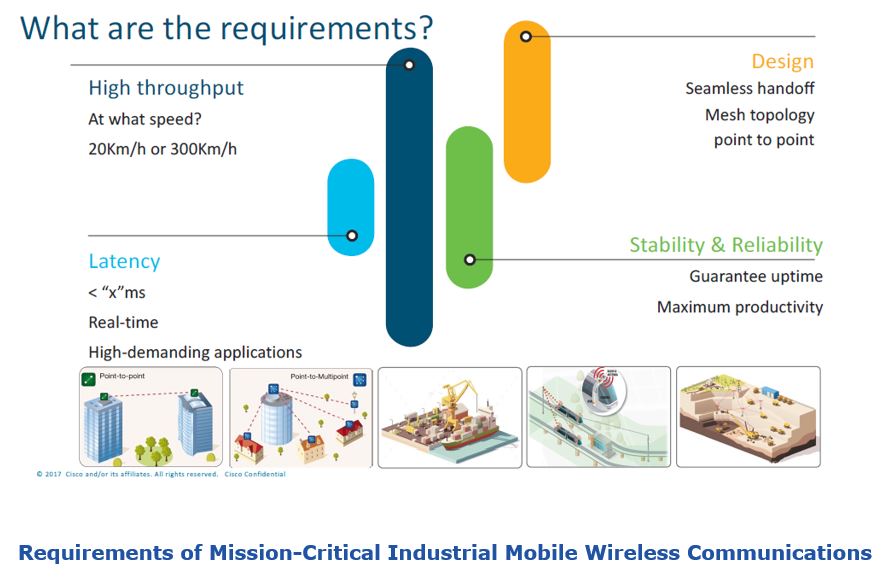
The reality for the near future, however, is that multiple wireless technologies will continue to be necessary to deliver ultra-reliable industrial wireless communications for mission critical installations. The timeline for 5G specification and adoption, including the incremental technology needed from future releases, as well as the timelines for component availability, device introduction, trials, and rollouts, are certainly important factors, as are the timeframes and business environments suitable for new installations and retrofits. The legacy telecom providers must likewise improve their operations expertise, adapt their business, service, and pricing models to the differing requirements of ultra-reliable installations, expand their geographic coverage, and collaborate on public-private hybrid infrastructure solutions.
In the meantime, transportation agencies and other customers will continue to deploy currently available technologies to meet the reliability, performance, certification, safety, and liability requirements of today’s mission critical industrial wireless applications. Examples range from unlicensed technology, like Cisco’s ultra-reliable wireless backhaul portfolio to private licensed LTE, WiFi, LPWAN, and satellite communications.