Representative End User Clients







Representative Automation Clients







Representative Software Clients








ARC Advisory Group’s recent India Forum in Bangalore included a number of interesting and insightful sessions about the latest trends in manufacturing across industries. Executives from leading end user organizations shared their  perspectives on the evolution of technology and key elements of digital transformation, such as data integration, data visualization, cybersecurity, and the Industrial Internet of Things (IIoT).
This ARC Insight covers noteworthy presentations from the power sector by M.K. Srivastava, GM (PE-C&I), NTPC; and Sanoj James, Head, Engineering, juwi Southeast Asia. The presentations highlighted the paradigm shift in technology and some of the advanced processes implemented in the power sector (electric and solar) to ensure quality and reliability of power; and the associated challenges and benefits.
Speaking about the technology upgrade programs, the speakers focused on the importance of digitalization via relevant case studies. These provided deeper insights into future trends. According to the speakers, the need to transition to new technologies has also accelerated the need to deploy smart, cyber-secure solutions.
NTPC, India's largest energy conglomerate, has established itself as a dominant power major with presence across the entire value chain of the power generation business. With a capacity of more than 57,000 MW (including installed capacity of 43,128 MW from 38 NTPC generating stations) the immense volume of information being transferred between departments poses challenges of its own. At ARC’s India Forum, Mr. Srivastava, GM (PE-C&I), NTPC, presented his views on the evolution of technologies and the key elements of digitalization, which he believes will be the next big thing. After providing a brief overview of NTPC’s history, vision, and goals, he addressed important topics such as the challenges of the digital transformation journey and how to overcome these to realize the digital enterprise.
Mr. Srivastava explained how the old structure/processes in the industry are now being replaced. He referred to NTPC’s current efforts to maximize power generation output through digitalization. He mentioned that the power sector had been impacted in all the industrial revolutions - mechanization and steam power, mass production, computer and automation – and now, cyber-physical systems and IIoT. He stated that the price of technology was insignificant compared to the benefits and, in this context, he spoke about collaboration in industry today and some of the challenges that still need to be overcome.
According to Mr. Srivastava, the key elements of digitalization are:
He explained the need to integrate data in power plants. For example, today’s vibration analysis systems can provide critical data about the health of rotating assets, but (as with any digital technology) only if the data is integrated, visualized, and analyzed appropriately.
NTPC has adopted many digital technologies. Examples include SAP dashboards; business intelligence (BI); analytics; APR (advanced pattern recognition); performance optimization; data visualization and analytics; digital twins; and NTPC’s own in-house-developed, AI-based NePPS (Netra e-Power Plant Solution) performance analysis diagnostic and optimization (PADO) software. NTPC has introduced many other advanced features including SAP-based fuel management. This works in a similar manner to online railway management solutions, which must respond rapidly in transactions. NTPC’s primary digital technology, “SMART CATCH” centralized fleet management, extends to more than 100 units. This data flows continuously, in real time, to a centralized location at the company’s M&D (monitoring & diagnostic) Center at Noida. NTPC developed a centralized data control room, called “Antariksh,” to manage the varied and vast fleet of power stations across the country. This helped NTPC improve operational flexibility to a significant degree.
Analytics will play a major role in the power sector, said Mr. Srivastava. He mentioned that data integration creates a lot of issues, like data synchronization and data duplication. Digital fragmentation and scalability are equally important  issues that must be addressed wisely. The culture and mindset of people needs to change as the technology evolves. Since data flows all around, addressing cybersecurity threats must be made a priority.
He also emphasized that the digitalization of the power sector value chain will be the key to improving efficiencies and that every enterprise should create a digital transformation roadmap using a phased approach. In conclusion, he said, “Digitalization is not an option now... It’s a necessity.” So, the sooner we adopt technology, the sooner we will yield better results.
Sanoj James, Head, Engineering, juwi Southeast Asia, presented his views on the changing trends in the industry and the technologies that he believes will be the next big thing.
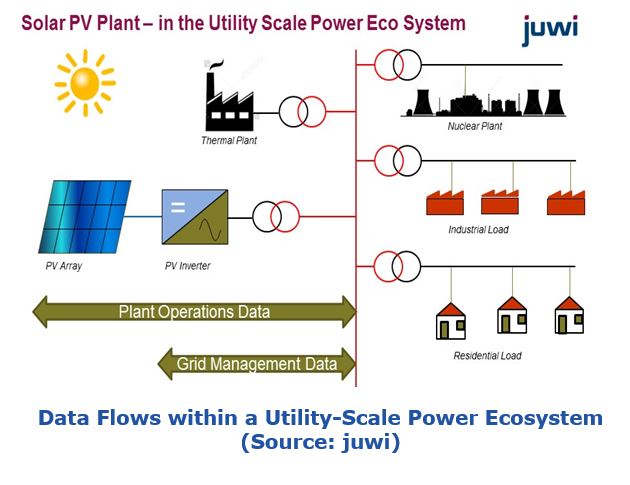
He explained that juwi (headquartered in Germany), one of the world’s leading renewable energy companies, has over 20 years of experience in this sector. juwi India has commissioned a variety of solar photovoltaic (PV) projects, including 182 MW of free field projects, 10 MW of carport projects, and 1,155 MW of roof-top projects, including a recently completed 300 MW project.
In addition to large utility-scale solar farms that are typically connected to electrical grids, he discussed two common methods of distributed solar PV deployment: the off-grid system, which is composed of PV, diesel, and storage; and the solar microgrid ecosystem, which may or may not include storage.
The off-grid system is used in large projects, using multiple configurations and maintained by technical staff with multiple skillsets. This requires acquiring project-specific data with adherence to local regulations and practices.
The solar microgrid is used mainly in island nations, such as the Philippines, Indonesia, and India’s Andaman and Nicobar islands. Here, the objective is to reduce dependence on diesel, which is costly, polluting, and difficult to transport. But when solar PV is integrated into the microgrid, it is necessary to balance diesel and solar power generation, which creates technical complexity. The microgrid can operate with or without storage of solar power; having reserve power seems the better option, but sometimes it is not economically viable.
For all solar PV plants, the solar input is not constant, making it challenging to predict the amount of energy that will be generated. For both these methods of PV deployment, different types of data analytics are required.
To help meet the diverse remote monitoring challenges of different types of solar PV installations, the company’s juwi Energy Evaluation Tool (jEET) has two deployment methods: central server and site-level architecture.
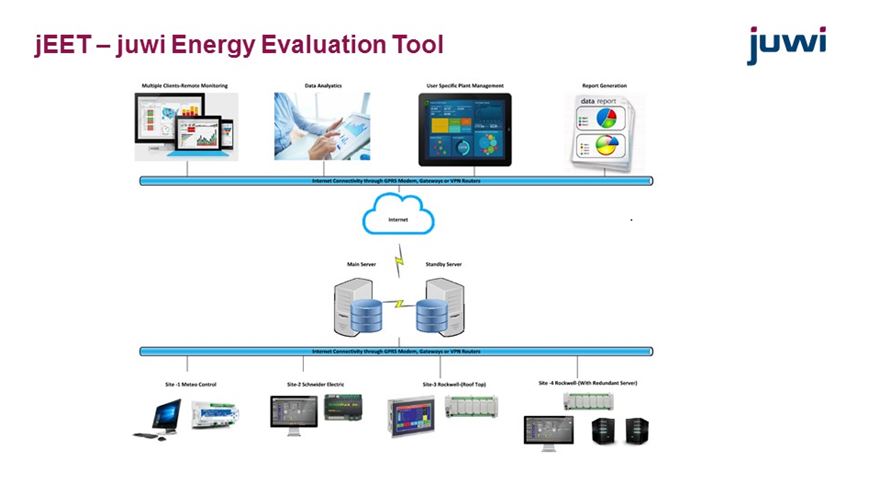
Central server is logged-in across all plant servers and shared remotely via cloud-based services to provide the company’s end user clients with access to the required data. With the site-level architecture deployment, the server is based at the site using a high level of hardware and software redundancy. Large volumes of data can be stored at the site level with a variety of data analysis options.
In one example, Mr. James explained that the SCADA system for a large solar farm spanned 220 acres of land with 2,000 solar modules (cells). These modules are dispersed across the facility in connected strings and must be maintained and checked periodically to know whether or not the modules are working. Measurements are collected to conduct a statistical analysis to see which modules and strings are performing well, and which are not - a perpetual challenge for solar PV farms.
Looking into the future, the company aims to find new solutions to help better predict, diagnose, and control solar PV performance.
Across the renewable energy industry, predicting generation output is becoming increasingly difficult due to the variability of the input sources. Using its algorithms, juwi can currently provide the utilities with 15-20 predictions for its solar PV plants.
The quality of diagnostic information has a lot to do with algorithms. The company is still fine-tuning its algorithms to be able to provide everyone with a better understanding of the needs of a PV plant.
Controls are needed to integrate solar PV generation into the larger grid; the grid is also changing a lot to accommodate renewables. As the percentage of renewable generation on the grid increases, controls will play an increasingly important role within the overall scheme.
These two sessions highlighted the importance of adopting new approaches and technologies to support digital transformation within the power industry. Key takeaways include:
If you would like to buy this report or obtain information about how to become a client, please Contact Us
Keywords: juwi, NTPC, Renewables, Solar, Power, Off-grid, Microgrid, SCADA, Digitalization, Cybersecurity, ARC India Forum, ARC Advisory Group.