Representative End User Clients







Representative Automation Clients







Representative Software Clients








Keywords: Sustainability, Energy Transition, Digital Transformation, Cybersecurity, Process Safety, AI, Circular Economy
In May 2025, Schneider Electric played a leading role at the ARC European Industry Forum in Sitges, showcasing its leadership across key areas shaping the future of industry. Actively participating in multiple sessions and keynotes, Schneider contributed insights on circular economy, energy transition, industrial-grade AI, safety and security, and delivered a keynote on digital transformation and universal automation. The company’s strong presence highlighted its commitment to driving sustainable, efficient, and future-ready industrial practices through innovation and collaboration.
Dave Pugh (Paebbl) and Domenico Napoli (Schneider Electric) delivered a keynote highlighting how their partnership is accelerating the scale-up of carbon-negative building materials.
Paebbl transforms captured CO₂ into durable construction materials, enabling concrete to act as a carbon sink. In 2024, they scaled production 100x, moving from lab to pilot plant. By early 2025, they’ll scale up another 10x as their demonstration plant comes online, marking a major step toward commercial deployment.
Dave shared why Schneider Electric became a key partner: a shared vision for decarbonization, deep automation expertise, and a co-ownership mindset. Paebbl selected EcoStruxure Automation Expert for its openness, modularity, and IEC 61499 compliance—perfectly aligned with their agile approach.

A unique feature of the collaboration was a parallel development process, which required multiple workstreams running in parallel, data sharing across teams and dynamic iterations. The result: a faster, more adaptive path to scalable, sustainable impact.
In his presentation Implementing Cybersecurity in OT/Industrial Environments: Moving the Cyber Posture to the Next Level, Aitor Lejarzegi from Schneider Electric highlighted the growing importance of securing Operational Technology (OT) in critical infrastructure sectors. He emphasized that as digitalization and connectivity increase, so does the exposure to cyber threats. Aitor outlined best practices for hardening industrial networks across the plant lifecycle, using real-world examples from industries like Food & Beverage, Water & Wastewater, Energy, Chemicals, and Transportation. Schneider Electric’s “secure by operations” approach was presented as a foundational strategy. Key takeaways included the need for visibility, collaboration, and resilience, and the importance of addressing cybersecurity as a business risk that involves technology, processes, and people.
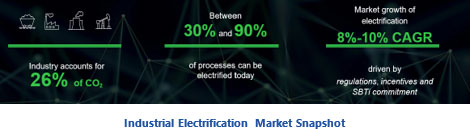
Schneider Electric actively contributed to the sustainability tracks, presenting in both the Energy Transition and Circular Economy sessions. In the Energy Transition session, John Van der Geer emphasized the decarbonization potential of industrial electrification and the shift toward renewables.

He highlighted how this transformation calls for smarter, integrated design in electrical systems, supported by a brownfield case study where a gas boiler was replaced with an electric one.
In the Circular Economy session, Ludovic Debuchy and Victor Gasulla showcased the Altivar Process Drive System, demonstrating how refurbished components can cut resource use, energy consumption, and CO₂ emissions by up to 80 percent. They also explained how Schneider Electric embeds circularity from the very beginning, starting with product design and extending across the entire lifecycle. This approach supports sustainability through reuse, refurbishment, and optimized end-of-life strategies, reflecting Schneider’s commitment to a more resource-efficient future.
In his presentation, AI To Autogenerate HAZOP LOPA, Chris Stogner from Schneider Electric explored the evolving role of artificial intelligence in safety systems and hazard analysis. He outlined a shift toward open, interoperable, human-centric, and resilient safety instrumented systems (SIS), stressing the need for user-friendly solutions and improved efficiency through analytics, machine learning, and AI. He also noted the growing influence of ESG goals, such as flaring reduction, in shaping modern safety standards.
Chris contrasted traditional hazard analysis methods—based on static data, expert input, guide words, and structured questioning—with emerging approaches that leverage digital twins and AI-powered dynamic plant models. He highlighted how integrating AI can significantly improve the accuracy and speed of safety assessments, paving the way for more adaptive and intelligent safety processes.
The ARC Forum in Sitges brought together key trends and challenges shaping today’s industrial landscape, from digital transformation and sustainability to safety and circularity. With a program rich in real-world use cases, engaging discussions, and inspiring keynotes, the forum fostered valuable dialog across the industry. Schneider Electric’s active participation reinforced its role as a leader in these areas. Through insightful presentations and cutting-edge solutions, Schneider clearly demonstrated its commitment to driving innovation, efficiency, and sustainability in the face of evolving industrial demands.
ARC Advisory Group clients can view the complete report at the ARC Client Portal.
Contact Us if you would like to speak with the author.
Obtain more ARC In-depth Research Market Analysis.