Representative End User Clients







Representative Automation Clients







Representative Software Clients








Digital transformation is the mantra of today’s manufacturing industries. Yet according to ARC research, only about a tenth of industrial companies surveyed recently said they are currently implementing  Industry 4.0, while another fifth of respondents consider themselves to be “Industry 4.0 ready.” However, as the benefits of digital transformation become more apparent, expect those shares to grow significantly in the coming years.
One barrier to progress in digital transformation is connectivity. Industrial plants are full of systems and devices connected via aging, proprietary networks that often don’t connect well with one another. While seamless connectivity is a prerequisite for a smooth digital transformation, only the newest plants designed with connectivity in mind have the modern infrastructure necessary to access and evaluate all the data necessary to achieve the goals of Industry 4.0.
Siemens is best known as a provider of end-to-end plant solutions, including industrial services. To help customers improve connectivity in their plants, Siemens offers Industrial Connectivity Services (ICS), a package of standardized software and services for consulting, implementation and optimization that analyze and optimize connectivity infrastructure in existing plants.
Digital transformation means digitizing manufacturing and business processes with the goal of improving economic performance. Digitized processes share data with stakeholders at all levels to  improve efficiency and even predict impending problems, but these data need to be exposed first, and this is where ubiquitous connectivity is of paramount importance.
Today’s plant floors are a hodgepodge of old and new systems and devices. Decades old machinery may be installed next to brand-new, recently installed equipment. Older machines, if connected at all, often use legacy networks and protocols to communicate. But old and new machines have something in common: they are treasure troves of raw equipment and process data that, if accessed and shared, can be used to optimize production processes, anticipate problems, and ultimately help companies to achieve their digitalization goals.
With such a patchwork of connectivity in existing plants, many industrial companies ask themselves:
The answer to these questions is to pursue a connectivity strategy that systematically connects old with new and makes data widely available to key stakeholders.
No two manufacturing plants are alike, so the Consulting part of ICS helps users take inventory of existing systems and their connectivity schemes. Regardless of how old the existing equipment is and whether systems of non-Siemens suppliers are deployed, the consultants work together with the user to develop a connectivity concept and establish a standardized connection between production networks, the industrial edge ecosystem, and the cloud. ICS consultants help the user to create an implementation roadmap to achieve defined goals.
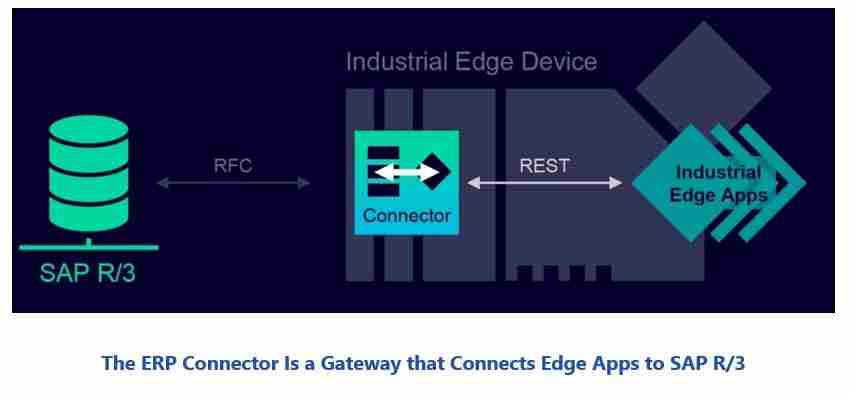
The Implementation part of ICS implements the connectivity solution using standardized software. “Industrial Connectors” are gateways that establish a connection between the production network and higher-level information systems such as human-machine interface software (HMI), manufacturing execution systems (MES), enterprise resource planning (ERP), or any cloud-based apps. These universal connectors are hardware-independent with unlimited scalability, and software connectors can be deployed via dockerization. For example, the ERP Connector for the industrial edge provides edge apps with a configurable and secure connection to SAP R/3. It handles the necessary credentials so the user can focus on processing, combining or displaying ERP data on the shopfloor.
Finally, the Optimization phase adds expert advice on managing data to optimize the user’s production based on long-term expertise.
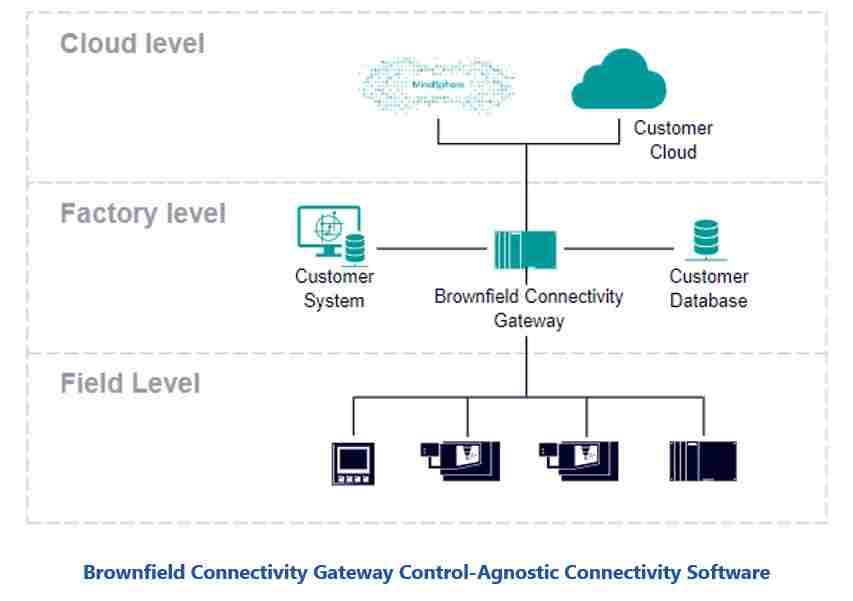
The Industrial Connector Brownfield Connectivity Gateway is control agnostic and provides standard software to connect computer-numeric controllers (CNC) as well as automation systems and sensors in general. The service consists of advice, implementation and maintenance to ensure seamless data transfer.
The last part of the ICS offering is Connectivity Operations. With this service level agreement, Siemens maintains the customer’s system and ensures a guaranteed level of system availability by monitoring and handling incidents. Customers can also request guidance from Siemens connectivity experts on connecting a machine with the Brownfield Connectivity Gateway.
To help understand how customers take advantage of the ICS offering, Siemens references case studies at several customer sites.
In the first case study, a manufacturer of steam and gas turbines wanted to gather information from fifteen machine tool controllers and visualize their states (NC program status, operation mode, operating times for machine states, NC start counter, stop condition, feed rate, spindle speed), as well as energy usage information from a power monitor.
The ICS solution was to connect the CNC controllers via Brownfield Connectivity Services (BFC) using local dashboards, and to share these data with MindSphere Fleet Manager. The result was the exposure of power information that made energy consumption in the plant transparent. According to the customer, the benefits were an increase in tool efficiency and availability, and greater transparency for large components and long running NC programs.
In the second case study, a manufacturing company desired to increase transparency on the shopfloor, shorten time-to-market for engineer-to-order products, and create closed-loop production for improved production planning. The solution was to create an end-to-end IT infrastructure that integrates all digital applications, from order entry to production.
The Siemens ICS team connected disparate functions ranging from production preparation, order creation, and resource maintenance to production scheduling, order orchestration, and progress monitoring. According to the company, the connectivity improvements and application integration resulted in improved production quality and minimized production time, reduced manual effort through digitalized production planning, as well as the creation of a generated blueprint for holistic OT/IT integration.
Many industrial companies struggle with their digital transformation. It’s easy to get lost in the details of integrating legacy systems to produce a reliable, coherent stream of useful data to fully digitize and orchestrate production processes with business processes. To support customers in their digital transformation journeys, Siemens offers Industrial Connectivity Services - a set of comprehensive, universal connectivity software, advisory, implementation and maintenance services supported by personnel with relevant domain knowledge. These services help users integrate legacy and modern systems and create a data-driven basis for the transformation to a truly digital business.
ARC Advisory Group clients can view the complete report at ARC Client Portal
If you would like to buy this report or obtain information about how to become a client, please Contact Us
Keywords: Siemens, Connectivity, Digital Transformation, Industry 4.0, ARC Advisory Group.