Representative End User Clients







Representative Automation Clients







Representative Software Clients









Keywords: Asset Management, Artificial Intelligence (AI), Asset Performance Management (APM), Analytics, Asset Investment Planning (AIP), Decision Analytics, Enterprise Asset Management (EAM), Asset Lifecycle Management (ALM)
To keep up with changing business dynamics, industrial end users need to excel in various areas. When it comes to managing their assets, they want to maximize asset life and ensure high asset availability, productivity, and reliability. However, this should be done in a manner that is cost-effective without compromising safety.
While the evolution of asset management technologies has helped users better address their business challenges, it has also complicated asset performance management (APM) decision making. End users often struggle to understand what projects to move forward with, which upgrades to make, and which technologies to adopt. For this, end users should make asset investment planning (AIP) a key part of their asset management strategy. Leading industrial software provider IFS recently briefed ARC on its portfolio of asset management solutions and highlighted how its recent addition of Copperleaf Technologies with its leading AIP solutions can help organizations achieve seamless end-to-end ALM success.
For every major asset investment decision, multiple factors need to be carefully evaluated. However, traditional methods of evaluating investment are often prone to bias. Without a clear method of evaluation, it becomes difficult to track how much risk is avoided, how much value is created, and the long-term financial and non-financial benefits of the plan. Furthermore, internal politics may drive prioritization. The lack of proper processes and an agreed upon framework for evaluation of decisions inhibits organizations’ abilities to quickly respond to unexpected changes and regulations.
As asset performance management (APM) has matured, it has made asset management more complicated. Available strategies range from reactive to prescriptive. While prescriptive maintenance may be the best approach to achieve the highest level of reliability and asset availability, it does not make sense to adopt this strategy for all assets as it can be quite expensive.
Most end users are looking to choose an APM strategy based on the criticality of the assets. Determining the criticality level of assets is not a simple task. Furthermore, planners need to consider additional factors such as age of the asset, availability of resources, and budget information when deciding on the maintenance strategy, making such decisions more complicated than ever before.
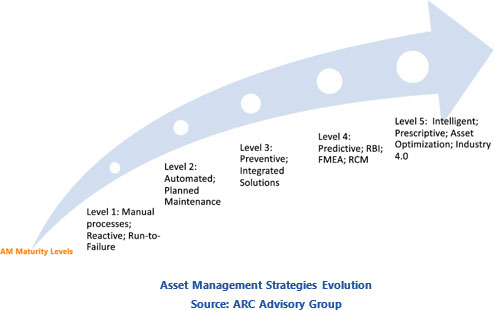
While organizations understand the value of effective asset lifecycle management (ALM) planning, traditionally different ALM phases were siloed and limited visibility existed from the design and build phase to the operate and maintain phase. Different business groups associated with ALM within the organization operated independently and thus sub-optimally.

Several modern technologies, such as Industrial IoT, cloud computing, and edge computing, are helping organizations eliminate these silos and push APM forward. However, it has again resulted in the increased complexity of APM projects. With the wide variety of products, technologies, and projects to choose from, end users are trying to better link their APM initiatives with business goals such as higher profitability and better margins.

An end-to-end ALM approach focuses on achieving top level business goals, but to do that at each phase of the asset’s lifecycle, the organization needs to have complete visibility into the entire asset lifecycle information. Additionally, to achieve cost-efficiency and derive maximum value from APM initiatives, asset investment planning (AIP) should be prioritized at the initial as well as the operations phase.
IFS, with its IFS Cloud solution, is looking to help industrial end users address all the above-mentioned asset management challenges. According to the company, the composable architecture of IFS Cloud helps users streamline asset management throughout the full asset lifecycle while reducing complexity and costs for its users as well. The company’s enterprise asset management (EAM) and field service management (FSM) solutions offer its users a wide range of capabilities and functionalities to choose from to best match their specific needs. In its endeavor to offer comprehensive end-to-end ALM solutions, the company recently acquired Copperleaf Technologies, a decision analytics company that specifically focuses on AIP.
IFS’ decision support suite of solutions enables organizations to align and compare all value-creating aspects of the organization on a common scale, hence infusing the procedure with objectivity, transparency, and thoroughness. This approach brings rigor to a process that has typically depended largely on intuition. IFS leverages advanced technologies such as artificial intelligence (AI) and analytics to offer end users off-the-shelf solutions that help them optimize investments across the organization.
IFS AIP employs advanced analytics tools to simplify the investment planning process. The solution suite easily integrates with end users’ various enterprise systems such as APM, EAM, and geographical information system (GIS) to easily bring asset and other key information that is vital to support effective decision making.

According to the company, their AIP value framework delivers a standard, consistent method to evaluate risks, expenses, and benefits of different strategies. The solution’s what-if scenarios help users quantify and compare risk and outcomes tied to different asset investment strategies. End users often want to know if they increase or decrease their budget by a certain percentage, how that will impact on their business performance. With the what-if scenario capability of its solution such an analysis can be done easily. The tool offers quick and easy access to actionable insights, to help users make better decisions that align with their overall business objectives.
IFS’ solutions focus on proactive risk management, offering a thorough, data-driven evaluation of all asset risks. For users new to the APM journey, the company’s asset library ensures a quick start of the process. The tool ensures that users clearly understand long- and short-term risks associated with different decisions.
Many executives may see ALM as a cost center and focus on cost control. In such cases, maintenance teams can have difficulty communicating business benefits in financial terms that members of the C-suite understand. Furthermore, in situations where budget modifications are needed, it could be extremely difficult for the maintenance teams to highlight the impact of proposed cuts.
With the IFS end-to-end asset management solution portfolio, maintenance teams can use data-driven decision-making to evaluate strategy options, highlighting their pros and cons. These tools help articulate the value and ROI of proposed APM strategies, aligning them with organizational goals to gain C-suite support.
ARC Advisory Group clients can view the complete report at the ARC Client Portal.
Contact Us if you would like to speak with the author.
Obtain more ARC In-depth Research Market Analysis.