Representative End User Clients







Representative Automation Clients







Representative Software Clients








ARC Advisory Group recently interviewed gas and steam turbine owner-operators along with suppliers of turbine monitoring equipment and services to learn more about today’s aftermarket services for turbines. Most of the owner-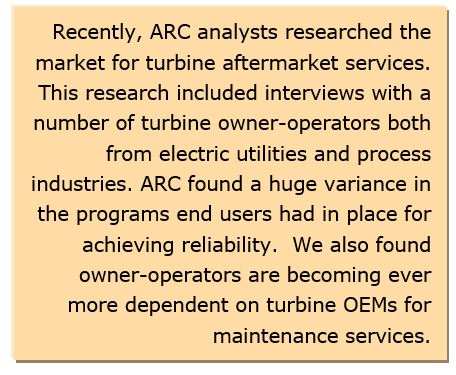 operators were from electric utilities, with the remainder from oil, gas, refining, and chemicals. Turbine monitoring is a hot area for new aftermarket services, given that both GE and Siemens are major turbine OEMs and each firm is now executing new internet service initiatives.
The level of losses attributable to gas and steam turbine failure is high. New technologies for remote monitoring, diagnostic, and prognostic services can better predict failures and help mitigate these losses. Services are being delivered by several types of suppliers including OEMs, automation suppliers, and smaller third-party firms with turbine equipment expertise. However, ARC believes turbine OEMs are the clear front-runners in these markets, which are the fastest growing segments of the overall turbomachinery market.
Here are some of ARC’s findings from this research:
A number of larger electric utilities have developed extensive programs for generating unit reliability with many forming 24/7 unit monitoring centers that are internally staffed. These are most often referred to as “M&D Centers” (for monitoring and diagnostics). Some large process manufacturing firms also support similar programs especially for monitoring turbines in remote and hard to reach locations.
In contrast, small to medium-sized utilities and process operations had no such internal infrastructure. It appears that while many of these utilities monitor or collect historical data, they are unable to analyze or act on the data in real time. ARC found that utilities are now making incremental and application-oriented investments in these M&D centers, as opposed to major new investments. Additional investment seems to be oriented to implementing applications like deeper analytics that can deliver additional returns while using the existing infrastructure.
 A certain scale is needed to support the investment in such a center. ARC estimates that a generating unit count of 50 to 100 can justify the investment. Utilities reported that the investment was not sustainable for smaller numbers of units. In addition, successful programs require dedicated staffing, the development of process and equipment mathematical models, as well as unit operations and engineering expertise. Without ongoing support from these disciplines, the value of the diagnostics atrophies because of growing model mismatch issues.
Successful M&D programs are characterized by strong internal champions and executive support. Such programs focus on improving unit reliability rather than on monitoring specific pieces of equipment. Turbines are, of course, critical for unit reliability, but other types of equipment can be equally critical.
The major problem end users reported was data quality. Most data anomalies result from problems with measurement data rather than equipment problems. Often, the value of a measurement may reflect conditions such as a field transmitter or data communication failure. Verifying that this is the root cause is troublesome, though necessary, work.
Reliability centers employ multiple software tools that have been integrated by internal staff with limited outside support. These tools include data historians, which form the primary repository of time-series data from plant sensors and instruments. In addition, end users deploy various process and equipment modeling and analytics software. Utilities 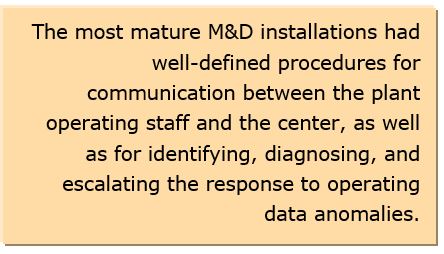 employ pattern recognition software and advanced pattern recognition models as primary analytic tools in their centers. Both equipment condition and unit performance metrics are the subject of these models.
Software functionality often provides alerts and messaging for both the M&D center staff and the plant personnel. In general, these anomalies are then investigated manually. Identifying and diagnosing anomalies is the usual day-to-day work in the centers. As part of that work, they communicate directly with operating staff of the units involved. The most mature M&D installations had well-defined procedures for communicating between the plant operating staff and the center, as well as for identifying, diagnosing, and escalating the response to operating data anomalies.
One trend revealed in the research was the move toward more long-term service agreements (LTSAs) with equipment OEMs, particularly for new units as opposed to older ones. It is common practice for utilities to have gas turbine peaking units covered by LTSAs. But since they expect more flexible operations from the new combined-cycle units now being installed, more utilities are putting these new units under LTSAs as well. Normally under these agreements utility maintenance personnel perform only the simplest and most routine maintenance tasks. All critical maintenance and outage-related work is performed by the LTSA contractor, usually the turbine OEM. Some utilities have even incorporated cost- and risk-sharing provisions as part of their service agreements.
Utility owner-operators expressed a desire for not only greater amounts of data, but improved data validation as well. The handoff of sensor data from a field device, to DCS, to data historian, to the reliability center requires proper processing and analysis at each layer of the system. Performing root cause analysis of data anomalies is more complex when there are multiple data handoffs. ARC believes that the ability to identify data faults along this handoff chain is technically available, but is rarely employed correctly across all devices in this data chain. The reasons the existing sensor diagnostic capability is not used include poor field device configuration, poor engineering practices, limited capability of installed DCS to read and act on sensor diagnostics or data quality information, and poor practices in the configuration of DCS and historian software.
The growing demand for energy and the increased focus on energy efficiency drive demand for turbine monitoring and controls solutions. IIoT technologies such as advanced analytics, machine learning, and enhanced communications are now available in turbine monitoring solutions. These can improve performance, increase energy efficiency and output, improve turbine uptime and availability, and reduce maintenance costs. This research project indicates that only larger utilities have the scale to justify investing in their own full-time monitoring and diagnostic centers.
Reducing the number of “false-positive” sensor data anomalies requires reviewing engineering practices at each hand-off between field sensors and analytics applications.
Owner-operators of larger fleets of turbines, or those with remote operations, should plan how to best integrate their own diagnostic activities with the types of assistance available from their turbine OEMs. Much of the investment in M&D centers involves 24-hour staffing, and the staff consists of many experienced domain experts. Such expertise is scarce and may be better used elsewhere.
Owner-operators of all sizes should explore their options for including unit performance metrics as part of long-term service agreements with turbine OEMs. This seems like a useful way to align the goals of service providers and owner-operators, yet ARC research indicates that only a few of the largest utilities are doing this today.
The 25th Annual ARC Industry Forum Goes Virtual, Accelerating Digital Transformation in a Post-COVID World, February 8-11, 2021 – Online will feature several sessions dedicated to how technology users and suppliers alike can take advantage of new IIoT-enabled service models to improve asset and business performance.
If you would like to buy this report or obtain information about how to become a client, please Contact Us
Keywords: Analytics, Diagnostics, Gas Turbine, Monitoring and Diagnostics Center, Steam Turbine, Utilities, ARC Advisory Group.