Representative End User Clients







Representative Automation Clients







Representative Software Clients








The adaptation of Pharma and Biotech must continue in light of increasing global competition, increasing regulations, public healthcare pressures, volatile economic conditions, new technologies, and mergers and acquisitions. In response, pharmaceutical manufacturing is undergoing a major transformation; one that makes use of new, smarter technologies.
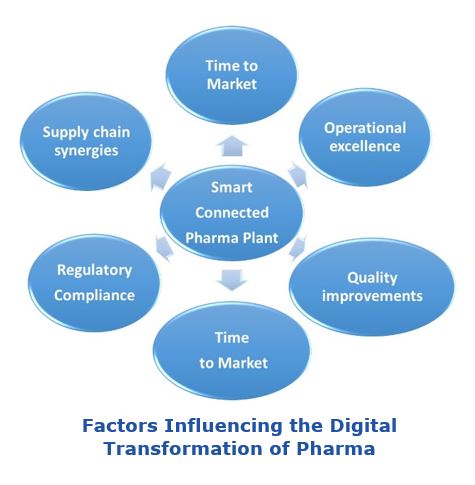
Objectives for this “global digital transformation” of manufacturing and the pharma industry as a whole include:
Due to government pressure on the healthcare industry to contain costs, pharmaceutical manufacturers must pay increasing attention to operational excellence. Operational excellence is about increasing efficiencies, continuous process improvements,  maintaining or improving product quality, and reducing costs. Operational excellence is the key to sustainable revenue and business growth.
To achieve operational excellence, pharmaceutical and biotech manufacturers must have complete control of their manufacturing operations to manage costs, improve product quality and consistency, minimize time to market, meet regulatory requirements, and operate in an environmentally sustainable manner. This drives pharmaceutical companies to connect the enterprise digitally. In addition, pharmaceutical companies must be able to meet the requirements for high-quality products and comply with dynamic global regulations that include complex payment schemes that vary by government and regions.
Processes must work in harmony with a goal to achieve perfection through:
Operational excellence focuses on manufacturing quality products efficiently. It is about excellence in purchasing, production, distribution, logistics and inventory management.
Manufacturers are integrating real-time information by using flexible technologies that can respond to changes in the market, enabling decision-making and actions that can help drive lower costs. Using this connectivity, operational excellence empowers organizations and people throughout the business to manage performance and align actions with business performance and strategies.
Companies are investing in connected technologies that can support operational excellence. Many of these technologies involve mobility and mobile devices. Global branded pharmaceutical manufacturers and contract manufacturers alike need end-to-end visibility into their supply chains and/or manufacturing assets to enable process excellence and supply chain integration. With dashboards and other tools, appropriate people have visibility to see trends that can help them can make faster decisions and even 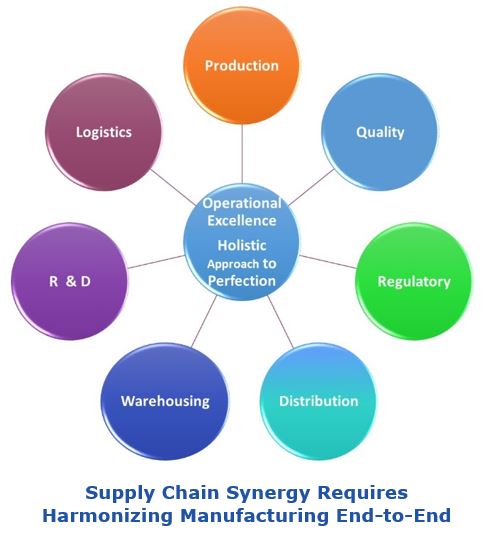 take proactive actions to prevent potential problems before they can occur. Improved connectivity can help reduce costs, prevent losses, improve revenues, and help organizations identify new, potentially profitable business opportunities.
Analytics and the ability to view results on dashboards, combined with relevant key performance indicators (KPIs), can help manufacturers increase efficiencies. This ability to combine operational and financial information provides manufacturers with actionable intelligence to optimize operational and business performance.
Operations must be able to react to on-the-fly changes in the production environment. These include changes in raw materials, production, equipment availability, customer demand, shifting priorities, inventory shortages and capacity changes, labor shortages, and any number of unexpected events. Operations must know where everything is; what and how much is needed; and what, when, and where it is supposed to be produced. Companies must be able to monitor production and make a quality product, all while negotiating innumerable conditions, options, partners, and priorities. Operational excellence in today’s business environment means not only delivering efficiency and quality, but also being able to manage and synchronize the supply chain from end-to-end.
For operations to remain competitive, they need to be flexible and agile and balance demand with costs. This requires a high level of connectivity into business and production activities to improve decision support at all levels.
Connecting the enterprise can lead to production savings from:
There is a huge business interest to get products into manufacturing and distribution channels quickly before competitive products emerge. Faster time to market is crucial. Developing processes that can be up and running quickly, enable fast changeovers, and reformulation as needed can make the difference between success and failure in this fast-paced and highly competitive market.
Contract manufacturing can provide an effective approach to get production running quickly. The pharmaceutical industry has witnessed a shift from a vertically integrated business model to a network of suppliers. Contract manufacturing has evolved as one of the integral components of the pharmaceutical supply chain. The current marketplace has numerous established and emerging companies that can manufacture new products, offering a diverse collection of services. The scale of operation varies from manufacturing for clinical trials to full production. Contract manufacturing includes API (active pharmaceutical ingredient) manufacturing and FDF (finished dosage forms) manufacturing. Contract manufacturing can also encompass packaging.
Another trend is the emergence of single-use disposable manufacturing. It is easy to imagine single use for filters or tubing systems but, today, even buffer containers and bioreactors are single use. Entire disposable facilities are also possible today at a fraction of the cost of traditional stainless steel manufacturing facilities. Manufacturing production that has to be up and running quickly, such as for a vaccine for a pandemic, often uses disposables.
China, India and other countries are rapidly developing domestic pharmaceutical, biopharmaceutical, and generic drug industries. Due to increasing cost pressure and increased local demand, global pharmaceutical companies are locating production to emerging markets. Disposable manufacturing works well because it speeds time to production and time to compliance.
Pharmaceutical regulations require validation of drug production. Documented evidence of quality production is essential. Quality 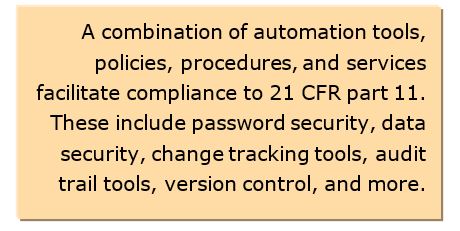 must be built into the process. The US FDA’s 21-CFR-Part 11 specifies that the documentation can be provided electronically with unique electronic signatures. Electronic records and electronic signatures must be trustworthy, reliable, and not have gaps.
Pharmaceutical manufacturers must comply with global regulations designed to reduce the risk of counterfeit or poor quality medicines and for government payment schemes. Each country has its own regulations and requirements for anti-counterfeiting, track and trace, and data storage. This can be challenging for manufacturers. As countries adapt regulations for securing the supply chain, manufacturers must not wait, they must start or continue to implement their programs now and work with solutions that will adapt easily to changes.
Newer technologies are available that can help companies manage and maintain the required documentation needed to meet global regulations.
The supply chain requires mechanisms for collaborating with manufacturers, wholesalers, re-packers, distributors, pharmacies, and other trading partners. Companies need ways to share information and intelligence to improve efficiencies, ensure product integrity, and foster smarter problem solving. This is not just about knowing where a shipment is today, but about tracking the shipment’s location and movement, managing inventory, maintaining product quality, managing the distribution, and product visibility. Enabling the appropriate degree of synergy between supply chain partners requires integrated smart digital technologies that solve business and operational problems.
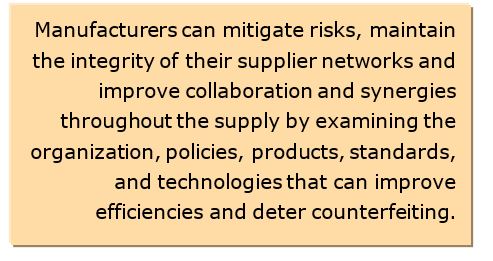 Companies must minimize the risks that could arise anywhere along the supply chain continuum; from the source of a product’s ingredients through the product’s manufacture, storage, transit, sale, and distribution. In addition to the sheer volume of imports and global manufacturing facilities, there has been an increase in the variety of sources, shippers, methods of transportation, and supply chain complexity for products. Combined, these factors challenge the industry to ensure that all drugs and drug components are of high quality and travel safely throughout their complex supply chains.
Companies need to work together to deploy connected, collaborative, and flexible global supply chains. While Industrial IoT and Industrie 4.0 initiatives promise significant benefits, without appropriate data management and analysis tools, the increasing volume of data generated by IIoT-connected devices, equipment, and applications can overload people with data, making it difficult to identify and respond to actionable events.
Effective supply chain management requires balancing supply and demand with more agility; reacting intelligently and quickly to major supply chain disruptions (counterfeits, recalls, earthquakes, tsunamis, and so on); and improving business continuity and supply chain risk management programs. Visibility is important for collaborative supply chains and tracking the business value.
Counterfeit drugs raise significant public health concerns because their safety and efficacy is unknown. A counterfeit drug with no active ingredient could prove harmful to patients who think they are taking a lifesaving or life-sustaining medication.
To address the tremendous global counterfeiting problems, manufacturers must understand the range of solutions, technologies, and methodologies they can employ to prevent counterfeiting and protect brands. The right solution must examine the supply chain, product, technologies, policies, training, global standards, organizational teams, and enforcement.
One of the best ways to prevent, detect, and respond to threats of counterfeit and recalls for substandard drugs is through an 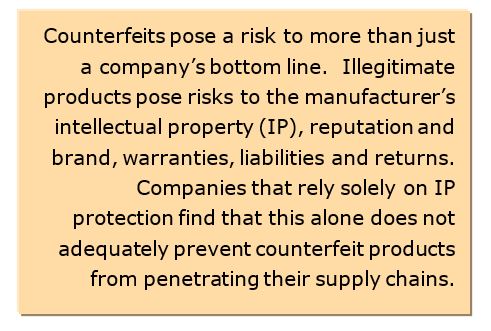 automated track-and-trace system. To help keep track of the millions of medications, the pharmaceutical industry supports the development of track-and-trace systems. The electronic pedigree (ePedigree) includes an electronic record on the drug’s strength, expiration date, lot number, serial number and transaction and source information (from manufacturer to wholesales, distributers and pharmacy). Resolving the global counterfeit drug problem requires common practices and a standards-based infrastructure that includes participation and collaboration by all trading partners across the supply chain, plus implementation of emerging technologies.
Supply chain synergies can improve competitiveness and benefit the entire supply chain with reduced costs, increased asset utilization, increased visibility and increased revenues and improved customer services. The ability to ship the product quickly and efficiently to the right location helps reduce both costs and counterfeiting-related risks. The ability to know the status of every shipment down to the product level is key. Missing inventory or not having track-and-trace capabilities can introduce counterfeits. Protecting patients from counterfeit and adulterated medicines should be a priority for manufacturers and makes good business sense.
Manufacturers need to undergo a digital transformation to remain competitive and meet global challenges. They need to integrate and connect a breadth of new manufacturing production and supply chain information technologies and products that can support operational excellence, global compliance, and supply chain synergy, and help achieve perfect quality and zero waste. The technologies the manufacturer ultimately chooses should align with business strategies. Ultimately, manufacturers need to undergo a digital transformation to improve the bottom line by utilizing technologies that increase value and reduce risks.
Resolving global regulatory harmonization, counterfeit problems, cold chain tracking and recall issues will require common global practices and a standards-based infrastructure that includes collaboration across the supply chain, adequate legislation and enforcement, and implementation of appropriate emerging technologies. Although there is no magic bullet, the right partnerships and the technologies can help.
Some steps that manufacturers can take to successfully initiate their digital transformation include:
If you would like to buy this report or obtain information about how to become a client, please Contact Us
Keywords: Pharmaceutical, Biotechnology, Digital Transformation, Pharmaceutical Technologies, ARC Advisory Group.