Representative End User Clients







Representative Automation Clients







Representative Software Clients








When first introduced back in the 1970s, truck fleet operators used basic GPS-based telematics solutions to remotely monitor the location and speed of their truck tractors and trailers in real time. Many still do, and continue to realize good ROI from these solutions. While this represented an early example of a Big Data problem, analyzing that data was relatively straightforward. Now, 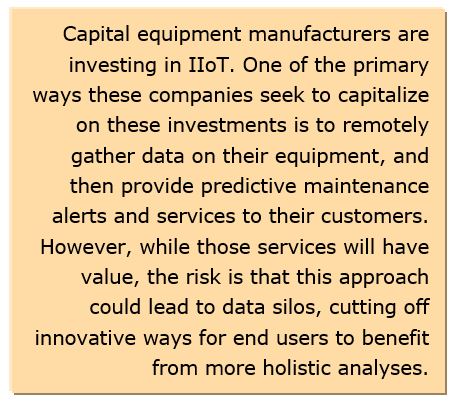 they can leverage big data to gain new insights.
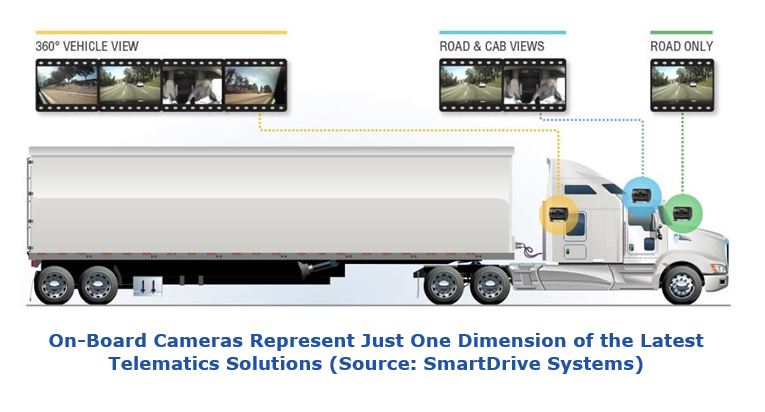
Now fast-forward to today’s far more sophisticated telematics solutions for truck fleets and other mobile assets. In some cases, these go well beyond GPS location and speed monitoring and analysis to also incorporate real-time measurements from engine sensors (to help improve fuel economy and support predictive maintenance), cab-mounted cameras (to monitor driver performance), and other measurements from vehicles that could be spread across continents.
These multiple disparate data sources, often involving sub-systems from multiple suppliers, increase the Big Data problem to a significant degree, and can make analyzing these data far more challenging. However, “enriched” data can provide fleet operators with valuable predictive insights to help improve fleet safety, reliability, and regulatory compliance, while reducing overall operating costs.
ARC is confident that this same “enriched data” approach can be applied across a variety of industrial sectors to yield similar benefits.
Fleet telematics solutions have been around since the 1970s. Thus, the transportation industry is one of the pioneers in the use of Big Data. Basic solutions use GPS to track the locations of trucks and trailers. More advanced solutions also use sensor data from the cab’s engine for predictive maintenance, to help ensure trucks are being driven safely, and to increase fuel efficiency. These kinds of analyses were revolutionary in their day, and to be fair, still provide a robust ROI.
The analytics platforms built to analyze telematics data were, logically enough, designed to analyze just telematics data. But since the 1970s, many other solutions to manage fleets have been introduced or greatly improved. Data on the transportation assets, their drivers, and particular trips also exist in human resources systems, routing software, advanced driver assistance systems (ADAS), and truck camera systems. Other data from outside the enterprise could also be leveraged.
But many telematics solutions have been built on previous generations of analytics platforms. These legacy platforms were not designed to ingest data from a variety of data streams and analyze that data.
Further, public cloud solutions have emerged that provide an opportunity to leverage enriched data from multiple companies to help users make better predictions and generate community metrics. Some newer telematics solutions also leverage the opportunities presented by a public cloud architecture.
One young analytics company is enriching its video data - feeds from road facing and interior facing cameras - with telematics and ADAS data.
Operators of larger truck fleets have been employing cameras mounted on their cabs, primarily to help protect themselves against litigation. If a road accident occurs and another driver claims that the truck was at fault, the company can often use that video information to exonerate itself.
This solution is based on a public cloud architecture that allows it to speed up investigations and insurance settlements. So, for example, assume that a car clips the side of a trailer. Both vehicles stop and the car driver claims the truck driver is at fault. The ADAS would detect that the truck is swerving from one lane to another, which would trigger analysis of the event at the fleet operator’s central control center (or “control tower” in logistics speak). If the analysis of the video stream indicates that the driver did the right thing to avoid a much worse accident, the video feeds can be sent to the driver to show to the police. This often leads to the truck getting back on the road much faster. When events are detected, the video is stored for the 10 seconds before the incident up to 10 seconds after it. This in turn leads to much quicker settlement with the insurance company.
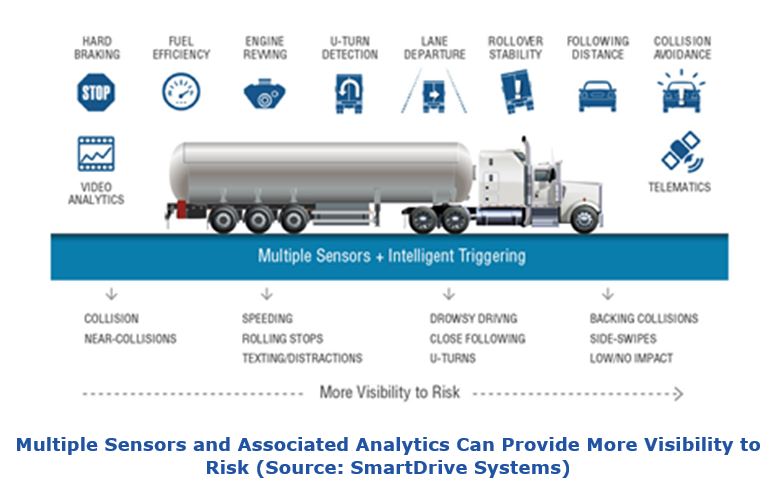
In this case, the combination of telematics and/or ADAS data triggers the examination of the video. The algorithms need to be smart to understand what an “event” is and when it occurred. This allows safety managers to access video feeds from an event in near real time. It also keeps the cost of the solution down as SmartDrive is not forced to store gigabytes of data on an ongoing basis.
As a public cloud solution, all customer data is captured by the solution provider. It has telematics, ADAS, and video on four billion miles driven, of which it scored almost 200 million events. The solution provider’s customer agreements allow it to analyze all the customer data so the company can continue to improve its algorithms.
The combination of telematics, ADAS, and video – data streams that have traditionally existed in different silos - has allowed the company’s experts to better interpret the telematics data. By reading the telematics data and then seeing what happened on video, 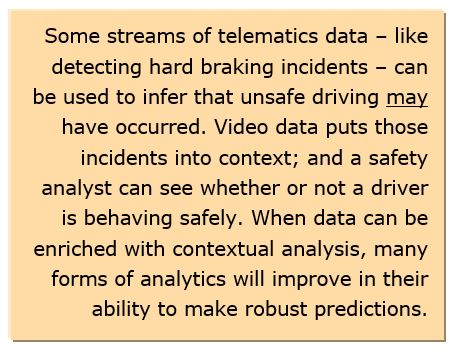 its data scientists could determine, for example, that turning more than 165 degrees within a certain turning radius and time window was a risky U-turn on a busy highway. The scientists combined this with GPS data to avoid false positives for turns occurring in large open areas such as parking lots and truck stops. Telematics solutions are typically not capable of detecting dangerous highway U-turn events.
Another telematics provider has also begun to enrich its telematics data as well. This company’s critical event reporting solution is used to predict which drivers are most likely to have an accident. The company’s models look at telematics safety events – hard braking, speeding, etc. - but enriched these with data from enterprise and routing systems, such as the hours worked and the driver’s schedule. Clearly, longer hours mean more fatigue. But not just the hours, but the specific time of day when those hours are logged must also be considered.
This company also offers a solution to help fleets retain drivers. In long-haul fleets, driver turnover frequently exceeds 100 percent per year. The company’s driver retention model helps fleets identify drivers at risk of quitting, giving the company time for remediation. In this case GPS data (such as data showing whether a driver is stuck at a delivery point waiting for his truck to be unloaded) is combined with human resources data indicating how many days off the driver has had. It could also incorporate data on shift start variability, and compliance data (hours-of-service violations) to make the predictions.
This provides just one example of why a public cloud architecture can make sense. The solution providers’ data scientists have access to all customer data, which improves their ability to upgrade their models.
But safety issues are not just related to drivers or how well maintained trucks are, they can also be based on location. For example, telematics-based black ice detection solutions are beginning to emerge. Advanced telematics solutions will be able to detect black ice by estimating the difference in the speeds of the drive shaft and freely rotating axles, which allows them to measure road friction. Once the solution detects black ice in a particular location, that data could and should be relayed to online navigation systems (like Waze), so other drivers approaching that stretch of road could be notified of the hazard.
Capital equipment manufacturers are investing in Industrial IoT (IIoT). One of the primary ways these companies seek to capitalize on these investments is to gather data on their equipment to be able to provide their customers with predictive maintenance alerts and services. However, while those services will have value, this approach could lead to data silos, cutting off innovative ways for end users to benefit from more holistic analyses. Operational personnel need to be open to combining data streams in innovative new ways. And capital equipment manufacturers need to work to make sure they provide an open approach to data analytics, and continue to examine how larger communities might gain value from their data streams.
If you would like to buy this report or obtain information on how to become a client, please Contact Us
Keywords: Big Data, Predictive Analytics, Telematics, Fleet Safety, IIoT, ARC Advisory Group.