Representative End User Clients







Representative Automation Clients







Representative Software Clients








“Visibility” can have many meanings when it comes to enterprise applications. The major supply chain software suppliers have already invested heavily in several forms of supply chain visibility. But this is just a start, with these same suppliers committing themselves to new related investments. In particular, JDA, Oracle, and SAP are all building 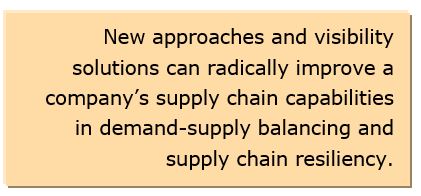 what they call “control tower” capabilities. All three companies recognize that a variety of B2B networks have data needed to enhance end-to-end visibility of the supply chain and all share a vision of becoming a “hub of hubs.”
The idea of a “hub of hubs” or “network of networks” is that the big software houses will partner with several B2B network providers, semantically mapping the data structures of their partners into their visibility solutions. But their respective control tower environments will be where their customers actually go to get enhanced visibility.
Meanwhile the recent focus on Internet of Things (IoT) technologies is opening up new opportunities to enhance supply chain visibility. IoT is nothing new in logistics, but some IoT data streams that have not been fully leveraged in the past are now gaining attention.
But it appears that the most significant advances in supply chain visibility have been made by two young technology companies – Resilinc, Elementum, and riskmethods. These companies “map” their customers’ supply chain networks. They then search massive numbers of web pages, access third-party content, and even monitor social media to provide much faster notifications to a wider array of potential risks than is available from any other vendor. These solutions, combined with fast and responsive planning, will lead to a quantum leap in the ability of companies to improve their supply chain resiliency. But those changes will not be easy. This ARC Advisory Group report includes a detailed case study of one large company’s journey, and the benefits it achieved, from enhanced resiliency.
Advances in supply chain visibility will lead to new capabilities for managing extended supply chains. But before we describe where we are going, it is worth exploring where we are.
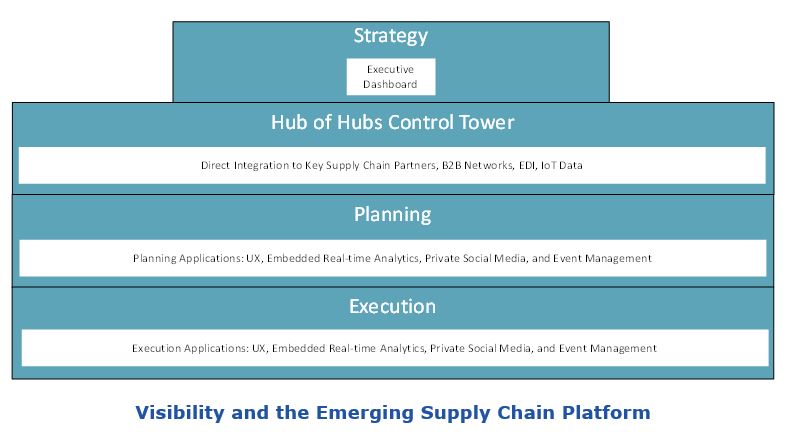
The major supply chain management (SCM) suppliers have similar platforms that all roughly resemble the following diagram.

Different technologies are used to transform a variety of data types into visibility for users.
On the data side, these include direct integration to a variety of internal systems, B2B networks, and supply chain partner systems and portals; EDI; Internet of Things (IoT) data; and manually entered data.
On the display side, things have greatly improved in the last five years. What we used to call a UI (user interface) is now being called a UX (user experience). This reflects the robust supplier investments, usability research, and role-based design efforts. Suppliers have also invested to provide visibility into applications from mobile devices such as smartphones and tablets. The applications increasingly incorporate the look and feel of Microsoft Outlook and Excel; tools that many people use every day and are very comfortable with. The user experience has also improved based on a new generation of in-memory database technologies that can generate plans much quicker.
Similarly, analytics have greatly improved. We have moved from backward-looking reporting to analytics based upon near real-time analysis. In-line analytics are increasingly common. In-line analytics bring up the particular metrics and dashboards necessary at particular steps in a process.
Private network social media applications have also become available. The idea behind incorporating this communication medium is that not all problems can be solved in an application. Sometimes, predefined teams must make collaborative decisions. Private social media communication provides real-time messaging and message archiving that these teams can use to collaboratively resolve exception situations.
And finally, exception management, or event management might be considered a visibility technology because when anomalous situations arise, new activities can be kicked off that display new screens reflecting the new activities that need to be completed. When an anomalous situation involves a larger set of predefined activities, we refer to that new set of activities as a “playbook.” For example, when a company is not on track to hit revenue targets, it may kick off a new unscheduled promotion. That unscheduled promotion playbook initiates a whole set of actions coordinated across many team members.
We have seen that supply chain visibility takes different forms – analytics, event management, better user interfaces, etc. But the hottest type of visibility is provided by B2B networks.
In the early 2000s, significant venture capital was invested to create B2B marketplaces. Ninety-percent of those marketplaces disappeared. However, the B2B networks that remain, and whose visibility extends beyond procurement processes, are among the leaders in the Supply Chain Visibility & Collaboration market; which, according to ARC research is the fastest growing supply chain software market.
These suppliers - including GT Nexus, E2open, Neogrid, and Elemica - represent a different set of suppliers than those that dominate other SCM software markets.
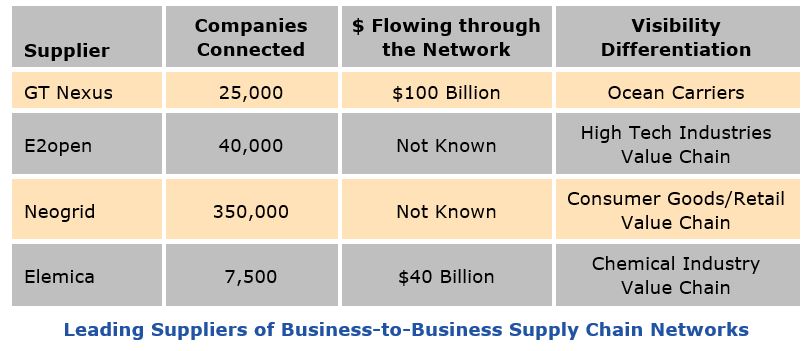
The fast growth experienced in the Supply Chain Visibility & Collaboration market has come from and will continue to come largely from the B2B public cloud providers.
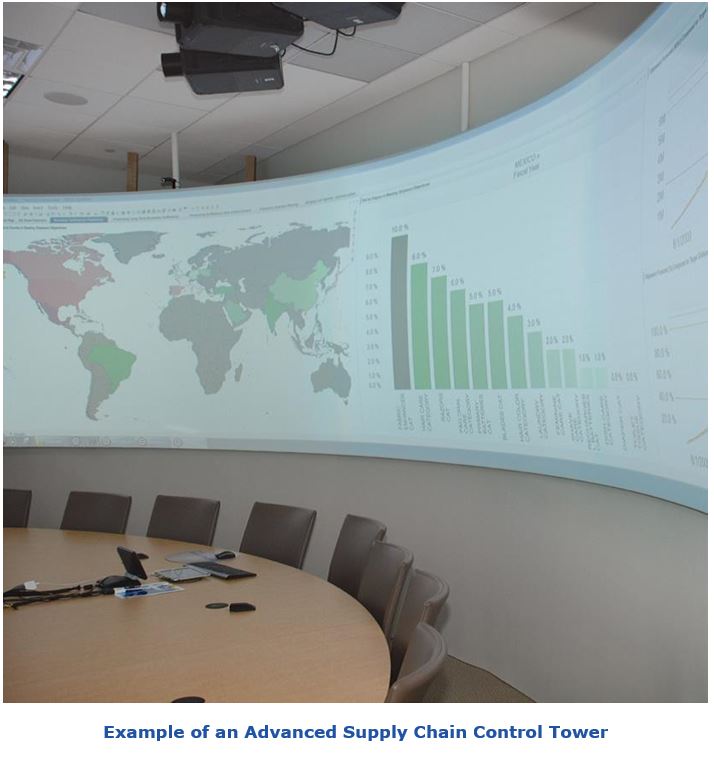
Further, contributing to the strategic position of B2B network providers is the concept of a network or networks (or hub of hubs) control tower. A supply chain control tower is a central hub with the required technology, organization, and processes to capture and use supply chain data to provide enhanced visibility for short- and long-term supply chain decision making. The scope of a control tower can be a facility, a group of facilities, a region, or a global supply chain.
Unlike demand planning “cockpits” or similar solutions that only provide narrow functional visibility, a control tower needs visibility to all pertinent data sets that will help a company efficiently balance demand with supply, and all data sets that increase supply chain resiliency.
This vision of a hub-of-hubs control tower is being pursued by the largest suppliers in SCM, including JDA, SAP, and Oracle. SAP and Oracle had previously purchased B2B network suppliers. More recently, Infor purchased the B2B network provider GT Nexus, which excels at visibility to ocean freight moves. GT Nexus, with an estimated $150 million in business, was purchased for $675 million. This very high valuation reflects the increasing strategic importance of this type of solution.
All major SCM vendors recognize that no one B2B network provides all the visibility necessary. Descartes, for example, is very good for air cargo visibility, while Transporeon excels at visibility into Europe’s road transportation. We are even seeing “co-opetition” – simultaneous cooperation and competition – among SCM suppliers. Oracle, for example, has selected GT Nexus, owned by Infor (one of its significant competitors), as an initial visibility partner for its network-of-networks control tower.
While it is praiseworthy that the major SCM software vendors are all pursuing hub-of-hubs style visibility, it is worth pointing out that to deliver the desired high-quality alerting, the software giants will need to carefully map their data structures and supply chain master data to their B2B partners’ solutions. This will not be an easy or quick endeavor.
On the downside, while many B2B networks today support network-level master data, it’s likely that hub-of-hubs control towers will lack this capability. For example, if a shipper tenders a load, it is accepted by a carrier, it arrives on time, and the shipper pays the carrier; the network solution could capture all those data. This can be very useful in eliminating disputes about what happened and when.
Maturing Sales & Operations Planning (S&OP) Processes – S&OP is the central planning process in supply chain management. This process efficiently balances demand and supply. When companies begin their S&OP journey, they often begin supply-demand balancing on a monthly basis. Many companies mature and have begun to do supply-demand balancing on a weekly basis. A few leading companies, Procter & Gamble for example, actually do supply-demand balancing on a daily basis. The better the visibility, the more rapidly supply and demand can be balanced. In particular, access to near real-time point-of-sale (POS) demand data has allowed consumer goods companies to spin this process much more quickly.
Outsourcing Growth – It is not a surprise that many companies have extensive outsourcing arrangements with contract manufacturers and logistics service providers. Yet, historically, supply chain planning was largely an internal-facing process that did not fully synchronize the end-to-end outsourced supply chain.
Responsive planning solutions from companies like E2open have long combined collaborative partner communication capabilities with fast planning. For example, the supply chain master might ask a contract manufacturer if it could produce 780 units of a particular product for delivery in 26 days. The contract manufacturer might respond that it could deliver 700 units in 26 days and the additional 80 units one week later. The planning engine then generates the bill of materials (BOM) and begins planning the material flows. Existing supply chain planning solutions, when combined with supplier portals, can do this kind of end-to-end planning; but B2B network providers that have both network-based communication messaging and responsive planning capabilities do it even better.
Supply Chain Risk Management Needs to Be a Core Competence – Only in the last five years has supply chain risk management become an active academic research topic and best practices begun to be codified. But there is increased awareness that companies that cannot efficiently prevent, or at least mitigate, major supply chain disruptions lose more in terms of market value, market share, and revenues than their more nimble rivals.
The final factor increasing the relevance of control towers is the increased attention and investments that Internet of Things technologies are receiving.
The Internet of Things (IoT) is nothing new in supply chain management. We have long tracked trucks with GPS, for example. And we’ve been taking RF scans and using that data to improve warehouse processes since at least 1975. Internet protocols make it easier to communicate sensor data to applications, which has led to better and less expensive applications.
Transportation management systems have been using GPS data to track trucks for several years. The next step is for SCM vendors to take this data and include it in the control tower layer to help balance demand and supply.
Similarly, in ocean shipping, IoT data has long existed. However, it was not being leveraged to improve visibility and carrier scheduling. In ocean, big carriers have traditionally interacted with shippers and freight forwarders using EDI messages to update interested parties on estimated times of departures, estimated times of arrival, and other pertinent status messages (vessel arrived at port, container gated in, loaded and departed full, etc.). EDI event data is better than having to proactively call carriers or look at carrier portals. But EDI, which depends upon carrier performance, can have problems. It is common for logisticians to jokingly refer to ASNs – which stands for Advance Ship Notices – as “Already Shipped Notices.” Unfortunately, while that joke applies to all transportation modes, it is particularly applicable for ocean.
And yet a rich stream of real-time data has long been available to improve ocean visibility. The Automatic Identification System (AIS), for example, is an automatic tracking system used on ships for identifying and locating vessels by electronically exchanging data with other nearby ships, AIS base stations, and GPS satellites. AIS was intended to help ships avoid collisions, as well as assisting port authorities to better control sea traffic. However, only recently has CargoSmart, a B2B provider of ocean booking and visibility, begun using this near real-time data (vessel details are updated every 15 minutes) to improve vessel scheduling and shipment tracking.
But to fully leverage IoT across extended supply chains the profession will need to build real-time flow models. As one small example, during the Long Beach labor strikes of 2014-2015, shippers shifted volume to other ports. A shipper might book with a ship headed to Vancouver only to find out a slew of other shippers had done the same. Delays by port were changing on a day-by-day basis. What if models of port throughput were used and combined with AIS vessel tracking data? If the model understood how many ships were sitting outside a port, how many were headed to that port, the relative sizes of those ships, and the throughput capacity of the port, shippers could have made much better port scheduling decisions.
A new generation of supply chain resiliency solutions has emerged. These solutions are based on Internet of Things (IoT) sensing of the external risk environment. As the following case study will make clear, these types of solutions have great potential.
This case study is based upon a presentation that Jan Theissen gave at ARC’s 2016 Industry Forum in Orlando. Mr. Theissen is AGCO’s Director of Strategy and Methods for Global Purchasing and Materials Management.
AGCO is a global leader in the design, manufacture and distribution of agricultural solutions, particularly tractors and combines. The company’s brands - Challenger, Fendt, GSI, Massey Ferguson, and Valtra - are better known than the company is. AGCO has 15+ plants around the world, and employs over 20,000 employees. From a cost-of-goods sold perspective, 70 percent of its costs are associated with procured components. This makes effectively managing the company’s supply base critical to its success.
In the past, AGCO had a decentralized approach to procurement. Internally, the procurement department was seen as a much lower priority than sales or product development. Consequently, AGCO lacked a world-class procurement organization. Different brands were buying goods from the same suppliers, but the company as a whole had no visibility to the overall performance of a given supplier.
When new leadership took over in 2011, they decided to change this by developing a centralized global purchasing organization capable of leveraging commodity volumes. This meant they needed to develop a standardized global commodity structure that combined regional market expertise with global cross-regional visibility and guidance. Mr. Theissen was one of the executives brought in to spearhead this change.
While the company needed to improve supplier management capabilities across the board, one area AGCO executives knew needed improvement was supply base risk management. In the past, supply base disruptions were “where we really suffered,” according to Mr. Theissen. In 2012, an earthquake in Northern Italy resulted in 1,000 tractors without wheels and tires. “We had to rent space for the work in progress. We incurred high costs because we were not prepared… to support our complex, just-in-time, and in some cases, just-in-sequence manufacturing.” These kinds of incidents led AGCO to prioritize supply chain risk management. “We learned our lesson.”
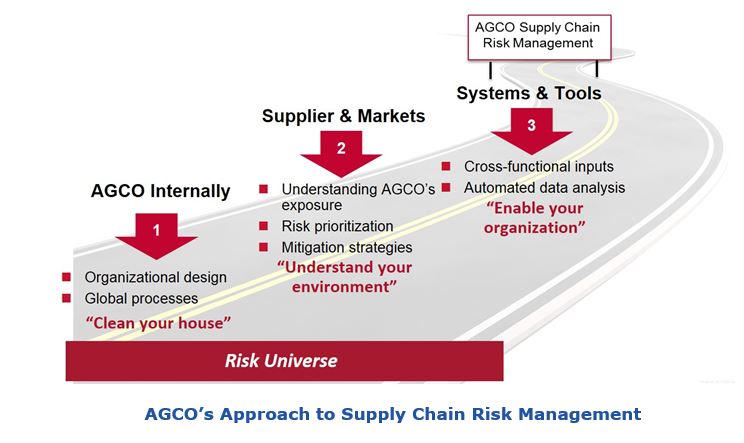
In this instance, investing in improved risk management capabilities did not require a detailed business case. But it did require a proactive, company-wide campaign to educate everyone on why these capabilities were critical. Cross-functional parties were invited to participate in workshops on risk identification. “At the end of the day,” Mr. Theissen explained, people outside of procurement “needed to understand that if our company wanted to proactively manage risks, everyone needed to participate.”
AGCO did not believe buying new software solutions would magically cure its problems. The company recognized it needed to first “clean their house.” Goals for the newly created global purchasing organization included achieving better global visibility to supplier performance, defining roles and responsibilities, and making it clear that the job of a commodity manager was not just cost savings, but also risk minimization. “Risk management is not just buying a tool or asking suppliers to be more transparent.” Mr. Theissen pointed out that risk management is really about changing the corporate mindset.
“Then,” according to Mr. Theissen, “we needed to understand our supply base. We have 5,000 suppliers. This is way too many suppliers for a company producing two major products, tractors and combines. But that was a legacy from the past.”
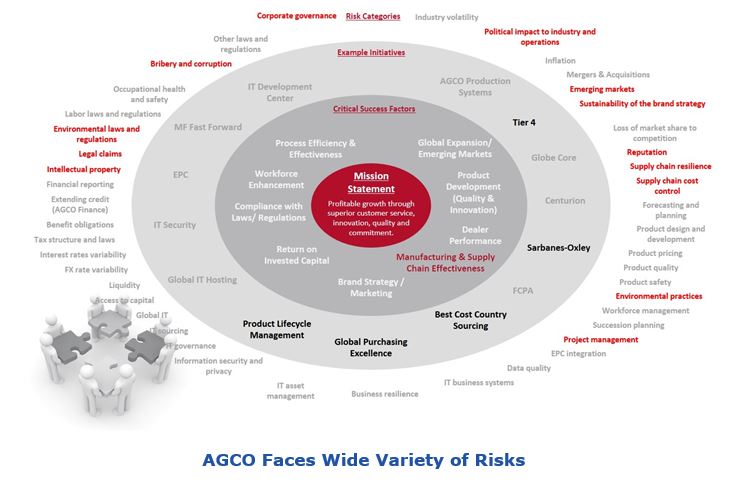
After the foundation was laid, AGCO began to think about automating the procurement and risk management processes. This included leveraging external content to help the company understand the financial, geopolitical, environmental, and compliance risks it faces. AGCO did (and still does), measure the performance of its suppliers across many dimensions, but lacked the expertise to fully monitor supply base risks.
Consequently, when going through the software selection process, AGCO’s Supply Chain Risk Manager, Jake Stone, spent “quite some time with our friends in manufacturing, engineering, and quality” to fully understand the risks they were facing.
AGCO’s internal capabilities were well enough developed two years ago to be able to begin looking at software solutions and content. To help support these changes, the company cleaned up its master data. Cleaning up the supplier master data required the commitment of dedicated resources, six to eight months of effort, and a fair expenditure of financial resources. This actually represented more effort than implementing the supply chain risk auditing software. The company’s supply chain risk management solution required geocoding supplier plants and other key partner locations. When they input these geocoded addresses into the system it was not implausible to find a location in the middle of an ocean.
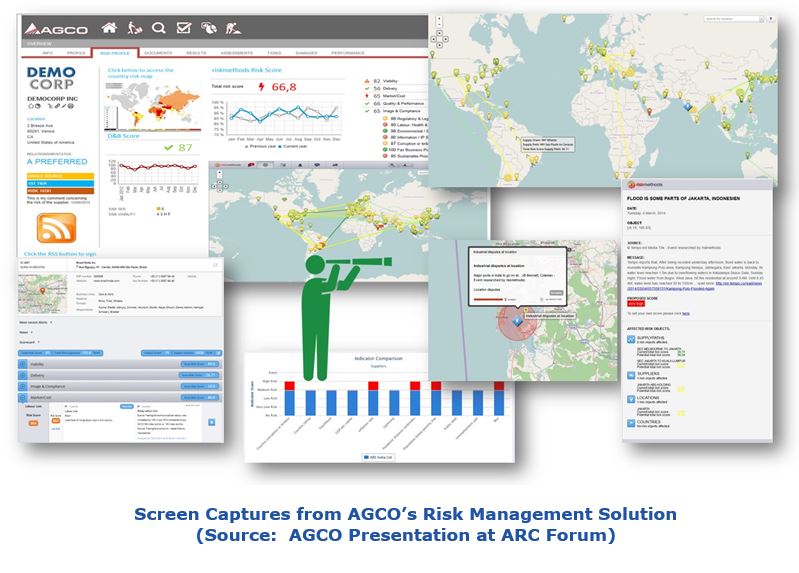
Once the master data was clean, the company implemented a global instance of a supplier auditing solution. AGCO ended up selecting procurence. The highly configurable procurence Meercat software allows users to evaluate their suppliers’ performance in areas such as collaboration (product innovation); risk, sustainability, delivery, and commercial performance.
The software was complemented with various integrated third-party data providers including Dun & Bradstreet, content from various insurance companies, supplier sustainability data from EcoVadis through riskmethods, and finally an IoT-enabled solution from riskmethods that searches over 10 billion web pages daily for risk incidents that apply to its customers and serves as the key tool to automate AGCO’s supply chain risk management approach.
The risk methods solution is based on:
Key to AGCO’s deployment strategy was ease of use. AGCO’s buyers and leaders can go into one integrated system to 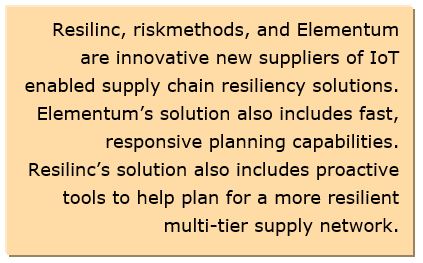 get the full picture on their supply chain and suppliers. This system includes both an internal view of supplier performance – how suppliers are doing in terms of quality, contract compliance, or on-time delivery performance – and an external view of risks (such as a strike at a port, floods affecting a supplier’s factory, or a logistics hub location cited for unfair labor practices). Suppliers also have risk scores across several risk categories so that buyers can gain a holistic understanding of a supplier’s risk profile.
“For the first time in our history,” Mr. Theissen stated, “we understood the material flows; where a supplier was located, and how that material flows from China to Europe, for example.” This was critical because it is important to not just monitor suppliers, but also the supply chain network and “how materials get from point A to point B.”
But while AGCO has unparalleled access to external risk data, we shouldn’t minimize the role AGCO employees play in identifying risk situations. Buyers can have very strong relationships at supplier companies; these buyers can learn of potential risk situations that have not yet been identified by external data sources. It is critical these managers’ inputs go into the risk solution as well.
While AGCO now has a very robust risk solution in place, certain types of risk, like the risk that a supplier will go bankrupt, remain difficult to detect. Insolvency requires that the financial reports provided by suppliers are accurate. AGCO is looking to put algorithms in place to link internal performance ratings – for example, around quality – with external data. The hope is that they may be able to find correlations between some of these internal measures and insolvency.
But having quick access to alerts at its control tower is not enough. AGCO created the role of a risk manager. Some risks are monitored but not acted upon. But when a risk manager identifies a serious risk, he or she kicks off a standard protocol to manage that particular type of risk situation.
AGCO is getting very fast alerts. For example, the company learned about a sudden port strike in Sao Paolo, Brazil within about 60 minutes after the strike began, enabling it to quickly put a team together to explore alter-native flow paths.
A fire last summer at a key supplier’s factory in Germany really proved the value of the solution. This plant supplied four of AGCO’s factories. AGCO had visibility to the fire within 45 minutes of the start of the fire. The source that the riskmethods solution used to identify this incident was a small German local newspaper with an online news presence. The newspaper broke the story just 30 minutes after the fire began; 15 minutes later AGCO’s risk manager had visibility to the incident as well.
The global purchasing organization had a member of the team located in Germany. He was given authority to manage this case and the standard protocol was put into effect. This manager hopped in his car and raced to the factory where he met with the owners and promised that AGCO would provide help to the supplier. In all likelihood, some of AGCO’s competitors ended up in an allocation situation where limited supplies were divided between customers. But because an AGCO employee was quickly on-site and was able to secure face-to-face commitments from management, it was only minimally affected by this incident, particularly as this global purchasing manager stayed on-site for many days during the four months. “This situation did not cause a delivery problem,” Mr. Theissen stated. “The only thing we had to do was change the sequence of our tractor manufacturing in Europe.”
From the AGCO case study, we learned that the supply chain profession has powerful new technology available to manage not just the S&OP process, but also to improve supply chain resiliency. ARC has designated Resilinc, riskmethods, and Elementum as Rising Stars – young companies deserving attention because of their innovative solutions. These companies “map” their customers supply chain networks, then search massive numbers of web pages, access other third-party content, and monitor social media as well. This allows these suppliers to provide much faster notifications of potential risk situations to a much wider array of risks than is available from any other vendor. Elementum supports these capabilities with a fast, responsive planning application.
It is not likely that Oracle, JDA, or SAP will develop these capabilities on their own. Elementum and riskmethods use machine learning to help identify real customer risks from false alerts. But in both cases, and at Resilinc as well, human employees examine the alerts to help ensure customers are not being sent a flood of false positives. While, over time, their risk engine is learning, and getting better at identifying true risks, neither company believes they can eliminate humans from this process. In short, part of what these companies are providing is content and managed services based on human labor. This is not a business model large software companies have been comfortable with. For the major SCM vendors to build these capabilities into their control towers, they would need to purchase or partner with one of these two companies.
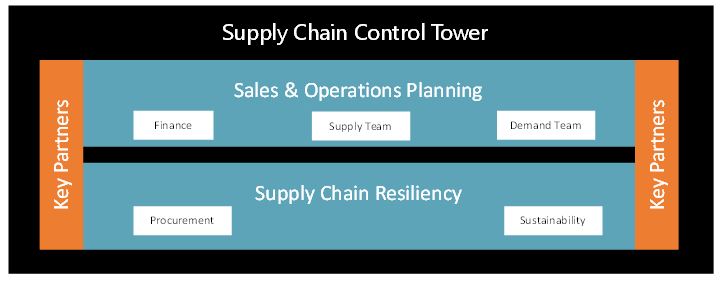
The S&OP process most commonly includes finance, supply, and demand teams. Improving resilience will require giving procurement and sustainability teams a seat at the table.
But increased visibility to major supply chain disruptions will also increase the need for thoughtful contingency planning followed by very quick and responsive planning.
The tsunami of 2011, which triggered the meltdown at the Fukushima Daiichi Nuclear Power Plant, was a wakeup call for General Motors (GM), along with many other major auto manufacturers. GM learned that its business continuity plans at the plants were too “tactical.”
According to Dan Howe from General Motors’ strategic risk management department, following the tsunami GM learned it is not enough to appoint “the person who will call the fire department.” You need to identify how an event will affect plants and respond quickly! “Most business continuity plans fall short in their ability to support a quick response.” GM responded in a traditional way to the catastrophe, “We circled the wagons and tried to figure out how to respond.” But the company’s response teams were not sufficiently cross-functional.
Supply chain risk management is now strategic at GM. In fact, the CEO has regular meetings with the strategic risk department. But no company can anticipate everything, nor can companies afford to mitigate all risks. Companies must be both insightful and selective in determining which risks require detailed risk planning.
One of the tactics GM uses to avert, or at least quickly mitigate significant risks, is to have Blind Spot Workshops. At these workshops, executives across the company are asked “What keeps you up at night?” Based on these meetings, the 30 top risks are identified and each risk is assigned functional leaders. Every key functional area at GM – procurement, product development, etc. – has embedded risk officers. Each of these top risks has a mitigation plan. And many of these risks must contain detailed resumption planning in the associated contingency plans.
When it comes to material availability, companies need to look deeply into their supply base. “You can’t just have good knowledge of your Tier 1 suppliers and trust them to manage Tier 2.” GM has worked to inculcate risk-based thinking, not just internally but also among its suppliers. One indication that this is starting to pay off is that one of GM’s Tier 1 suppliers came to them and told them about one of their important suppliers that they were starting to worry about.
Since the catastrophe in 2011, GM has invested in new analytic tools that help analyze the risks associated with suppliers and catastrophic events. GM worked with Resilinc to develop these tools. Resilinc, a cloud provider of supply chain resilience solutions, helped geocode supplier’s plants and logistics hubs across GM’s multi-tier supply chain. This allows GM to draw a circle around an event like an earthquake and answer the question, “Which of our suppliers are located within 100 miles of the epicenter? Within 200 miles?” GM can also look at suppliers located within the flood plain of a river and ask questions like, “Are all our key suppliers of a particular component located in that flood zone? What happens if they all go down at once?”
So is all this work paying off at GM? In 2011, following the tsunami, six weeks after the disaster, GM was still finding suppliers located within the affected area. A few weeks ago, Japan had a magnitude 7.0 quake. Within six hours, GM understood the supplier impacts from that quake.
Jabil, a large electronics industry contract manufacturer, reports that within three to four minutes after it was notified of the Nepal earthquake, it was able to look into their solution and see all the suppliers within a 500-mile radius of the earthquake. In their case, 156 components were sourced within this earthquake radius. The company also knew which products used these at-risk components and who the customers were. And Jabil knew how much of that component inventory was in Jabil facilities or in transit to their facilities. Finally, it understood which components were single-sourced versus dual-sourced. With that core information, the company was able to initiate fast and responsive planning to respond to this natural disaster.
Industrial facilities have had control rooms in place since the 1920s. And many lessons have been learned over the years about how to design these rooms. At ARC’s last Industry Forum, several speakers addressed these issues. Many of these lessons apply directly to supply chain control towers.
First of all, what is a control room? A control room, or operations center, is a physical space from which a large production facility (such as a refinery or power plant) or physically dispersed industrial operation (such as an oilfield or pipeline) can be monitored and controlled by operational personnel. Control rooms are very common in the heavy process industries. The control room’s goals are to help ensure safe and efficient operations and production control. Here, real-time and near real-time data on production processes are presented to operators almost instantaneously to help ensure timely response to exception situations. Clearly, when production capacity is impacted by factory-, or plant-floor events, these data also need to be surfaced to the supply chain control tower environment.
Key lessons both from operational control rooms that apply to supply chain control towers and from the control tower-related case studies discussed in the report include:
If you would like to buy this report or obtain information about how to become a client, please Contact Us