Representative End User Clients







Representative Automation Clients







Representative Software Clients









Distributed analytics extends data processing and computing close to or at the data source. In many instances, data for  distributed analytics comes from IIoT devices located at the edge of the operational network. These devices can be located near or embedded in a wide variety of edge machines and equipment, such as robots, fleet vehicles, and distributed microgrids.
These analytics can reside within one or more intelligent, two-way communication devices, such as sensors, controllers, and gateways. While the terms “edge” and “fog” are often used interchangeably to describe these types of distributed analytics, as we’ll see, there are some distinctions between the two.
Analytics at the edge of the operational network is common in some industries, such as retail and finance. However, until recently, analytics at the edge wasn’t possible in industrial settings due to a mix of cost, complexity, security, and technology barriers. Instead, edge data-to-cloud analytics was the default starting point.
Integrating analytics, and distributed analytics into industrial setting offers significant and far reaching benefits. These include:
When considering and developing an analytics strategy to drive these benefits, companies often begin with centralized solutions in mind. These typically leverage cloud solutions due to their ability to provide powerful analytics to complex and large data sets. However, ARC has observed a recent trend toward edge data and analytics, with most solution providers, including those with industrial platforms, heavily marketing edge capabilities. That makes sense. The growth of IoT devices, supporting systems, and related data has skyrocketed and will continue. Digitization will occur in brownfield environments by adding on devices or greenfield ways by building intelligent infrastructure.
For companies engaged in digital transformation, analytics will be key to turning that data into value both for their own operations as well as the customers they serve. These companies need to think very carefully about where and how that data is and will be used.
In some instances, data needs to be processed centrally, such as in a cloud, to drive strategic decisions. In other situations, decisions will need to be instantaneous, meaning that centralized solutions cannot be used. From the edge to the cloud, how should companies think through the different ways to employ analytics?
This report will provide useful ways of thinking about distributed analytics today. It will outline the different methods for deploying analytics, including in the cloud, at the edge, and via fog methods. To help ARC clients better understand how to consider the right analytics solutions for their respective businesses, we’ll provide multiple use case examples where edge data are leveraged
As business leaders wrestle with “data explosion,” cloud computing has been seen as the solution for any associated volume, speed, and complexity issues. While that is largely true, the edge environment also presents arguments for distributed data intelligence.
Certainly, cloud solutions can lessen or eliminate many storage, access, and sharing constraints. Also, cloud solutions can handle a host of other issues that a traditional system solution architecture cannot, even those constructed modularly. Most importantly, cloud solutions can bring massive computational power to problem solving, such as using analytics for asset performance or process quality optimization.
One of the most accepted benefits of the cloud is its viability for complex analytics. The related thinking is that edge data should be captured and fed to the cloud. However, even though cloud solutions can manage complex, high-volume data, many businesses are reconsidering the role of edge data, particularly for analytics. Use cases are being developed that increasingly demonstrate the value of keeping edge data localized.
Some major justifications for doing so include:
Until recently, advanced analytics for industrial purposes couldn’t be done in a distributed way due largely to cost, data management, and technology limitations. Instead, advanced analytics using edge data relied on centralized  architecture. This required data to be transported to a centralized resource for processing, often far away from the source. This included instances using cloud-based analytics engines.
That dynamic is quickly changing. The main drivers of change are improvements in edge technology compute power and communication (at an increasingly lower cost), combined with a better understanding of edge data. Analytics can be done right at the edge, close to or in the device or machine. Also, solutions are being offered that can distribute analytics across the layers of a business.
Because of this shift, more use cases are being built on the principle of “data stays or goes where it is of most value.” This flexible use of data for analytics is the idea upon which fog computing is built.
As mentioned, the default starting point for advanced analytics in industrial settings has typically been edge data-to-cloud analytics. With this approach, edge data is sent to a cloud for storage and processing.
Models can be created and data run through an analytics engine. Results are shared via back-office system integration or through reports to help humans make informed decisions. In some instances, results can be sent back to the edge devices or, more commonly, to edge control systems to modify device performance.

Additional data from the enterprise or third parties may also be stored, processed, and analyzed in the same cloud environment. If a use case supports it, that additional data could be used for edge analysis. This centralized model provides the most power for processing, storage, and analytics.
Using a local cloud or server, this deployment leverages the power of a traditional server architecture or centralized cloud. The edge gateway communicates with the edge device, ingests data, and transports that information to the local server or cloud. The local server or cloud manages data readiness, storage, analytics, and visualization.
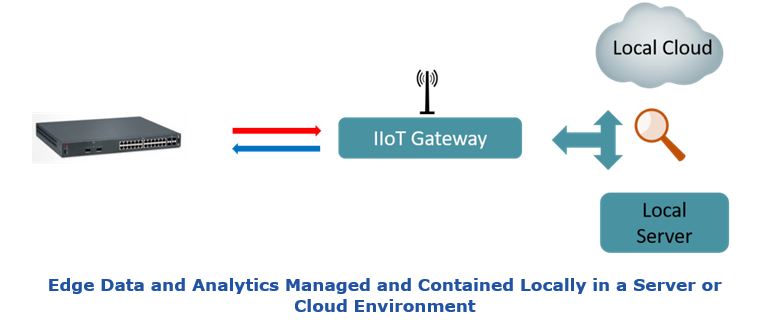
Security, privacy, data-related cost, and regulatory constraints are often the reasons cited for keeping the analytics local.
This instance is the technical definition of edge analytics as it excludes the cloud or any other centralized analysis, even if local. The analytics are embedded within an edge machine or device, delivered via an add-on edge technology, or supported by a nearby gateway. Data storage and analytics are done on the device or within a network of edge devices. This is beneficial when bandwidth requirements are small and the analytics less complex than what is typically processed at a platform level.
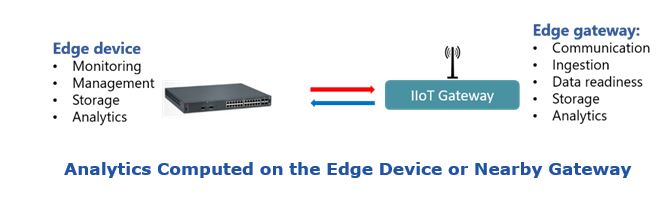
Speed is typically cited as the chief reason for using edge analytics where results data is streaming or results must be delivered in real-time or near-real time. Proponents of this approach also mention that a lot of edge data is not useful for the rest of the enterprise. Edge analytics can then be used to eliminate the cost of transporting, storing, and processing of this “noise.”
The most recent innovation related to edge data envisions intelligence distributed at any data node. This approach is referred to as fog analytics or fog computing.

Fog analytics operates on the principle that processing should be done where it provides value. In this instance, flexibility is the overriding requirement, as the analysis might occur at any layer of the operational footprint, extending to any point both horizontally or vertically. A use case may require any mix of device-only, local, network layer, or enterprise analytics.
Fog analytics provides agility: data is measured and processed based on its ability to provide value, and not just for the processes they might support. The data can be considered for analytics across multiple time scales, from streaming to investment planning, for example. If the use case requires the data to stay in a contained environment, the organizations benefits by limiting data cost and process complexity. Or, it can be shared and broadly used across the enterprise, should a use case develop where it provides business value to do so.
As companies create use cases that include edge data, they will increasingly embrace the value of distributed analytics. In some cases, there will be quantifiable tactical benefits to contain data locally and use it for instantaneous edge analytics. In other instances, some or all data will be shared to support “big picture” analysis. These analytics, processed in the cloud, will deliver business model, process optimization, competitive, customer satisfaction, and other strategic-level benefits.
A likely high-growth area for distributed analytics is with solutions for asset performance management (APM). Given how many high-value, high-risk assets operate at the industrial edge, it’s a logical jumping off point. Here are a few examples of use cases that process edge data both locally and in a centralized cloud:
Integrating analytics into a business is challenging. It requires businesses to rethink industrial and corporate settings in which processes are rigidly embedded. However, the benefits far outweigh the risk of change. As analytics become increasingly integral to digital economies, businesses that aren’t effectively using data to drive decisions won’t be able to compete.
Based on ARC research and analysis, we recommend the following for industrial organizations:
If you would like to buy this report or obtain information about how to become a client, please Contact Us