Representative End User Clients







Representative Automation Clients







Representative Software Clients









Industrial companies increasingly compete in markets affected by globalization and rapid technology advancements. To survive and thrive, these companies are attempting to leverage massive amounts of data from connected and  intelligence systems and devices. The phenomena are commonly referred to as the Industrial Internet of Things (IIoT).
Using interconnected equipment, devices and systems, organizations can collect a wealth of real-time data about their operations. Historic data, collected then often unused for decades, can also be mined for new value. Provided the proper methods are used, unstructured data such as video, audio, work logs, manuals, paperwork order documents can also be integrated into analytics to provide value.
Analytics is hardly a new thing, as many industrial businesses have been employing historic performance monitoring and describe/discover analysis (also known as “business intelligence”), for some time. How-ever, analytics are quickly evolving beyond their business intelligence roots.
Advanced analytics solutions, particularly those that use machine learning and pattern recognition to predict asset failures, are becoming widely available in industrial markets. Sometimes real-time condition monitoring is also labeled as asset failure prediction. In other contexts, it can be considered as a subset of asset performance management (APM), which ARC has written about extensively in the past.
This report will discuss asset failure prediction within the overall context of predictive analytics. It will outline why predicting asset failures is critical to industrial companies. It will further define and discuss cognitive analytics, a method used to predict asset failure and detail what operational conditions are specifically suited for this application.
In this report, we’ll explain how cognitive analytics differ from other predictive methods. Our goal is to provide some clarity about how to consider cognitive methods within the overall context of APM in your operations.
Asset failure prediction provides a clear example of the tangible benefits industrial users hope to gain by using advanced analytics. Driven by the growth and availability of IIoT data, asset failure prediction is one of the operational applications currently dominating industrial analytics use cases. Failure prediction is deemed the basis for  implementing more advanced APM strategies, such as predictive and prescriptive maintenance.
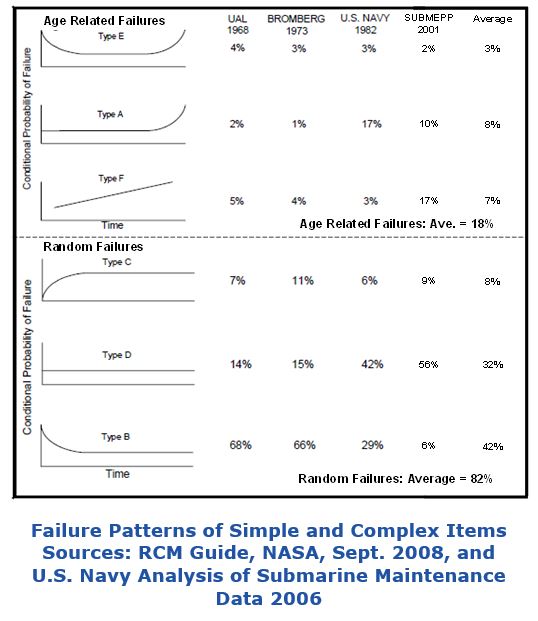
Why is it so important for companies to achieve these more mature methods for asset maintenance? Based on enterprise asset management (EAM) research conducted by ARC’s Ralph Rio and validated by other independent reliability organizations, 82 percent of all assets fail randomly despite having rigorous reliability and preventive maintenance programs in place. Clearly, companies need more effective ways to predict with high accuracy both why and when assets will fail, whether early in life or as they age.
 Using analytics to predict asset failure delivers benefits for users at several levels. On the operational level, it enables companies to identify where, when, and why risk is possible and implement maintenance strategies to eliminate failures before they occur. Doing so drives more precision into work, removing the cost of ineffective maintenance and rework. Additional operational benefits include asset longevity, operational uptime, and improved safety.
On the business side, cash can be conserved by avoiding investment, thus improving margin. Quality assurance can be improved as operational disruptions are limited. Supply keeps pace with demand to im-prove customer satisfaction.
Cognitive analytics methods are designed to replicate human thought processes in computers and machines. They are often marketed using terms such as deep learning, deep machine learning, neural networks, neural nets, and artificial intelligence. In industrial applications, cognitive analytics is often combined with several other analytical methods.
Like other analytic techniques, cognitive analysis is not new, going back to an algorithm published in the mid-1960s. However, a few recent drivers have revitalized interest for harnessing these methods for business purposes. The most visible aspect was the Google Brain project led by noted  machine learning and artificial intelligence (AI) researcher Andrew Ng. In this project, Ng and team randomly selected ten million YouTube videos and then used unsupervised deep learning so computer processors could identify and aggregate cat and human images. The results were accurate enough to demonstrate the general potential for deep learning. Since the experiment, users of this method have continued to improve its accuracy.
Historically, cognitive analytics fell out of favor due to the overwhelming computing challenges. Even Mr. Ng’s experiment required staggering processing power.
That power is now cheap, ubiquitous, and fast. As a result, cognitive analytics are experiencing a resurgence, particularly for business use.
Cognitive analytics use algorithms that apply aspects of human intelligence to problems. Using machine learning, they can find representations in data without being told what to look for. So, they tend to work well with unstructured data. This capability is the basis for one type of predictive machine learning solution used for applications such as predicting asset failures to optimize an organization’s maintenance scheduling.
In contrast, statistics or single-layer reasoning algorithms, such as decision trees, draw conclusions. They are very effective at doing so and can also be applied via machine learning. These methods are ideal for discovering hidden but known insights by filtering out noisy, irrelevant data.
On the other hand, cognitive analytics discovers representations in data without presupposing any relationships among them. Using super-vised machine learning, cognitive methods can support image recognition in onboard cameras in cars, as an example. They are also used to direct recommendation engines and support customer relationship management automation.
Because relationships are not necessary among the data, cognitive ana-lytics are ideally suited for working with unstructured and unlabeled formats using unsupervised learning. And because they work well using unsupervised learning, cognitive analytics are also effective for working with large data sets. Google News is a good example.
Given that research shows that 82 percent of all assets fail randomly, many variables need to be considered to predict failure with a high degree of accuracy. Contributing factors might reside within a wide range of sources: work orders, visual and audio recordings, operating data, sensors, engineering inspection notes, operator logs, etc. Third-party information, such as weather data or previously untapped customer data, could provide additional value.
Cognitive analytics are suited for the volume and random nature of this data, particularly if unsupervised learning is needed. When applied to assets, cognitive analysis can identify new patterns or outliers that will lead to degradation and failure.
With these considerations in mind, deep learning analytics provides four capabilities critical to problem solving asset failure. These are:
• Detecting similarities and anomalies: The ability to identify an outlier or commonalities is the root of failure prediction. Cognitive methods aren’t locked into a data relationship, so they can detect anomalies and similarities in data where no prior relationships were understood. This ability to discover the previously unknown contrasts with engineered algorithms and single-layer analysis that detect the hidden but known.
• Adaptability: Cognitive algorithms work well for unsupervised learning. This characteristic is suited for operating environments where the data from physical objects, such as assets within the same class, naturally varies from use to use. The underlying capability doesn’t change, so the analytics remain unaffected as the asset use conditions or any related data variances occur.
• Scalability: Cognitive analytics improve the more they are exposed to data. As the analytic examines additional data and receives feed-back, predictions become more precise and accurate. Assets (and related processes) are constantly producing new data, whether directly or via systems and people. These data may provide new in-sight into predicating asset failure, so scalable learning is required if the analytics are to keep pace with change.
• Knowledge transfer: End users often simplify or misunderstand this prescriptive capability. Cognitive analytics can be applied to dis-cover, crowdsource, contextualize, and share knowledge from disparate sources that are often tightly siloed, collected but rarely ever used, or not part of an “active” knowledge base. These data usually involve a mix of structured and unstructured formats residing within a range of sources, including work logs, applications, event re-ports, images, e-mails, manuals, historians, the Internet, etc.

Additionally, techniques like natural language processing (NLP) can deliver prescriptive feedback to support the point of decision. The sup-ported application does so by interacting with humans using common language. (Think of your mobile device boosted to perform at an industrial level.) For example, a technician working in a difficult environment, elevated in a wind turbine or oil platform, can speak directly with an application that can engage in a complete discussion with an NLP application. The application can use that analysis to have a discussion, identify problems, query knowledge sources, and send answers as the work is being undertaken.
Integrating any form of advanced analytics into a business can be challenging. Cognitive solutions require patience for matching the methods with the use cases for which they are best suited. They also require businesses to adopt a mindset that is comfortable, one that relies less on human judgment and more on probability. However, the benefits far outweigh the risk of change, as these analytics can provide business insights that, in the past, were simply out of reach.
Based on ARC research and analysis, we recommend the following for industrial organizations:
• For effective asset performance management, realize that different methods of advanced analytics have different objectives: some are designed to discover the hidden but known, while others identify similarities and anomalies that point out the previously unknown.
• Consider developing strategies for how analytics can be used for knowledge management.
• Analytics aren’t about “best” versus “worst.” They are about fit. When looking at any solution, apply the ARC analytics rule of thumb—three rights never make a wrong:
If you would like to buy this report or obtain information about how to become a client, please Contact Us