Representative End User Clients







Representative Automation Clients







Representative Software Clients








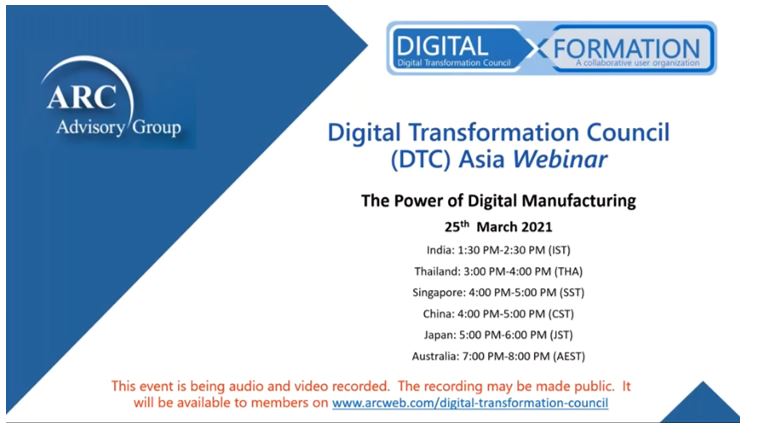
The Power of Digital Manufacturing was the theme of the Digital Transformation Council (DTC) Asia webinar, hosted by ARC Advisory Group, India on March 25th. In his welcome note, G. Ganapathiraman, General Manager and Vice President, ARC Advisory Group, India, said that the DTC is meant only for the end user community and provides a platform to connect, collaborate, learn and share with peers who are digitalizing and transforming their organizations. DTC members can use the Council’s library, consult analysts, and have access to the global forum archives for the next three months. Further, he informed the audience about the agenda and process to be followed during the webinar. Bob Gill, General Manager, Southeast Asia, ARC Advisory Group introduced the topic and welcomed the speaker, Luc Scheffer, Chief of Manufacturing Technology, Rolls-Royce. This was followed by a lively Q&A session. The webinar can be viewed here.
Introducing the topic, Mr. Gill said that the manufacturing industry continues to be a major contributor to economies across Asia. Although devastated by the COVID-19 last year, the manufacturing sector held up relatively well. For instance, in Singapore, while the economy contracted by 5.4 percent (worst recorded performance), the manufacturing output increased by 7.3 percent, compared to a year earlier. In many parts of Asia, the nature of manufacturing is changing, and Singapore is a prime example of this. Labor intensive manufacturing of relatively simple products back in the 1960s has gradually been replaced by an industry that is much more reliant on knowledge, skills, IT, and automated processes. The focus today is on semiconductors, high value electronics, precision engineered components, biopharmaceuticals, petrochemicals, and aerospace parts and components. The Singapore government affirmed its commitment to maintain manufacturing as a key pillar of the economy, announcing plans to grow the sector by 50 percent in value over the next decade. This necessitates investments in R&D, workforce skills training, and initiatives to help companies to digitalize their manufacturing operations and transform their businesses. Singapore already boasts of global companies that have chosen the country as the preferred location for advanced manufacturing facilities. In this context, he said that Rolls-Royce has a strategic partnership with Singapore’s Nanyang Technological University, (NTU). Then the baton was passed on to Luc Scheffer.
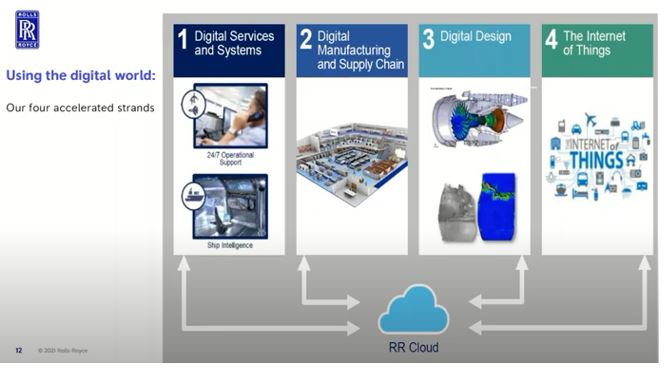
Last year taught us to work remotely and leverage digital technologies, said Mr. Scheffer. Rolls-Royce immediately brings to mind the high-end luxury automobile, but this segment was sold to a German group years ago. Rolls-Royce is now a technology company aiming for more sustainable power for society, and the company’s motto is Pioneering the Power That Matters. The pandemic created a challenging environment, but a few sustainable initiatives were accelerated. Need of the hour was leveraging technology for top notch manufacturing. “The technologies we are working on today are about imagining what’s possible in the future.” The company has been using digital solutions for a while, he said. Mr. Scheffer spoke about data optimization and the company’s launch of “power-by-the-hour,” in the mid-90s for the civil aero market; this is part of the “total care” contract. This enabled excellence in service delivery as the parameters of all the engines could be assessed and monitored in real time. Besides, Rolls-Royce provides power for marine applications and trains too. To leverage this knowledge and apply it to manufacturing operations and the supply chain, an end-to-end digital thread was needed. He spoke about the four accelerated and interconnected strands that create the ecosystem for operational excellence.
Further, he spoke about communication protocols and evolving technologies, like 5G and new sensors, that provide significant advantages. Solutions can be merged with the IoT architecture communication systems, and informed decisions can be taken for end-to-end manufacturing, while ensuring cybersecurity. Mr. Scheffer cited the example of a fan blade linishing machine (historically manufactured only in the UK) being manufactured in Singapore as the country provides strong IP protection. This is a significant achievement, as the plant will furnish most of the fan blades for all Rolls-Royce engines. Speaking about the technology readiness level and technology maturity, Mr. Scheffer said that some technologies can be adapted, like Rolls-Royce has from NASA. Moving from a university’s lab environment to the shop floor can be daunting, hence it’s necessary to share knowledge and collaborate, he said. Strict regulations are enforced in the aerospace sector and microscopic defects have to be detected, so Rolls-Royce deploys digital cameras together with artificial intelligence (AI) and machine learning algorithms to scan the blade/product. This is an intelligent method of manufacturing.
The driver to adopt smart manufacturing: Understanding and deploying the right method of manufacturing increases operational effectiveness and efficiency levels, and this proved to be a strong driver.
Similar approach in other Rolls-Royce plants: The flagship plants in Singapore were rolled out with the government’s collaboration. The learning gained through this has been shared across all plants and operations.
Partnership model and technology transfer: In the research centers, technology is shared, and some can be used in varied industries for different applications. Collaborating, testing, and implementing all happen in a shared environment.
Standardizing the solutions provided by multiple vendors: Standards have to be set, and through various projects, specs and protocols are defined.