Representative End User Clients







Representative Automation Clients







Representative Software Clients








Implementing Artificial Intelligence (AI) has become a key challenge for organizations looking to create a competitive 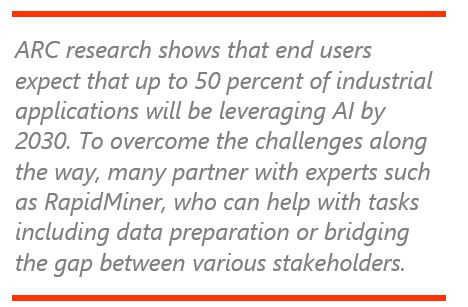 advantage through their data. Introducing a new technology (and associated process changes) is always a demanding task. According to ARC research, around 50 percent of respondents consider themselves to be in the “piloting” phase of an AI implementation. End users also expect 40-50 percent of all industrial applications to leverage AI by the year 2030. To reach this lofty goal, they need technology partners to help them address the main challenges that come with AI implementation: bridging the gap between multiple stakeholders and dealing with data. This ARC View will show how the use of RapidMiner as a partner for AI projects can help end users address these two key challenges.
Implementing an AI application is still a relatively new concept for many end users. As with any new technology or  strategy, every step from proof-of-concept to lifecycle management can seem daunting. ARC’s continuous research on artificial intelligence in manufacturing has uncovered the most common challenges that organizations face in their AI projects––you can see the results in the chart below.
The blue bars represent challenges that are not just unique to end users, but to their organizations as a whole. In the case of AI, these challenges are amplified by the fact that it is such a cross-functional technology and has to address the needs of plant floor workers, data scientists, business executives, and many other groups. At times, the interests and goals of these groups can vary strongly, leaving many gaps to bridge.
The orange bar represents a common blocker that’s preventing many organizations from even getting started with AI. Anyone who works with data knows that you must clean and prepare it to be usable for analysis. For those who aren’t lucky enough to have processes in place for data prep, this process can consume a lot of time and resources while having significant implications for the success of a project.
Still, as mentioned above, most of the respondents in our survey expect AI to become an integral part of production through 2030. Research also shows that early adopters of AI can typically expect a faster ROI and greater impact to their bottom line. So, what does it take to be part of the early adopter group?
The gap in question is characterized by different groups, their goals, and varying levels of knowledge in data science and manufacturing, respectively. The knowledge of these groups is often “tribal knowledge” that is only passed on within the group. As Sarma Malladi from the Swiss engineering and manufacturing company SWM International puts it, “all manufacturers face the problem of tribal knowledge.”
To bridge the gap, strong management, leadership, and technology are needed. In ARC’s view, these fundamental internal requirements must be supported with a suitable tool that fulfills the following crucial demands:
RapidMiner’s tools specifically address the “skills gap” issue and support the need to bridge that gap.
The tailored user interfaces enable both beginners and experts to work with the same data. For example, beginners can use the AutoML solution RapidMiner Go to create basic models in just a few clicks, while experts can custom-code their own functions and share them with teammates using RapidMiner Notebooks.
This is all done on a single version of truth, e.g. a common database. This helps to bridge the aforementioned knowledge gap, as OT people from the plant floor can work with data quickly and create their own insights. Typically, the first aim is to re-create existing views and test the system against tribal knowledge. Then, after trust is built up, new insights and productivity gains follow.
In the following case study from the electronics industry, data from customer support was used by the data science team––given the size of the organization, the data represented millions of customers around the world.
As is the goal with any data science project, customers aren’t aware of what’s happening behind the scenes––they’re simply served better as a result of the right model being implemented. This case study below also shows how AI impacted the post-sales department as well as the production of spare parts. All parties involved rely on and trust the predictions of their developed machine learning models.
The organization that implemented this use case is a well-known, leading electronics manufacturer for the consumer and professional markets. Its diversified business includes consumer and professional electronics, gaming, entertainment, and financial services. The company needed to reduce overall customer support costs and tasked the 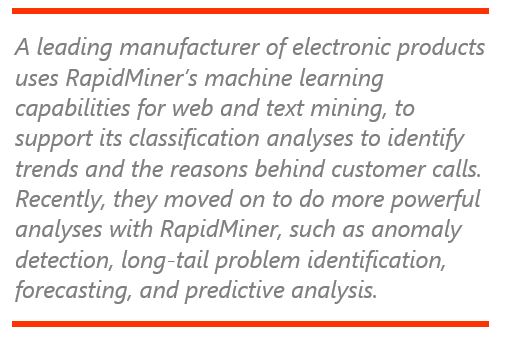 data science team in their post-sales organization with achieving that goal.
The main project owner and their data science team understood the basic customer support statistics -- how many people called, how long people stayed on the phone, how many people visited the support website etc., but it was more difficult for the team to determine why people were calling. The reason for their lack of understanding was that the vast quantities of unstructured data that could help them had not previously been used.
A first step towards deeper analytical insight and greater business value was to focus on classification analyses -- why people are calling–– and document it in as much detail as possible (reasons and multiple layers of sub-reasons). To do this, the team first had to automate many of their existing business processes. An example of this was the translation process. With RapidMiner, the team could create workflows that allowed unstructured data in 26 different languages to be routinely translated for easier interaction and analyses.
This electronics manufacturer first used RapidMiner for web and text mining to support their classification analysis, which allowed them to identify trends and the reasons behind customer service calls. Today, the team is moving on to do more powerful analysis with RapidMiner, such as:
 In a recent panel discussion at the ARC Europe Forum, it was stated that 80 percent of the work on AI is not about AI itself. One of the major challenges is lack of data and poor data quality. Imagine having to connect 40 years of equipment usage in a brownfield plant to gain access to the necessary data. Even if you’re successful, the resulting data will likely vary in completeness, collection frequency, units, accuracy, availability, etc. It’s also likely that most of the data has not been labeled correctly, which creates even more work.
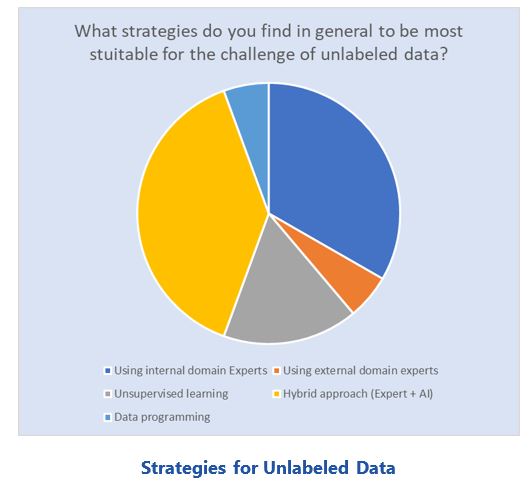
Over the years, ARC has done a lot of research into the way organizations typically approach the problem of unlabeled data. Most rely on internal experts, often supported by some sort of tool, which can range from excel templates to more sophisticated software. This time-consuming process often increases the true cost of a project.
To support the data preparation and labeling, RapidMiner offers their data preparation tool Turbo Prep, which helps address the issue of inconsistent data. Its supporting functions are divided into five broad categories:
In this case study, the electronics manufacturer first experienced benefits by simply using the translation function. It created insights and tangible benefits without even getting to the core of AI.
The end user also mentioned that previously, the data science team operated in an 80/20 environment – 80 percent of its time was spent on collecting and managing data, and only 20 percent on analyzing it. Now that all the tedious tasks of data cleansing and collection are automated with RapidMiner, the company flipped this ratio -- 80 percent of their time is spent on in-depth data analysis, and only 20 percent on collecting and managing data.
ARC has experienced it often in the past: End users and machine builders do not implement any new technology unless they understand it fully and are convinced it can help them achieve their goals. This has often resulted in the development of proprietary, in-house solutions, which can be effective but is extremely time and resource intensive. After solutions of this nature are implemented, they often stay in operation for sometimes up to 40 years, resulting in huge lifecycle costs.
While it is certainly true that an end user or machine builder needs to understand the technology fully – as they are responsible for the safe operation of plants and equipment – the right platform (such as RapidMiner) combined with industry expertise can help to kickstart the process, accelerate implementation, lower lifecycle costs, and even create opportunities that go well beyond the initial scope that your organization envisions.
ARC Advisory Group clients can view the complete report at ARC Client Portal
If you would like to buy this report or obtain information about how to become a client, please Contact Us
Keywords: Artificial Intelligence, AI, Machine Learning, AI Implementation, RapidMiner, Data Conversion, Anomaly Detection, ARC Advisory Group.