Representative End User Clients







Representative Automation Clients







Representative Software Clients








Summary
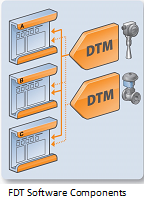 FDT is a standardized software technology for interoperability between field devices and automation systems. FDT specifies two types of software components. One is the DTM (Device Type Manager) that acts like a device driver -- encapsulating the features and behaviors of a particular field device (for example a radar level transmitter or a robotic welding tool). The second component, the Frame Application, provides a unified runtime environment for any and all DTMs. The FDT specification defines the interface between the Frame Application and the DTM (see figure). FDT manages the properties and behaviors of individual fieldbus protocols separately, treating fieldbus as an abstraction. This makes both the DTM and Frame Application independent of any fieldbus protocol and makes FDT extensible to support any present or future fieldbus protocol.
Many small-to-medium sized suppliers of measurement products find FDT especially attractive. They can provide DTMs for their products, enabling them to work with any FDT Frame Application. But creating their own FDT Frame Application is not something these companies want to do. A Frame Application is a relatively complex piece of software and these SMEs prefer to focus on developing their measurement and automation products and differentiate themselves based on these products. In their view, configuration software tools are a means to that end and they prefer to supply such software tools without charge to their customers. But to employ and test their DTMs, these firms needed a Frame Application.

Enter PACTware (www.PACTware.com), a Frame Application developed and maintained by a consortium of 24 companies. Consortium member companies have access to the PACTware source code and are allowed to distribute the executables to their customers and partners. The typical PACTware consortium member is a German instrumentation and device supplier, but the membership has a wide range of company locations and sizes. The PACTware deliverable is a high- quality FDT Frame Application for the Microsoft Windows platform. The PACTware Consortium operates using a "shared source" business model rather than open source. Source code (and development cost) is shared only among participating firms. Members are also assigned responsibility for portions of the software testing.
Membership in PACTware has proven invaluable to many automation companies. The biggest business value has been access to a high-quality software product at a low cost and risk. Some members are not technically capable of undertaking a major software product development. Even those that are capable prefer not to invest merely to develop a product configuration and management tool. Based on discussions with member companies, ARC Advisory Group estimates that PACTware membership costs roughly 10 percent of what an in-house product would require. Risk and responsibility for the product are shared among the members. This also provides a broader spectrum of input for requirements and enhancements as well as a much broader testing process. Consortium membership fees are based on corporate revenues, but the fee structure is such that it attracts companies of all sizes. Invensys (recently acquired by Schneider Electric) is a member, so the consortium now includes automation companies of all sizes.
Key Success Factors
Sadly, the automation industry is littered with the remains of many failed attempts at technical collaboration and standardization. This makes the unheralded success of the PACTware consortium remarkable. It is worth considering some of the factors that have contributed to the success of PACTware and its consortium.
The organization was created with a clear, manageable and well-defined mission. The PACTware articles of association are only four pages long – the shortest such document that ARC has ever seen.
Software development and software technology are not highly strategic for many of the members. This is not to say that FDT is not important to these companies. It surely is. But FDT Frame Applications (and software development in general) are of lesser importance to many members. SME members are much more focused on differentiating their measurement and field products. Indeed, many treat software development as a cost center rather than as product. Large members (such as Invensys) already manage many software businesses and products, most far more important as differentiators than an FDT Frame Application. So all members want a high-quality product, but are focused on controlling costs, risk, and avoiding "mission creep."
 The consortium is focused on a single product deliverable, so there is no internal competition or need to allocate the available technical resources.
The PACTware product operates quite standalone and does not require significant integration for most members. Some members integrate it with other configuration applications, but the majority simply re-distribute the software to their customers along with the DTMs that support products these customers have purchased.
There is a high degree of cultural and business harmony among the member companies, especially among the earlier members, who were German instrument and field device companies. In ARC's view, this factor helped the consortium get going and quickly become effective. It did not begin with sponsorship of any major automation supplier, so the initial members had a similar outlook and objectives and truly had to share their costs and risk. This is different than a partnership program sponsored by a major automation supplier, where the major supplier generally provides most of the technical and financial support for the organization.
The group benefitted from the intellectual property contributions of one member (Pepperl+Fuchs) that had begun to develop its own software but realized that widely sharing its future cost burden would work out better for them and for others.
PACTware members report to ARC that the value of their membership has also been enhanced because the consortium is revising the software to incorporate the latest revision of the FDT standard. The PACTware consortium will soon release an FDT2 version of its product, with its design improved to further ensure interoperability. When completed, this software will be made available to PACTware members for their own use.
Conclusion
The consortium software development model grows increasingly effective as internet collaboration technologies improve. Indeed, the collaborative software development technologies that enable the many critical open source programs in IT can easily be adapted for use by private groups operating with a shared source model, similar to PACTware. Likewise, the legal entity governing such an effort can be located anywhere in the world based on convenience and suitability of local legal systems.
ARC sees considerable room for this type of software development cooperation within the automation industry. Limiting the efforts to non-strategic products does not eliminate the value of collaboration, as suppliers need to integrate a growing number of technologies and products in today's market. Another example, quite similar to PACTware is the WiTeck consortium (www.witeck.org) that develops WirelessHART communication stacks and other related software products. The list of possible areas of cooperation does not end there. The benefits of higher software quality and lower cost and risk are attractive business propositions in many cases.
The development of PACTware has given a major boost to FDT adoption in automation. Marketeers who see software development requirements as a barrier to success should consider these types of options carefully. ARC believes there could be many more similar success stories.
All signed-in ARC Advisory Group clients can view this report in pdf format at this Link
If you would like to buy this report or obtain information about how to become a client, please Request ARC Info
Keywords: FDT, Field Device, PACTware, Shared Source, Software.