Representative End User Clients







Representative Automation Clients







Representative Software Clients








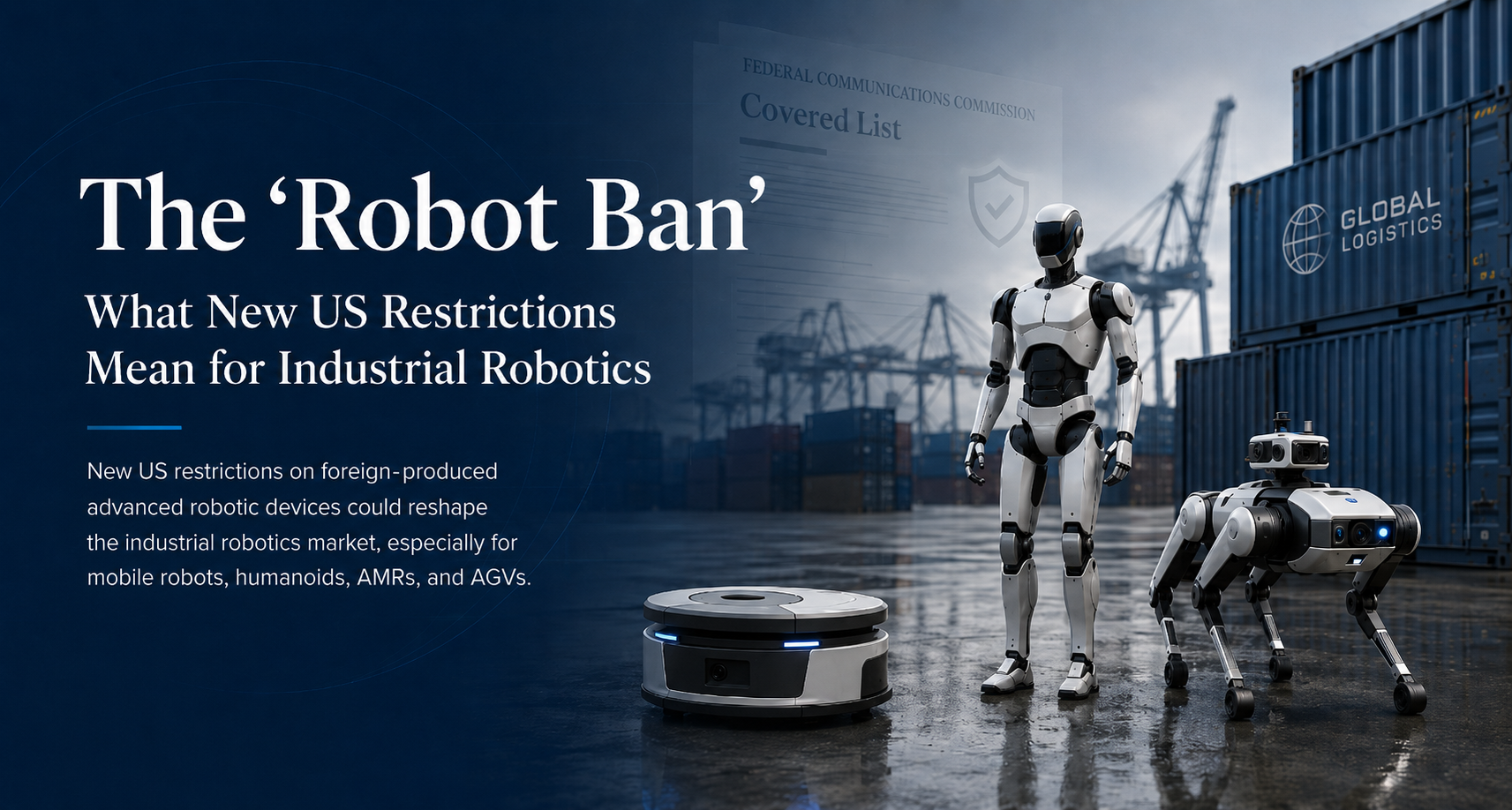
In recent weeks, the US Federal Communications Commission added foreign-produced “advanced robotic devices” to its Covered List. New models can no longer receive the FCC equipment authorizations generally required for import, marketing, or sale in the United States unless they obtain conditional approval. Previously authorized models remain legal to import, sell, and use, and fixed industrial robots are explicitly excluded.
The latest US action is not simply a ban on Chinese humanoids, but a production-based market access rule for connected mobile robots that reaches European, Japanese, Korean, and Chinese suppliers alike. For industrial stakeholders, the larger issue is whether this policy strengthens the domestic robotics ecosystem or inadvertently slows the automation needed to make US manufacturing more competitive.
Robots covered under the restrictions must satisfy the following requirements:
Be a mobile ground device capable of locomotion, navigation, obstacle avoidance, or movement.
Operate away from a human operator based on commands or sensor data
Weigh more than 4.4 pounds, including any docking or ground station
Contain an environmental sensor, wired or wireless connectivity of at least 200 kbps, and software, firmware, or AI model weights controlling navigation, perception, data collection, or remote command.
Specifically excluded are connected vehicles, rail-only vehicles, drones, unmanned underwater vehicles, FDA-regulated medical and mobility devices, and fixed stationary industrial robots.
“Foreign-produced” is defined using the federal domestic-end-product test. A robot must be manufactured in the US, and the cost of domestic components must exceed 65 percent for it to be allowed. The nationality of the manufacturing company does not matter.
| Segment | Ban Exposure |
|---|---|
| Fixed articulated robots | Low |
| Stationary cobots | Low |
| AMRs and AGVs | High |
| Humanoids | High |
| Quadrupeds/inspection robots | High |
The most obvious beneficiaries are US developers of AMRs, autonomous forklifts, quadrupeds, mobile manipulators, and humanoids that can demonstrate qualifying US production. These suppliers faced stiff competition for the US mobile robot market, which was gaining serious ground in the region. Many deployments in recent years also originate from Japan and Europe, which shows how dependent the broader automation market has become on international supply.
However, being an “American company” does not mean suppliers are safe from this regulation. US developers using contract manufacturing abroad or relying heavily on foreign components may still fail the 65 percent component-cost test. With so many of the innovative robotics startups using components from abroad to build prototypes and test their solutions, they may find themselves having to unwind their development strategies.
For non-Chinese foreign suppliers, the rule creates an unusual split. A Japanese or European fixed robot arm remains outside the FCC action, while that same supplier’s AMR, AGV, autonomous forklift, mobile manipulator, or humanoid can be covered if produced outside the United States.
The positive technology outcome could be a shift toward secure-by-design robotics. Suppliers seeking approval must understand component provenance, software ownership, update responsibility, sole-source exposure, and manufacturing location.
The risk is that market fragmentation reduces developer access to affordable hardware. Low-cost platforms emerging from the Chinese market have been critical for embodied-AI experimentation, learning, and developer-scale testing. Restricting future low-cost platform generations could raise the cost experimentation for US universities, startups, and integrators,even as it protects domestic suppliers from price pressure.
Manufacturers using fixed robot cells should first determine whether they are actually affected. In most cases, an installed stationary articulated, delta, Cartesian, gantry, or SCARA robot is outside the FCC action. Logistics, warehousing, utilities, process plants, infrastructure operators, and manufacturers using AMRs, AGVs, quadrupeds, autonomous forklifts, or mobile manipulators have a more direct exposure.
For existing mobile fleets, buyers should preserve authorization records, validate the permitted update path, secure spare parts, and confirm how long the supplier will maintain the authorized model. For new projects, request evidence of FCC status before pilot approval and require the supplier to identify the production location, domestic-content methodology, and approval status.
The probable outcome is a regionalized robotics market with overlapping supply chains, not complete separation. Final assembly, trusted software governance, sensitive data, and certain critical components will increasingly be localized. Commodity electronics, compute, batteries, sensors, actuators, and permanent magnets will remain internationally sourced where domestic capacity cannot meet the need.
For US buyers, this likely means more supplier qualification, higher early compliance costs, and potentially less price competition. Over time, it could also produce better traceability, stronger update governance, more resilient sourcing, and deeper domestic production. The balance will depend on whether US policy pairs these restrictions with sufficient investment in domestic manufacturing capability and talent. The FCC has created a powerful incentive to localize in the US, but it has not yet solved the harder problems of manufacturing scale, component economics, integration, safety, and productivity.
Do not confuse US branding with domestic qualification. Production location and component cost determine exposure, not company headquarters or nationality.
Separate fixed automation from connected mobility. Fixed industrial arms remain outside the FCC restriction, while AMRs, AGVs, quadrupeds, humanoids, and mobile manipulators may be affected.
Expect competition to shift from hardware price to deployment capability. With reduced access to cheaper Chinese products, supply-chain provenance, cybersecurity, service capacity, authorization resilience, and repeatable application performance will increasingly determine who can scale in the US market.
What I saw at Automate 2026, Part 1: The US Manufacturing Renaissance
What I saw at Automate 2026, Part 2: The Future is Humanoid?
Humanoids for Industry Blog Part 1: Why Humanoids? Why Now?
Humanoids for Industry Blog Part 2: Navigating the Ecosystem
Humanoids for Industry Blog Part 3: A New Market on the Horizon
For discussions on physical intelligence and the new wave of industrial robotics, or to offer feedback on this article, contact Patrick Arnold at [email protected].
Set up a meeting with myself and the Analysts at ARC Advisory Group to find out more about our Executive Insights Service for Industrial organizations, MarketMap efforts, and more.