Representative End User Clients







Representative Automation Clients







Representative Software Clients








Keywords: Digital Twin, Siemens Xcelerator, Industrial Metaverse, Software-defined Automation, Digital Data Chain, Sustainability, ARC Advisory Group.
Siemens has been a player in process automation since the early 1980s with solutions for a wide variety of industries, from power generation to pharmaceuticals. In recent years, the company has made a series of strategic acquisitions and investments to round out its process automation portfolio, including a growing share of software. At the same time, Siemens has installed a new generation of management stemming from diverse background. So, it was time once again to travel to Siemens PA headquarters in Karlsruhe, Germany, where the company offered ARC analysts a 2-day on-site briefing.
Key Takeaways
The Industrial Metaverse is an environment in which users interact with physical assets and their digital twins to simulate, design and test in collaboration with others.
The Siemens Xcelerator is driving a growing ecosystem of customers, partners and solutions.
The Digital Data Chain is a useful joint industry initiative for standardized information exchange.
Sustainable products can be created by using gPROMS to design for sustainability.
ZETA and Siemens are cooperating on Smart Engineering Services.
It’s been 25 years since Siemens launched Simatic PCS 7, the successor to its dated Teleperm M process automation system. Using the same hardware as for its large PLC, Siemens showed the world that an automation supplier can play both sides of the net (factory and process) using common hardware. But the world has changed significantly in a quarter century. In 2019 Siemens launched Simatic PCS neo, a successor to Simatic PCS 7, which is currently offered in parallel as the company adds functionality necessary to evolve it to a “full-blown” distributed control system (DCS).
Simatic PCS neo uses the same S7-400 hardware as Simatic PCS 7, but its engineering layer is entirely new. The user interface is browser-based, which offers new possibilities in multiuser, collaborative development while disposing of traditional monolithic engineering software.
Siemens’ gPROMS for general PROcess Modeling System is among the most advanced general purpose process modeling and simulation software available today. gPROMS enables companies to produce more sustainable products starting from the design stage by offering advanced process modeling and simulation. It allows engineers to simulate various design scenarios and optimize them for resource efficiency, waste reduction, and energy savings. By accurately predicting process behavior, gPROMS helps in identifying the most sustainable and cost-effective design choices before actual production begins. This leads to a reduction in material usage and environmental impact. The software also facilitates continuous improvement by allowing companies to refine their processes based on real-time data and insights, ensuring that sustainability is integrated throughout the product lifecycle.
For Siemens, software-defined automation (SDA) is the end game of industry’s evolution from the classic automation pyramid to a user-oriented architecture. Like their colleagues in factory automation, Siemens PA has a vision of the future of process control that is centered on SDA as the path of evolution from the classic automation pyramid to a user-oriented architecture.

The current Simatic PCS neo offering includes important features such as object-oriented data management, support for the new MTP standard, multi-user cloud-based engineering, and secure remote system access via IT encryption. The vision builds on Simatic PCS neo as the core of an open system centered on virtual control that mixes Siemens apps with third party apps from the edge to the cloud, providing full data accessibility from top to bottom.
Simatic PCS neo cloud-based engineering offers features including co-creation via multi-user capability, easy and secure access, integration of local workplace, and a SaaS business model (pay only what you use). The move to the cloud is logical and should not be difficult for most current users as it doesn’t require any additional skills. Assuming set up and maintenance are left to qualified IT people, process engineers can continue to focus on the task at hand while enjoying new benefits such as collaborating with project colleagues around the world.
Artificial intelligence (AI) is a key part of Siemens’ vision. AI serves as the basis for Simatic eaSie, a multilingual chat-bot for operations and maintenance tasks in the field. Simatic eaSie is a digital assistant that allows users to access data from different systems by combining human machine interfaces with modern interaction methods such as chat, QR codes and voice input. While the use of AI-driven digital assistants is new to most process engineers, the technology is appearing in every conceivable application, so as with cloud-based engineering, the learning curve will be flat as users quickly reap the benefits.
A key part of SDA is virtualization, an area where Siemens PA has previous experience with the Industrial Automation DataCenter (IADC), an engineered solution for PCS7 deployed in a virtualized IT environment that it calls SIMATIC Virtualization-as-a-Service (SIVaaS).
Siemens’ process software portfolio has evolved through in-house development as well as acquisitions (COMOS) and strategic partnerships (Bentley). According to Siemens, the digitalization of all stages of the lifecycle from R&D to engineering and operations is key to process manufacturers becoming more sustainable. This is where the digital twin plays a big role.
Siemens’ process offering for digital twins starts with gPROMS, a process modeling tool for digital twins that capture fundamental knowledge about a process. A gPROMS model is used with state-of-the-art mathematical techniques to analyze and optimize the process design or operation. COMOS is Siemens’ engineering tool for process design and simulation, while SIMIT helps users simulate their process automation systems using existing engineering data. Mobile Worker is a maintenance management tool that consolidates information from different data sources such as CAx, ERP, and sensors and makes them available to mobile workers. Finally, XHQ is an operations intelligence solution that aggregates, integrates, analyzes, and visualizes information, with connectivity to multiple types of backend data sources.
gPROMS from Siemens enables users to produce more sustainable products starting from the design stage by offering advanced process modeling and simulation. With gPROMS, engineers can simulate various design scenarios and optimize them for resource efficiency, waste reduction, and energy savings. By accurately predicting process behavior, gPROMS helps identify the most sustainable and cost-effective design choices before actual production begins, which can lead to a reduction in material usage and its associated environmental impact. The software also facilitates continuous improvement by allowing users to refine their processes based on real-time data and insights, ensuring that sustainability is integrated throughout the product lifecycle.
Zeta Corporation, an EPC for the pharma and biotech industries, was invited to talk about the company’s cooperation with Siemens on the Smart Engineering Services (SES) platform, described as a seamless solution for integrated engineering and operations, ensuring maximum productivity and efficiency. According to Zeta, the future of integrated engineering is solutions in both the digital and the real realms. The goal is to address contemporary challenges such as labor costs, availability of talent, global collaboration, shorter times to market, and the growing complexity of plants with solutions that de-waste workflows, reduce interfaces, provide collaborative work environments, and simplify the implementation of new technologies.
Zeta aims to achieve these goals with the help of the SES platform. According to Siemens, SES consolidates data of all project partners, makes project status transparent, reduces interfaces for change management, and provides tools for project management. The collaboration foresees Siemens as the platform provider with SES running on the Siemens Xcelerator platform. Enabling technologies include generative AI, which powers the Siemens Industrial Copilot. Together with partners, Siemens plans to deploy the Industrial Copilot along the entire value chain to improve human-machine collaboration and accelerate development and innovation cycles.
Open platforms and close collaboration require air-tight security. According to Siemens, many security challenges remain:
Increasing cybersecurity attacks due to more data and connected devices
Higher complexity of data usage and open networks
Lacking knowledge of how to deal with cybersecurity challenges
Lack of skilled workforce due to specific skills needed
More security compliance requirements
Difficulty understanding facility status and preventing human errors
Ensuring remote work
Securing data exchange and communication with global companies
For industrial companies, it is important to start by upgrading the OT infrastructure to become compliant with the upcoming NIS 2 regulation and to establish cybersecurity with a defense-in-depth concept. According to Siemens, the solution is a move from a traditional infrastructure to a state-of-the-art cybersecurity environment by integrating managed switches and firewalls and implementing anomaly and intrusion detection. To this end, Siemens presented its new SINEC NMS network management platform, which provides a live overview of the entire network infrastructure with monitoring, diagnostics, and communications configuration.
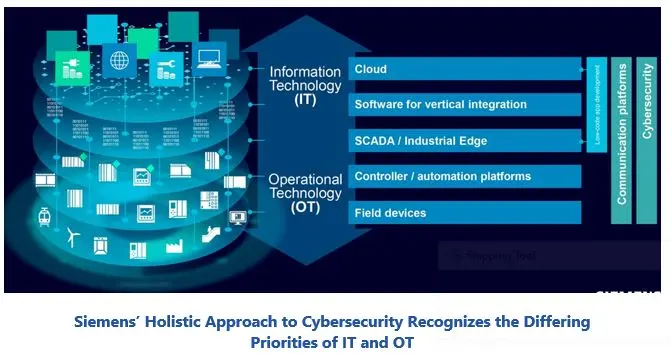
Key to a successful cybersecurity implementation is a clear understanding of the differences between IT security and OT security. ARC research has identified these in the past as data security and confidentiality on the IT side, and equipment availability and safety on the OT side. Siemens points out that while there are differences, all aspects can be addressed with a comprehensive, holistic approach to cybersecurity.
Siemens PA has come a long way since its early days in power generation. Its central DCS platform is now well into its third generation, and over the years the company has augmented its offering not just in functionality, but also in a growing portfolio of software and services. Some competencies such as power generation and oil & gas were spun off in 2020 into the separate entity Siemens Energy, while the Siemens Process Automation division continues to service its core chemical and pharmaceutical industries.
Software-defined automation and artificial intelligence are the primary drivers of Siemens’ vision for the future of process automation. In all areas of automation, technology is on the cusp of migrating to IT-like architectures and building AI support into software, from engineering and design to data analysis tools. With its deep investments in these technologies, Siemens is well positioned to help its process industry customers meet the challenges of the digital age.
ARC Advisory Group clients can view the complete report at the ARC Client Portal.
Please Contact Us if you would like to speak with the author.
Obtain more ARC In-depth Research at Market Analysis