Representative End User Clients







Representative Automation Clients







Representative Software Clients








The first ARC Industry Leadership Forum Singapore on August 1, 2024, was a resounding success with over 200 attendees. The theme of the Forum was Accelerate Transformation in the Age of AI, Open Automation, and Sustainability. Yokogawa participated as a Gold Sponsor at the Forum and in the session on Technologies for Transformation, Bejoy Jose, Vice President, Industrial Automation Products and Life Innovation Business, Yokogawa Engineering Asia, discussed the evolution and optimization of maintenance practices in industrial settings, focusing on leveraging AI and IIoT. At the end of the session there was a lively panel discussion. This blog captures the salient points of Bejoy’s presentation. It can be viewed in entirety here.
Bejoy’s session comprehensively covered best practices for field instrumentation and analyzer maintenance, focusing on lifecycle extension, performance optimization, minimized downtime, and cost-efficiency. He provided clear illustrations of the evolution of maintenance tools and techniques, sharing live examples that resonated with the audience, especially those who have experienced these transitions. He delved into meticulous inspections, precision calibration, and the importance of ideal environmental conditions. By adopting these refined best practices, organizations can significantly enhance field instrument maintenance, leading to increased productivity and reduced downtime.
Bejoy also highlighted the critical role of calibration and calibration management in maintaining measurement accuracy. He outlined comprehensive calibration procedures and the necessity of meticulous documentation as key components of a reliable maintenance strategy.
Furthermore, he explored proactive maintenance strategies, including preventive and predictive approaches, which empower maintenance teams to anticipate issues and prevent costly disruptions. The integration of advanced technologies such as IoT, AI, and data analytics was prominently featured, enabling real-time data utilization and predictive maintenance.
Bejoy emphasized the shift from routine periodic maintenance to predictive and optimized calibration practices, leveraging historical data and AI-based diagnostics to improve efficiency and reduce costs. He discussed the improved stability of modern pressure instruments and the need to optimize calibration intervals based on historical data.
While six months of stability was once considered excellent, some modern instruments now offer lifetime stability, allowing for fewer calibrations and reduced maintenance costs. Bejoy referenced ARC Advisory Group’s recent market analysis report on Pressure Transmitters, noting that data from previous calibrations can be used to predict future needs and optimize calibration intervals.
AI-based diagnostics can predict the condition of instruments and optimize maintenance practices. For example, AI can monitor the stiffness of Coriolis meter tubes and predict when maintenance is needed, aiding in the planning and optimization of calibration and maintenance activities.
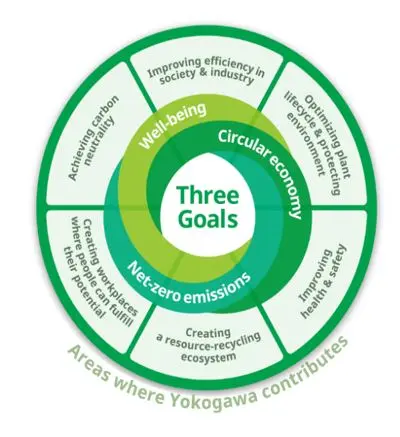
Bejoy concluded by aligning these practices with Yokogawa’s goals of well-being, circular economy, and net zero. He emphasized improving efficiency in society and industry, optimizing plant lifecycles, enhancing health and safety, creating a resource-recycling ecosystem, fostering a workplace where people can realize their potential, and achieving carbon neutrality.
Bejoy shared his thoughts on protocols and new technologies, highlighting that Yokogawa flowmeters now support the EtherNet/IP protocol, with plans to extend this to other instruments. Yokogawa has been involved in the shift from traditional to digital technologies, actively supporting HART, Foundation Fieldbus, Profibus, ISA100 Wireless, LoRaWAN, and more. The aim is to enhance data flow from the field to control systems using open protocols and platforms.
Bejoy emphasized that all manufacturers and vendors should take responsibility for transparently educating users about the advantages and disadvantages of various digital protocols. This will help users make informed decisions and maximize the benefits of available technologies, rather than merely promoting their preferred protocols.
For example, Yokogawa pressure transmitters have used digital sensors for around 30 years. And the differential pressure transmitter has multi-sensing capability, i.e., a single instrument can measure not only differential pressure but also line pressure, capsule and ambient temperatures, which reduces the number of devices needed. What's important is the willingness to use and make the most of these technologies.
AI for Gas Chromatograph (GC): It employs a machine learning model built from regular monitoring of chromatogram data and identifies anomalies and visualizes them for users. It also forecasts the future resolution state of measured peaks, allowing for optimized maintenance planning, such as timing for column replacements, to ensure optimized usage of spare parts and zero or minimum downtime.