Representative End User Clients







Representative Automation Clients







Representative Software Clients









Cybersecurity risks, skilled labor shortages, improved IT/OT collaboration to simplify network operations, and AI-readiness are driving massive transformation in industrial networks. Customers increasingly view the network as a critical enabler of the digital transformation necessary for meeting mounting macroeconomic, competitive, and regulatory challenges. OT cybersecurity is gaining the attention of CIOs as the industrial threat surface expands, while the burgeoning market for AI-enabled applications and processes extending from the enterprise to operational environments is fueling even greater emphasis on networks as a core foundation for business success.
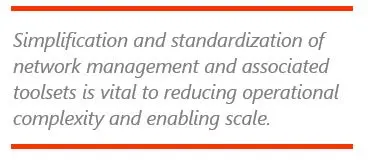
Industrial network infrastructure customers are increasingly looking to extend IT processes, security, and network management tools into OT to drive automation, overcome skill gaps, and strengthen industrial threat protection. Network automation can help reduce costs, improve efficiency, and improve production processes by streamlining workflows, minimizing human intervention and errors, enhancing quality and consistency, and enabling autonomous processes.
Industry 4.0 and advanced OT networks need more IT capabilities, demanding that more IT and OT organizations collaborate and bridge existing silos. The benefits of extending IT into OT are well documented, including improved cybersecurity, lower costs, operational simplicity, and improved sustainability. Global network infrastructure leader Cisco continues to leverage its unique legacy of successful service to OT, enterprise, and security applications to help customers build the right foundation for successful digitization, prepare for a future of AI-enabled applications, and drive continued market share increases.
Industrial assets need high bandwidth, resilient, and deterministic networks to meet escalating current and future functional requirements, including a plethora of new AI-enabled applications. Customers can achieve highly available, future-proof secure connectivity by emphasizing simplicity, standardization, and recognition of the increasing convergence of not only IT and OT technologies, but also security.
Horizontal and vertical integration throughout enterprise and operations, increasingly in service to analytics and now AI-based applications, necessitates a converged strategy as management of the respective networks increasingly overlaps. Enlightened executive leadership recognizes the network as the foundation for innovation and futureproofing and the consequent benefits of a unified approach, but IT, OT, and security activities remain siloed, negatively impacting business efficiency and threatening the overall security posture.
Centralized management and visibility of security operations and unified visibility into IT and OT security events are essential for a converged approach, with customers increasingly leveraging IT-oriented methods to this end. A converged approach can heighten operational efficiency and reduce both operational complexity and the size of the attack surface while extending the benefits of AI and data analytics applications. A converged approach can likewise encompass both hardware and software through consolidation of network and security functionality into multi-function network infrastructure devices with visibility and management provided via integrated operator and management consoles. A converged strategy must also consider ecosystem alignment between preferred OT vendors and IT/enterprise/hyperscaler and cybersecurity suppliers.
Recognizing the importance of network design, threat protection, and management, global network infrastructure market leader Cisco brings enterprise-grade networking features, network design solutions, and best practices that reflect increasing adoption of enterprise-wide security postures and scale to meet the needs of industrial networks. Embedded cybersecurity capabilities, including visibility, policy enforcement, remote access, next generation firewalls (NGFW), and more are some of the company’s biggest differentiators. Cisco Validated Designs (CVDs) offer substantial value to specific industries by providing pre-tested and documented network architectures tailored to specific business needs.
Building on this comprehensive legacy, Cisco’s industrial Ethernet switch (IES) portfolio, value proposition, and associated market share have expanded rapidly since the company first entered the market in 2003. The company is now the leading IES provider with a global 2023 market share of 25 percent. Since the inception of ARC’s IES market coverage in 2014, the company’s average annual compound growth of over 21 percent is double that of the total market.
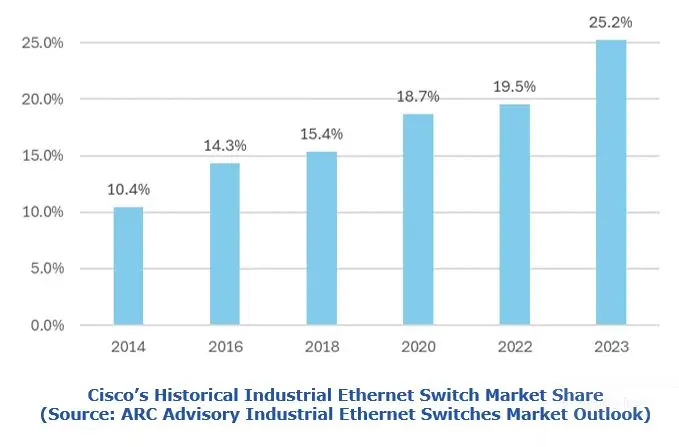
The complete report detailing the industrial networking infrastructure market’s emphasis on embedded security, IT/OT integration, AI-enabled operations, and Cisco’s ongoing increases in IES market share is available here.
Material for this blog was drawn from ARC Advisory Group’s extensive ongoing coverage of the industrial Ethernet Switch and associated industrial network infrastructure markets. Visit our website or contact the author at [email protected] for more information.