Representative End User Clients







Representative Automation Clients







Representative Software Clients








The first ARC Industry Leadership Forum Singapore on August 1, 2024, titled Accelerate Transformation in the Age of AI, Open Automation, and Sustainability, saw over 200 delegates networking and sharing best practices. SUPCON participated as a Gold Sponsor and in the session on The Age of AI: Opportunities and Solutions for Industry Mercy Zhang, Vice President, SUPCON International Business discussed the importance of integrating Artificial Intelligence (AI) in the industrial sector to supercharge digital transformation. Founded in 1993 in China, SUPCON is a process automation and digitalization vendor with a refreshed mission to lead Industrial AI towards sustainable growth. AI is seen as the next big thing for the process industry, capable of transforming operations and optimizing assets. This blog captures the main points of Mercy’s presentation, which can be viewed here.
Digital transformation has evolved beyond just automating workflows and replacing human labor. While the concept remains somewhat vague, its integration with AI is recognized as the future, bringing undeniable value and becoming essential rather than a luxury. Significant investments are being made in this area, and SUPCON is committed to developing next-generation digitalization and AI solutions for process optimization. Further, Mercy spoke about the technologies such as IoT, cloud, Big Data, and robotics that are crucial for digitalization, and their integration is essential for deriving value. He gave the example of predicting future values of a technology using linear regression for which infrastructure is needed to run Python code, a runtime for the software, a way to convey signals, and modernized actuators to receive those signals.
“AI and digital transformation are becoming more systematic engineering work, evolving into a cohesive whole rather than scattered concepts,” explained Mercy. SUPCON is already investing in, developing, and researching the latest technologies. The aim is to manage and understand how these technologies work in unison.
Industrial AI as defined by Peres, R.S: “Industrial AI is a systematic discipline focusing on the development, validation, deployment and maintenance of AI solutions (in their varied forms) for industrial applications with sustainable performance. Hence, Industrial AI is an interdisciplinary area of research, encompassing fields such as ML, NLP, and Robotics.” These components are integrated by top engineers into a framework and put into production. Without a single loop in the middle, no value can be derived from it. The basic difference between traditional automation and Industrial AI is that while traditional automation focuses on rule-based systems and first principles, Industrial AI utilizes data-driven methods and integrates various advanced technologies to optimize processes and solve complex problems.
The starting point to implement Industrial AI revolves around the data. Effective data utilization and governance is crucial for breaking down silos. Mercy discussed the importance of gathering and organizing data from various sources, such as equipment data, process data, simulation data, and quality data. By contextualizing and orchestrating this data, it can be fed into domain-specific AI models to generate valuable insights. These aspects are clear in the graphic below.
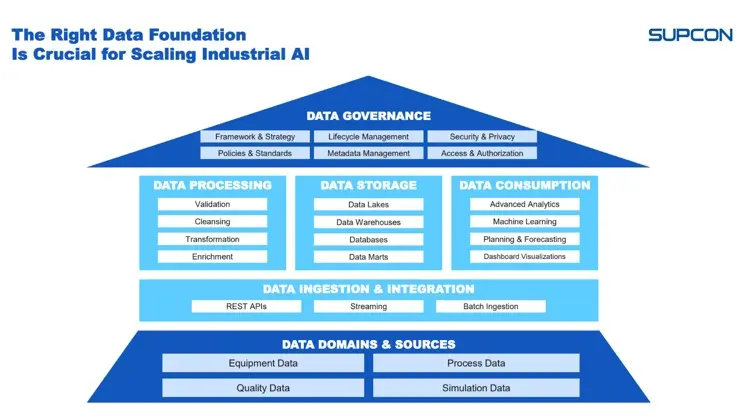
Different modalities and use cases need different models: Large Language Models for text and audio; Computer Vision Models for images and videos; and Time-series Pre-trained Models for historian data. Mercy laid emphasis on time-series prediction because in the process industry, about 90 percent of the operational data can be represented as time-series data.
Time-series models are used to predict the future status and tag values of complex processes in the industry. An example is the use of a deep neural network based on transformers, called the time-series pre-train transformer. This model is dedicated to predicting future values in complex industrial processes, achieving better results than traditional first principle methods and dynamic simulations. Time-series models can be integrated with reinforcement learning to optimize processes. By observing future statuses predicted by the model, control tactics can be developed and implemented in a closed-loop system, ensuring robustness and safety.
Via case studies on Generative AI for code generation and its applications, and Chatbot for knowledge organization, Mercy illustrated the practical applications of AI in various industrial contexts (chemical production, refinery etc.) showcasing the potential benefits and improvements in efficiency and effectiveness. “Industrial AI is not just for the engineers, it is everybody’s job,” concluded Mercy.
Industrial AI in supply chain optimization: Supply chain management is vast, so we focus on practical daily operations. This includes optimizing warehouse operations, spare parts ordering, and stock levels using traditional systems. By abstracting these actions into data, we can develop AI scripts to optimize processes and replace human decisions. For example, determining the optimal number of forklifts in a warehouse can be simulated before and observed after construction, using AI-driven reinforcement learning and simulation.
About AI and the leap forward: I believe we've moved past the initial leap in technology and are now advancing from one to many. Large language models (LLMs) are transforming applications, signalling a fundamental shift in software engineering that will also impact industrial software. Previously, we created frameworks to manage complexity, but now we can rely on AI to generate perfect code from our requirements. Although currently more time-consuming than manual coding, it's only a matter of time before this approach is streamlined.
Moreover, data-driven optimization and AI-based autonomous control are revolutionizing physical plant operations. One AI model can adapt across different processes with sufficient data integration, reflecting a future where cross-domain models cover entire industrial lifecycles. These changes indicate we're already seeing the future unfold.