Representative End User Clients







Representative Automation Clients







Representative Software Clients








Keywords: Additive Manufacturing, Industrial 3D Printing, Navigator, Collaboration, Expertise, Scalability, Knowledge Exchange
A pioneer only reaches his goal with a good navigator. For manufacturers, the question is: which additive manufacturing (AM) technologies and levels of automation can help a company navigate the uncharted waters of new applications and business cases?
One answer is the AM I Navigator. This initiative is designed to answer questions and provide interested companies with tangible solutions for their individual requirements. Developing production by integrating AM technologies is a long and complex journey. Information exchange and collaboration are critical in the heterogenous landscape of additive manufacturing industries. This is where the AM I Navigator initiative comes in.
Several professional AM providers such as Dye Mansion, HP, Forward AM, EOS, and more recently Stratasys, have joined this initiative to navigate interested companies through the potentials of the heterogenous AM landscape via a flexible and professional “comprehensive maturity model.” The initiative offers prospective and interested AM users personalized advice with a comprehensive approach to navigating the complexities of industrial 3D printing and making the most of the benefits of this fascinating machine segment.
Recent years have been challenging for the additive machinery, as well as for other machinery and manufacturing industries. This trend will continue well into 2025 with uncertainties around energy and production costs, trade disputes, and ongoing geopolitical conflicts. Reshoring (production near the customer), sustainability efforts and customization are driving industries to overcome supply chain issues.
In the face of these challenges, AM can play a key role in helping manufacturers overcome these hurdles. With its flexibility, various technologies and wide range of materials AM can support users to create more innovative and customized products that are stronger, lighter, more sustainable, and more functionally integrated.
Currently, most approaches to integrating AM are centered on isolated and customized solutions that are challenging to integrate, maintain, and scale. The Additive Manufacturing Industrialization Navigator (AM I Navigator) is a holistic maturity model that maps the stages of industrialization in the AM industry and thus increases interoperability in additive manufacturing.
The model defines the stages of industrial 3D printing along the entire process chain, from material to machine to automation. It is a structured, flexible approach to implement a customized up-to-date AM strategy within an open, best practice framework, based on the experiences of many experts, which is permanently improved. Creating a common understanding of the different stages helps to find ways to scale and integrate additive manufacturing into traditional and new production processes.
The AM I Navigator addresses the various degrees of industrialization in AM and different application requirements. The maturity model not only maps the stages of industrialization in the AM industry but also increases efficiency and interoperability by incorporating expert knowledge and experience from a wide range of industries, sectors and applications. Finally, the maturity model outlines the stages of industrialization in additive manufacturing, enhancing interoperability across the entire process chain from material selection to machine automation and outgoing inspection.
Achieving these goals starts with an introductory workshop led by AM experts from the AM I Navigator consortia. The experts help the interested company to clearly define the current AM level a manufacturer has at each stage and, more importantly, which realistic level the company can achieve and how. Based on the findings, a strategy and proposals for measures are defined. It also suggests companies that are best to work with to set realistic targets so that the desired goals can be achieved.
Current AM approaches and methods are frequently concentrated on isolated and customized solutions, resulting in challenges with integration, maintenance, and scalability. AM has evolved to a stage of maturity that necessitates its integration with conventional manufacturing technologies and latest automation technologies.
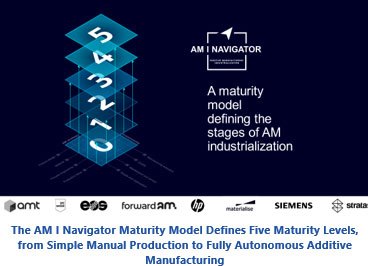
The starting point for every analysis is to record the current status. The AM I Navigator is like a recipe construction kit. The Navigator builds the framework to analyze the status quo of a company's AM efforts, while an individual maturity level check is performed and optimized to the company’s needs. The analysis shows the current maturity level of AM and the potential for improvement. Currently, five maturity levels are defined, from simple manual production to fully autonomous additive manufacturing.
This approach is based, among other things, on the findings of the Siemens Digital Manufacturing Excellence in Additive Manufacturing and its consortia partners. As more companies join the initiative and more expertise is gathered, the check will achieve higher levels of detail and efficiencies and will bring more value to the interested parties.
A basic assumption is that there may also be different characteristics in different dimensions. The degree of a maturity model is characterized by its flexibility and its matrix structure. There are 5 levels for each dimension. The following “levels” serve as a framework for a better and easier classification in manufacturing execution:
Basic
Mainly manual production. At this basic level, additive manufacturing technologies are used for prototyping and small series production.
Professional
Partially automated production: Some processes are automated to increase efficiency and reproducibility.
Advanced
Fully automated production: Additive manufacturing is fully automated, resulting in higher productivity and lower error rates.
Integrated
Integrated production: Additive manufacturing is seamlessly integrated into existing production lines, resulting in greater flexibility and adaptability.
Autonomous
Fully autonomous production: At the highest level, the entire production chain works autonomously, from material provision to final processing and output inspection.
The maturity check follows the structure of the AM I Navigator framework. Depending on the use case and business model, a company requires a different, tailor-made maturity level for AM.
Following this structured approach, comprehensive recommendations are provided for further development of production. It is crucial that the individual steps in the process chain are well-coordinated, as only open and interoperable additive manufacturing adds value to the entire production process. Depending on the application and the company's maturity level in the different dimensions, appropriate action steps can lead to the desired target state. The results of the assessment are shared with the respective company and can serve as best practices, offering a detailed overview of the advancement in industrial 3D printing.

By the end of 2024, the partner companies had already created over 150 maturity level descriptions. According to Siemens, more than 25 additional transformative insights and enabler descriptions have already been included into the model. The model is permanently improved and new descriptions and findings added.
The more expertise is incorporated into the initiative, the more successful it will be. The founders are therefore actively encouraging other AM technology and solution providers worldwide and from all sectors to join the initiative to continue to successfully shape the future of additive manufacturing together. ARC supports this open, collaborative approach and encourages interested parties to take this step. The more diverse input from a variety of sectors and specializations is integrated into the AM I Navigator, the more rapid, bespoke and successful AM projects will be developed and implemented. This will also facilitate the creation of new, customer-centric solutions and products.
Standardizing AM processes and offering these standards to a broader community is a necessary goal of the AM I Navigator initiative. It is not an exclusive endeavor, but rather an open offer to the AM community to share and benefit from varied expertise and knowledge, from the lessons learned to accelerate AM industrialization for everyone. With its open framework, the AM I Navigator offers a structured individual approach to defining the current status and steps towards a target state of industrialized additive manufacturing. It is based on established digital manufacturing frameworks such as the Smart Industry Readiness Index (SIRI), which helps companies assess their current level of digitalization and to develop and implement strategies for modernizing their production processes.
Key to the success of the AM I Navigator is the collaboration among key players, including amt, Dye Mansion, EOS, forward AM, HP, Stratasys, Siemens and Materialise, and the openness to welcome new members to achieve future scaled mass customized production with AM. ARC believes that a trusted broad foundation and joint efforts will help to further push AM into new industries and applications and so to expand acceptance and the market.
ARC Advisory Group clients can view the complete report at the ARC Client Portal.
Contact Us if you would like to speak with the author.
Obtain more ARC In-depth Research Market Analysis.