Representative End User Clients







Representative Automation Clients







Representative Software Clients








The manufacturing and operations landscape is experiencing a significant shift, fueled by advanced technologies such as artificial intelligence (AI) and simulation software. Central to this transformation is the concept of digital twins—virtual models of physical assets, systems, or processes. When integrated with AI, digital twins offer powerful capabilities for simulation, analysis, and optimization, reshaping how industries manage design, production, and maintenance.
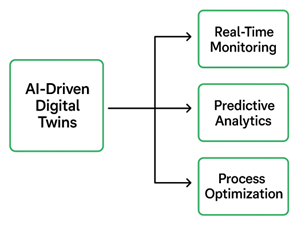
A digital twin is a virtual model of a physical object or system, built using real-time data from sensors, IoT devices, and other sources. It creates a dynamic environment that allows engineers and operators to simulate operations, monitor performance, forecast outcomes, and fine-tune processes. When enhanced with artificial intelligence, digital twins become intelligent systems capable of learning from data, adapting to changing conditions, and driving continuous improvement across operations.
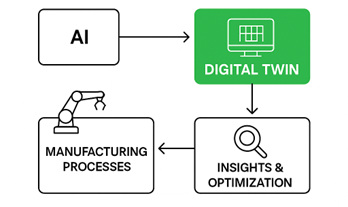
Simulation software serves as the foundation of digital twin technology. It allows engineers to build virtual environments that replicate real-world conditions, enabling them to model, test, and analyze system behavior across different scenarios. When combined with AI, these simulations become more powerful—capable of processing large volumes of data, detecting patterns, and generating actionable insights.
In a manufacturing context, for instance, a digital twin can replicate the entire production line, from the intake of raw materials to the delivery of finished goods. AI algorithms can then evaluate the simulation to streamline workflows, minimize waste, and maintain consistent product quality.
Real-Time Monitoring: Enables real-time tracking and predictive analytics, supporting faster and more informed decision-making.
Operational Insights: Leverages simulation to deliver deep performance insights, helping optimize processes and enhance product quality.
Accelerated Product Development: Integrates simulations with AI analytics to speed up design iterations and streamline manufacturing.
Cost Efficiency: Improves manufacturing efficiency, leading to reduced operational and maintenance costs.
System Integration: Seamlessly connects with CAD and PLM systems to support end-to-end digital workflows.
Smart Manufacturing: Powers intelligent operations with data-driven insights for improved decision-making and performance.
Product Design and Testing: Enhances design quality and testing efficiency through accurate simulations and AI-enhanced analysis.
Operational Optimization: Boosts efficiency and consistency by integrating real-time data and predictive modeling.
Cost Reduction: Minimizes downtime and maintenance costs through proactive analytics and process optimization.
Integrated Engineering Workflows: Supports cohesive design and simulation workflows through CAD and PLM integration.
AI-driven digital twins are transforming the way industries manage manufacturing and operations. By integrating advanced simulation software with artificial intelligence, these digital models offer deep operational insights, streamline processes, and foster innovation. As adoption grows, they are poised to reshape industrial efficiency, sustainability, and competitiveness.
For organizations navigating an increasingly digital landscape, adopting AI-driven digital twins is becoming essential. These technologies are helping define the future of manufacturing and operations—one that is smarter, more adaptive, and built for long-term success.