Representative End User Clients







Representative Automation Clients







Representative Software Clients









Keywords: Manufacturing Execution System (MES), Manufacturing Operations Management (MOM), Cloud, Artificial Intelligence (AI), Digital Transformation, Smart Manufacturing, SAP Digital Manufacturing
Industrial manufacturers face a myriad of challenges in today's rapidly evolving landscape. As cost pressures and inflation continue to rise, organizations need to optimize manufacturing processes. Changing customer preferences, ongoing supply chain disruptions, product customization challenges, shorter product lifecycles, aging workforce, and a stringent regulatory environment necessitate increased agility within organizations.
Modern cloud MES systems can play a key role in helping manufacturers address these challenges by offering enhanced operational efficiency, providing real-time visibility, and supporting smart manufacturing and digital transformation. SAP's advanced cloud MES solution, SAP Digital Manufacturing, supports agile operations and increases manufacturing efficiency by leveraging cloud technology to provide a perpetually young application. Key benefits of SAP Digital Manufacturing include accessibility, scalability, enhanced collaboration, and robust security. Additionally, the solution offers capabilities such as high computational power, storage, and deployment flexibility needed to support complex AI models.
MES/MOM (manufacturing execution system/manufacturing operations management) is a software technology that is used in manufacturing and production to track, manage, and execute production processes.
The primary function of MES is to track and document the transformation of raw materials into finished products in real time as well as ensure process enforcement. The MES captures data from many different data sources including automation systems, ERP systems, sensors, operators, and a large mix of heterogenous existing shop-floor systems.
The MES provides real-time visibility and visualization of production processes, enabling workers to monitor and execute operations, identify bottlenecks, minimize downtime, improve quality, increase yield, and optimize production. MES plays a key role in the manufacturing process as it streamlines workflows, automates tasks, tracks materials, and improves processes. This technology usually provides traceability, raw material and product genealogy, material and inventory management, data analysis and reporting and integration to ERP and automation systems. It also enables workers to utilize the manufacturing intelligence to make better data-based decisions that often lead to process optimization.

While MES began as an execution system, it has morphed and expanded its scope substantially into a new and broader technology that is typically considered a key technology in smart manufacturing and digital transformation.
Smart manufacturing and digital transformation both involve integration of advanced digital technologies like the Internet of Things (IoT), cloud, analytics, and automation into traditional manufacturing. MES software, being a key link bridging the gap between IT and OT or between the ERP and automation system(s), plays a critical role in helping organizations attain smart manufacturing and be successful on their digital transformation journey. It also ensures coordination of live production changes with manufacturing adjacent systems in the broader supply chain focused on planning, logistics, quality, maintenance, and HR.
Historically, all manufacturing software was done on-premises, but today this is changing rapidly. Although much of the MES software sold is still on-premises, Cloud-based MES is one of the fastest growing markets. The adoption of the cloud is a major trend in the industrial world. In recent market research conducted by ARC, adoption of cloud was identified as the most critical technology priority for achieving smart manufacturing. While around 70 percent of the 589 respondents indicated they have already implemented cloud for a range of different applications, around 25 percent indicated they are planning to adopt the technology in the near future.
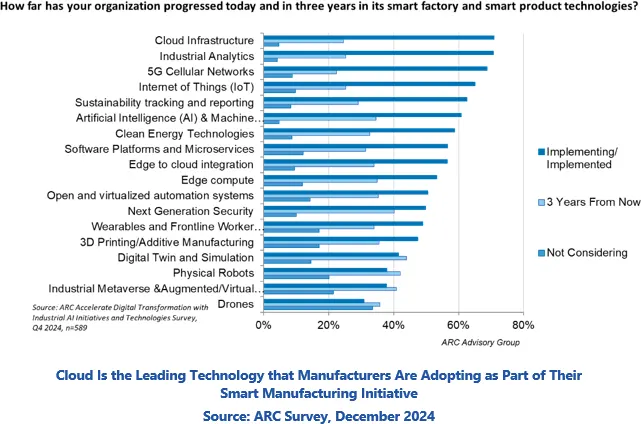
As manufacturers are looking to take advantage of many newer advanced technologies, they are realizing the need to be cloud ready. When selecting an MES many manufacturers want a solution that can be used interchangeably and is transparent to the user both on premises and in the cloud. Even after requesting the capability, some manufacturers will delay use of cloud MES for now, but they want to ensure that they are future proofing their technology selection.
Forward-looking solution providers such as SAP are also reinventing to better meet rapidly changing business requirements and help them get ready for the transition. While SAP ME (Manufacturing Execution) offered a traditional MES on-prem solution focused on managing shop floor operations, its SAP MII (Manufacturing Integration and Intelligence) offers enhanced capabilities with a platform for integrating data from various manufacturing systems. SAP Digital Manufacturing helps manufacturers get one step further by leveraging a cloud-based solution that combines functions from both SAP ME and SAP MII into one integrated solution to support agile operations and increase manufacturing efficiency and leverages the power of the SAP Business Technology Platform to scale in size, security, and [micro-]services.
SAP Digital Manufacturing is revolutionizing organizational operations with its extensive cloud benefits, making it a popular choice for innovative manufacturers. Key benefits include:
Accessibility: Users can access data from any location with an internet connection, eliminating the need for a specific physical presence. Its flexible architecture allows for seamless integration with other SAP and non-SAP systems, including SAP S/4HANA, enabling centralized control and data flow and thus providing a single source of truth for data and processes.
Scalability and Flexibility: With cloud storage capability, SAP Digital Manufacturing can be expanded in accordance with business requirements. The system's flexible execution lets manufacturers adapt to changing production needs and integrate new business models.
Collaboration and Integration: The solution facilitates enhanced collaboration among teams on various projects. Its Production Connector offers a modern connectivity layer between the plant floor and SAP Digital Manufacturing, offering a more streamlined cloud-based integration, allowing easy connection to IIoT devices, PLCs, and other plant systems.
Maintenance: SAP Digital Manufacturing is maintained regularly, thus requiring minimal IT/Engineering overhead and facilitating automatic access to updated features without concerns about upgrades, enabling convenient access to innovative features.
Security: SAP invests significantly in comprehensive security measures to ensure the highest standards for cybersecurity and privacy protection for its clients and publishes updates regularly to the SAP Trust Center.
Compliance: SAP Digital Manufacturing promotes effective information governance through centralized management, automated tracking and reporting tools, and seamless adaptation to evolving regulations. This has recently been extended to support the stringent needs of Life Sciences with a Quality Requirements Schedule (QRS) offering.
While SAP Digital Manufacturing offers many benefits, one major benefit that will stand out the most for manufacturers in the near future is its ability to offer advanced AI capabilities. Outdated legacy systems often prevent manufacturers from taking advantage of new technology and AI innovations. According to SAP, by leveraging the cloud, SAP Digital Manufacturing offers manufacturers the required computational power, storage, and deployment flexibility needed to support complex AI models. SAP's embedding of AI into business processes is transforming operations for organizations overwhelmed by developing and deploying AI applications.
SAP already offers many advanced AI applications, including access to sophisticated large language models. These allow users to interact using natural language to better understand manufacturing processes, find similar processes, and leverage advanced computer vision capabilities, among others. Additionally, SAP is developing Agentic AI capabilities. In the future, SAP plans to offer Agentic AI capabilities that can assist manufacturers orchestrate manufacturing processes integrated with the organization’s other key agents such as sales, supply chain, and purchasing, to help them achieve fully coordinated end-to-end business processes.
A significant challenge of a cloud-based MES is its dependency on internet connectivity. Any disruption in internet service may result in MES downtime, thereby impacting operational continuity.
SAP addresses this critical challenge by providing an edge solution with SAP Digital Manufacturing, which incorporates buffering capabilities to ensure uninterrupted operation during cloud outages, thereby improving internet connection resilience. This boosts efficiency by processing data at the network's edge, reducing latency, and ensuring continuous operations even when disconnected from the cloud.
Manufacturers often ask us, “how do we begin our journey to move to Cloud MES?” Since this question usually requires an in-depth discussion and will ultimately be based on the company’s process and requirements, we included here a summary of the key steps involved when trying to design your MES migration strategy.
The adoption of cloud-based MES solutions is rapidly transforming the manufacturing landscape. As manufacturers strive to leverage advanced technologies, the need for cloud readiness becomes increasingly evident. Future-ready modern MES solutions, such as SAP Digital Manufacturing, not only enhance operational efficiency but also play a pivotal role in smart manufacturing, IT/OT convergence, and digital transformation. With SAP Digital Manufacturing, manufacturers can look forward to a future where innovative applications and capabilities drive significant improvements in their processes and overall business performance.
ARC Advisory Group clients can view the complete report at the ARC Client Portal.
Contact Us if you would like to speak with the author.
Obtain more ARC In-depth Research Market Analysis.