Representative End User Clients







Representative Automation Clients







Representative Software Clients








Keywords: IT/OT Convergence, Operational Resilience, Cybersecurity, Digital Transformation, Fused Intelligent Technologies (FIT)
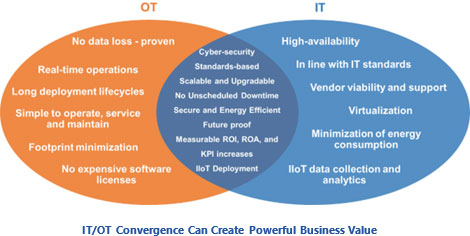
The increasing convergence of operational technology (OT) and information technology (IT) across industry and infrastructure has been a recurring theme for the last 5-7 years. This convergence between OT and IT in today’s industrial plants has led to a rapid learning curve for both groups. In general, IT groups have been learning what “real time” and legacy systems mean, and OT groups are starting to learn how they can best leverage IT-enabled technologies in operations, ranging from AI and ML, analytics, cloud, edge, digital twin, and cybersecurity. Also, while IT groups have traditionally focused on preserving data integrity and data flows, OT groups are typically more concerned about non-stop system availability to help ensure 24/7 plant operations and plant and employee safety. IT/OT convergence has remained a hot topic for a good reason.
IT/OT convergence requires both groups to work together to figure out how to connect the large installed base of legacy OT assets (control systems, instrumentation, etc.) with today’s powerful new OT and IT-enabled AI, analytics-based solutions to improve business performance without compromising system availability. The reality is that we still have 30-year-old legacy assets in our plants, and we simply can’t afford to do a wholesale “rip and replace.” This makes it necessary to figure out how to connect legacy OT systems to a combination of modern OT systems as well as IT systems that leverage the embedded systems with technologies, such as AI, along with analytics, cloud, edge, digital twin and cybersecurity.
As automation systems become more complex, the probability of human-influenced errors increases, which is being exacerbated by a shrinking, less experienced workforce. Anything that can be done to reduce complexity, such as generative and large language model AI solutions, should be considered and implemented, as this will help minimize the probability of human error. One of the major challenges involves the dramatically different lifecycles between OT and IT.
While process control systems and field networks have typically remained in service for 20 to 30 years or more, most IT is updated or replaced every several years to avoid technological obsolescence in this rapidly evolving space. It is expected however that today’s OT systems will have much shorter lifecycles, especially with technologies, such as virtual controllers, and the de-coupling of hardware and software, and new standards, such as O-PAS from the Open Process Automation Foundation.
Another significant challenge that has emerged in recent years involves ownership and responsibility. In this case, the convergence of real-time operations technology with transactional information technology is just one element of technological change to which organizations must adapt. To prevent declining performance, it’s critical for an organization to assess both its maturity and its ability to evolve and change. Whatever the cause (technology, economics, geopolitical, etc.), organizations need to refresh their thinking periodically and modify their organizational design to adapt and survive.
Operational resilience is essential for a company’s survival and growth, ensuring resilient operations to overcome potential business risks, cybersecurity threats, unscheduled downtime, supply chain disruptions, extreme weather and climate change, plant personnel safety, and geopolitical issues such as tariffs and trade embargoes. IT/OT convergence is crucial for companies to achieve operational resilience.
ARC Advisory Group clients can view the complete report at the ARC Client Portal.
Contact Us if you would like to speak with the author.
Obtain more ARC In-depth Research Market Analysis.