Representative End User Clients







Representative Automation Clients







Representative Software Clients








Keywords: Life Sciences, Pharmaceutical & Biotechnology, Medical Devices, Validation, Regulations, ValGenesis
In regulated industries, such as pharmaceuticals and medical devices, validation is critical yet burdensome. Although the documentation and testing to complete the Installation Qualification (IQ), Operational Qualification (OQ), and Performance Qualification (PQ) are essential for ensuring compliance and quality, validation can often be a bottleneck on projects. However, integrating artificial intelligence (AI) into validation workflows is changing this paradigm—transforming the validation process from a costly constraint into strategic advantages of speed, accuracy, and innovation. Some of the key findings include:
ValGenesis is a life sciences software company that provides ValGenesis iValTM, as a part of their digital validation platform vision known as ValGenesis Smart GxPTM, to help companies digitalize and manage their compliance-based validation processes. Through AI-powered, paperless validation management, ValGenesis offers a cloud-based platform that helps ensure data integrity, reduce costs, and accelerate time-to-market by streamlining the validation lifecycle.
Traditional validation is predominantly manual, time-consuming, and expensive; beyond the volume of testing, progress stalls because evidence and data are scattered across siloed systems. Validation teams usually operate very lean, making it difficult to stitch everything together when regulations change or standards are still maturing for novel modalities.
The result is labor-intensive authoring and execution of protocols and evidence collection with multiple review/approval cycles; poor end-to-end traceability from URS/FRS to IQ/OQ/PQ and risk controls (GAMP 5, ICH Q9) that drives rework; cumbersome change control and periodic reviews that trigger partial re-validation; and knowledge gaps and turnover that erode consistency and audit readiness.
Collectively, these inefficiencies delay time-to-market, inflate costs, elevate compliance risk, and constrain the agility required for innovation. Digital validation centralizes requirements, protocols, and evidence in one system, eliminating silos and improving consistency. Integrated authoring and execution of IQ/OQ/PQ protocols, standard templates, e-signatures, end-to-end traceability, and streamlined change control strengthen compliance and audit readiness, cutting rework and review cycles.
Artificial intelligence has moved from pilot to production across pharma and biotech, shaping day-to-day operations in R&D, validation, and manufacturing. AI accelerates protocol authoring and execution, strengthens risk-based decisions, and helps companies sustain a continuously validated state. Learning from process, equipment, and quality data, AI enables real-time automated gap assessment and anomaly detection, predicts failures, and recommends controls, delivering a 360° operational view that lets organizations move faster with greater accuracy, compliance, and confidence.
Typical digital validation systems without AI are still paper-on-glass, consisting of manual, error-prone workflows and siloed data that miss changes, cause late discoveries, inflate costs, and delay releases. Many companies are now going beyond chatbots and generative AI by utilizing agentic AI with large language model (LLM)-enabled software tools. These agents can produce validation lifecycle documentation required for GxP compliance.
ValGenesis offers VAL™, a smart AI validation assistant that powers the validation lifecycle in ValGenesis Smart GxP. This changes how validation deliverables are created, executed, and reviewed. ValGenesis’ Smart Agent, VAL, can grow with the organization and adapt to the environment.
According to ValGenesis, VAL can help reduce validation timelines from months to days, find hidden risks instantly, ensure full traceability, and ensure consistency across global teams and documents.
Global regulators including the EMA and FDA are actively advancing their regulatory frameworks to support the integration of AI in validation and compliance processes. For example, in January 2025, the FDA issued a draft guidance titled “Considerations for the Use of Artificial Intelligence to Support Regulatory Decision-Making for Drug and Biological Products. ”This guidance outlines a risk-based credibility assessment framework for establishing and evaluating AI models for a particular context of use (COU).
The FDA has also completed its first AI-assisted scientific review pilot, which demonstrated significant reductions in review time—from days to minutes—while maintaining regulatory rigor. This pilot is part of a broader agency-wide initiative to roll out AI capabilities across its review and compliance functions.
AI can help to analyze and assess large amounts of data for regulatory compliance and retain multiple dimensions of knowledge and information that even the most skilled and experienced workers cannot compete with.
This pilot is part of a broader agency-wide initiative to roll out AI capabilities across its review and compliance functions.
Key highlights of the FDA’s evolving stance include:
These developments signal a shift in regulatory posture—from cautious observation to proactive enablement—positioning AI as not just a compliance tool, but as a strategic enabler of innovation in life sciences.
By freeing up resources and accelerating validation, AI allows R&D and manufacturing teams to focus more on innovation and fast-track time to manufacturing. Using an AI enabled closed-loop feedback for documentation ranging from clinical trials to commercial manufacturing, supports adaptive process improvements and continuous innovation.
AI-enabled digital validation platforms are emerging as a foundation for digital transformation in life sciences. They automate key aspects of validation—documentation, test execution, anomaly detection, and compliance tracking—while keeping a human-in-the-loop for oversight. These systems use intelligent AI agents to analyze historical validation data, predict compliance risks, and dynamically generate test cases. The result is reduced manual effort alongside improved consistency, traceability, and audit readiness.
ValGenesis Smart GxP™ (Figure 1) illustrates this vision. Within the platform, AI agents support compliance and efficiency by auto-generating validation documents, analyzing requirements and protocols for gaps against SOPs and regulatory standards, auto-building trace matrices, assisting in protocol execution, and identifying anomalies in executed protocols. These functions help organizations strengthen accuracy and audit readiness while reducing rework and cycle times.
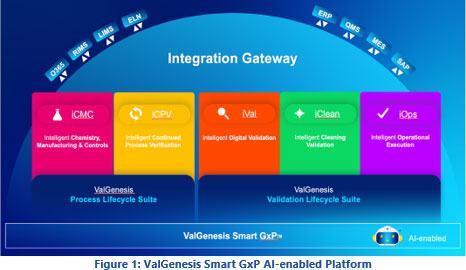
In addition, the Smart Agents summarize validation deliverables, answer user queries, and provide proactive insights. This creates a more agile and consistent validation environment that can help organizations reduce errors, shorten timelines, and improve preparedness for regulatory reviews.
The broader vision of ValGenesis Smart GxP extends beyond validation. By unifying product development, validation, and manufacturing lifecycles, the platform links critical parameters, quality attributes, and control strategies from early design through commercial production. This structured digital framework helps ensure data integrity, regulatory alignment, and continuous monitoring across the product lifecycle. It also supports reliable technology transfer and ongoing process improvement.
In this way, platforms such as ValGenesis Smart GxP demonstrate how AI can shift validation from a narrow compliance requirement to an integrated enabler of innovation and operational resilience in life sciences.
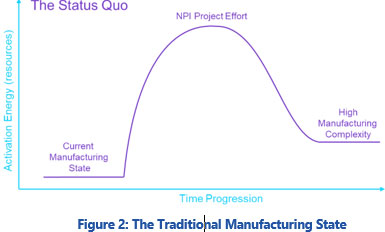
In the traditional manufacturing environment, bringing a product from development into full-scale production requires significant effort (Figure 2). Disconnected systems, duplicated validation activities, and site-by-site variability create a high-friction landscape. Every new product introduction carries a heavy burden as teams retrace steps, revalidate equipment, and realign documentation to ensure processes fit within existing frameworks. This operational drag is represented by the steep climb in resources shown in purple -- a state where the activation energy for progress is high, and efficiency is difficult to sustain.
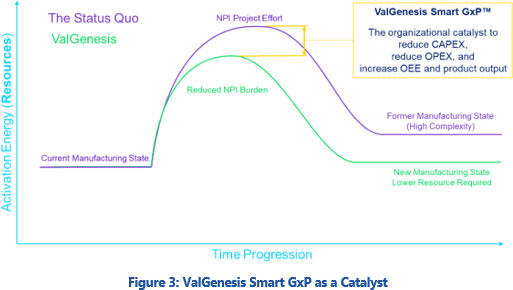
With ValGenesis Smart GxP acting as a catalyst, the activation energy required to reach a stable manufacturing state is dramatically reduced (Figure 3). Digital validation intelligence and connected lifecycle data streamline workflows, eliminate redundancy, and embed proactive risk management into daily operations. The result is a lower-resource, optimized state shown in green—one that is repeatable, controlled, and continuously verified. Here, process readiness is not assumed but assured, enabling faster product introduction, consistent quality, and a more resilient foundation for long-term manufacturing success.
In this way, platforms such as ValGenesis Smart GxP demonstrate how AI can shift validation from a narrow compliance requirement to an integrated enabler of innovation and operational resilience in life sciences.
ARC conducted several interviews with industry experts that underscore a pivotal shift in how life sciences companies approach validation. All of the users want to move from manual, siloed processes to intelligent, AI-driven platforms that enhance speed, accuracy, and compliance. Executives and experts emphasized that AI not only streamlines IQ, OQ, and PQ documentation and testing, but also empowers less experienced workers by bridging knowledge gaps and improving onboarding.
ARC conducted interviews with many pharmaceutical and biotechnology pioneers that included:
Dr. Alton Johnson, Pharmaceutical Consultant - With his extensive biotechnology background, Dr. Johnson emphasized the strategic role of ValGenesis in driving digital transformation and compliance in the life sciences industry. With a background in Quality by Design (QbD) and risk management, Dr Johnson sees ValGenesis VAL as a powerful enabler of digital validation lifecycle management, especially in AI-assisted documentation and audit readiness. Dr. Johnson supported piloting ValGenesis VAL: AI-Assistant at the pilot site and demonstrate the value before scaling globally, citing the ability to achieve measurable ROI and reduced compliance risk.
Mr. Jose Caraballo Oramas, Biotech Leader - Mr. Caraballo shared his experience implementing ValGenesis in several companies. He highlighted the platform's impact on validation efficiency, error reduction, and documentation consistency. Mr. Caraballo emphasized the importance of human oversight in e-validation, as well as the need for site-specific commitments to drive successful adoption in the near future. His insights reflect a deep understanding of regulatory compliance and the challenges of integrating legacy systems with modern platforms. He also noted: “In addition to the efficiency that digital validation can offer us, capital projects typically dedicate part of the capital costs for validation. Now with ValGenesis VAL that cost can be adjusted down by 15, 20, or even 25 percent.”
Dr. Jose Vidal, CEO, CytoImmune Biologics - Dr. Vidal, a pioneer in applying AI to biopharma, discussed the transformative potential of ValGenesis AI in managing complex biologics and cell therapy validation. Dr. Vidal estimates that, by using the new VAL tool, he anticipates being able to reduce validation hours by 20 to 50 percent in project timelines on top of the digital validation time savings. Dr. Vidal, noted that, with ValGenesis VAL, “They will be able to improve sampling and testing, and enable data-driven decisions." He emphasized the ValGenesis Smart GxP platform’s ability to uncover previously misunderstood process behaviors. Dr. Vidal advocates for real-time, self-aware validation systems and considers ValGenesis uniquely positioned to support predictive control and regulatory evolution.
Some of the key benefits of using AI, ValGenesis VAL, and Smart GxP Platform include improved speed, efficiency, accuracy, ease of compliance, and more.
AI can reduce validation cycle times and cost by up to 50 percent on top of the time saved by digital validation tools, enabling faster tech transfer and product launches. Automated validation test case execution with human in-the-loop and verification can streamline the entire lifecycle from design to commercial production. It can also reduce project times and/or time-to-market by as much as 20 to 50 percent.
According to ValGenesis, the software creates standardized and compliant validation protocols from existing documents and enterprise data—as much as 80 percent faster—in as little as 90 seconds. The software can also reduce review cycles from weeks to hours through real-time gap assessor and anomaly detector.
By using AI agents for validation, data integrity and regulatory compliance can be improved through real-time anomaly detection enabling readiness for audits, accuracy and consistency. According to ValGenesis, validation documentation and execution can be 80 percent faster, with significantly reduced review cycles (from weeks to hours). This can minimize the risk of human error and improve inspection readiness.
ValGenesis enables real-time anomaly detection and regulatory checks to ensure accuracy, consistency, and readiness for audits. The software can also be used to flag exceptions and anomalies in real-time, check compliance against SOPs and highlight gaps and regulatory exceptions (e.g., FDA, EMA, etc.) enabling audit ready results.
The software automates result capture, evidence collection (including image-based verification), and pass/fail tagging-accelerating protocol execution, ensuring right-first-time output all activities with humans in the loop.
The use of AI can be extremely helpful for onboarding new workers who do not have the knowledge base or skillsets of more experienced workers and can make up for their many years of knowledge base. This is tremendously important with the extensive turnover to a younger, less experienced, and smaller multi-tasking workforce.
Smart GxP seamlessly integrates with enterprise systems-LIMS, MES, ERP, QMS- ensuring data continuity. Built on a cloud native architecture, it includes stringent security measures, such as encryption, audit trails and role-based access controls.
ValGenesis Smart GxP includes one platform for everything from R&D and validation to manufacturing.
ValGenesis is backed by Morgan Stanley and already trusted by 30 of the top 50 life global life sciences companies.
Digital validation becomes not just a compliance requirement—but a competitive advantage and driver for innovation, speed-to-market, and reduced costs.
Using AI for the validation of lifecycle and regulatory documentation is not just a tool for compliance, it’s a strategic asset for innovation and speed and should be built into compliance processes and protocols. By automating IQ, OQ, and PQ processes, documentation and testing, organizations can reduce costs, accelerate time-to-market, and foster a culture of continuous improvement. As regulatory bodies, such as the FDA embrace AI-reviews, and validation documents generated by AI, the future of validation is not just digital, it’s intelligent, smart and accurate. It can find, reduce and fix human errors that are often part of manufacturing processes. Accelerating new product releases with AI validation can deliver rapid or even immediate returns on investment, boosting profits, market share, capitalization, and first-mover advantages in emerging product categories. Some recommended next steps include:
ARC Advisory Group clients can view the complete report at the ARC Client Portal.
Contact Us if you would like to speak with the author.
Obtain more ARC In-depth Research Market Analysis.