Representative End User Clients







Representative Automation Clients







Representative Software Clients








I spent the past few days immersed in the immense energy of Cognite Impact 2025 in Houston, an event that has demonstrably scaled in size, drawing three times more attendees than last year. While the buzz surrounding Industrial AI continues to be immense, the primary takeaway from this conference is definitive: the strategic battleground in the ongoing “AI Wars” is the foundational ability to manage, contextualize, and orchestrate industrial data.
Cognite’s strategy, product roadmap, and alliance announcements serve as a powerful validation of ARC Advisory Group’s core thesis on Industrial AI: success is built on an Industrial-Grade Data Fabric (IDF) that unifies IT, OT, and ET data, and the next wave of value will be unlocked by agentic AI systems fueled by robust Context Engineering.
The progress demonstrated by the chemicals, oil, gas, and energy community—Cognite’s anchor verticals—shows rapid acceleration toward this goal. This velocity is aimed squarely at Cognite’s self-proclaimed “moonshot”: achieving and delivering over 100 billion dollars in cumulative customer value by 2035. As CEO Girish Rishi noted, the company is currently “shy of a billion today” toward this objective, highlighting it as the “epic” leading indicator for running the company.
For years, ARC Advisory Group has maintained that the IDF is the “critical, non-negotiable infrastructure required to unlock the value of Industrial AI at scale.” The fundamental industrial data challenge—the vast volume, high velocity, and inherent messiness of OT data, engineering documents, and IT records—remains the silent killer of AI projects.
Cognite Data Fusion® (CDF) is positioned as the purpose-built Industrial DataOps platform that solves this specialized “first-mile” problem. It specializes in creating the essential industrial knowledge graph (IKG)—a dynamic, queryable representation of industrial reality—by linking disparate data sources like high-frequency time series from sensors, transactional IT data (e.g., work orders), and engineering technology (ET) data (e.g., P&IDs and 3D models). This IKG is the source of the crucial contextualized data that data science teams require to build accurate and operationally relevant AI models. The sheer scale and growth of this foundation were affirmed by Cognite’s product leadership, who declared that the IKG is the world’s largest today, but is also “the smallest it will ever be.”
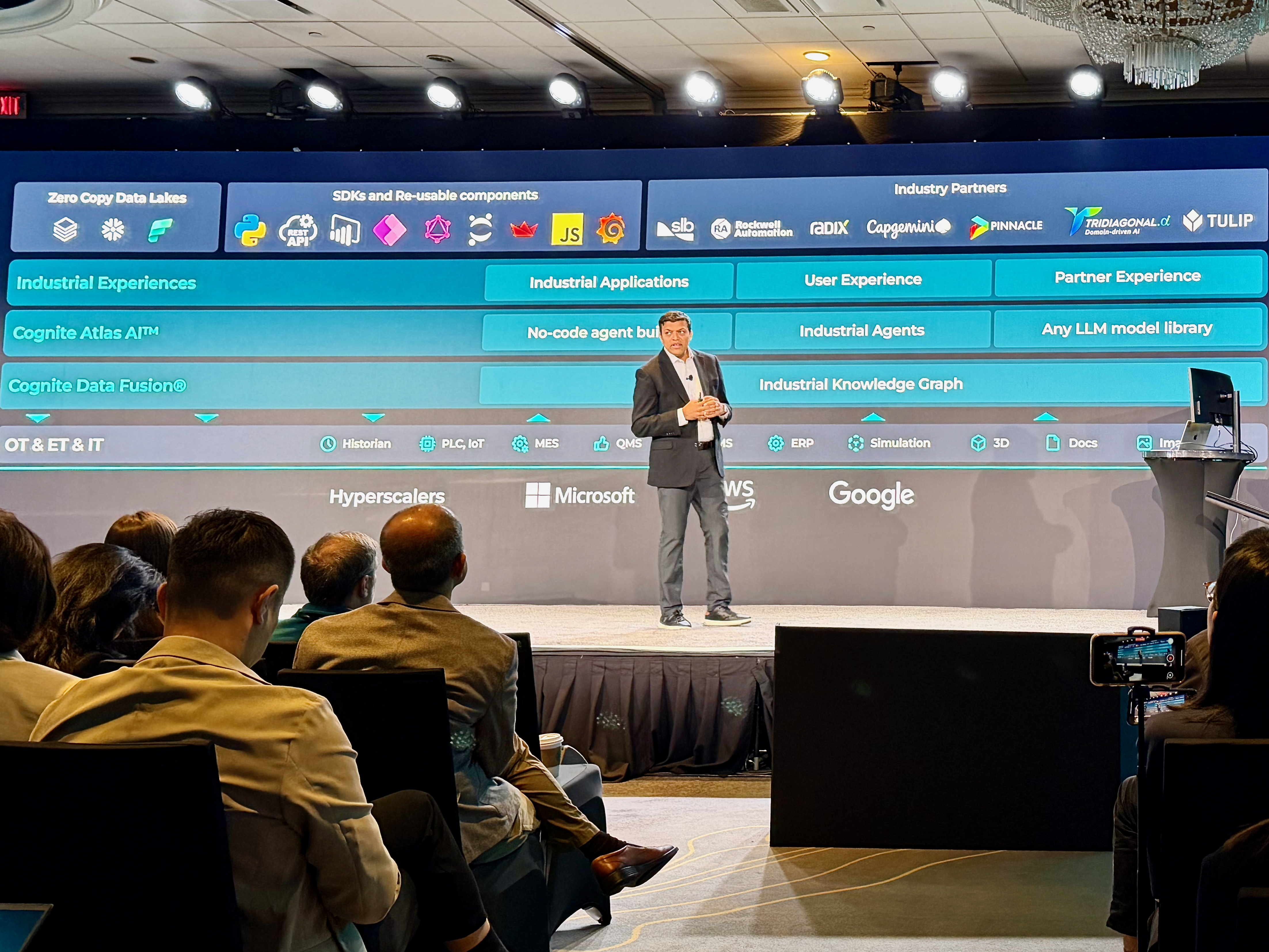
Key foundation updates announced at Impact 2025 are designed to harden this core and accelerate data onboarding:
Data Workflows General Availability (GA): This vital component streamlines the process of integrating data and automating data pipelines. Crucially, Data Workflows allows for the direct embedding of AI agents to automate data quality checks and contextualization services, moving the IDF from a passive repository to an active, programmatic system.
Expanded Knowledge Graph Capabilities: Cognite is continuously enriching the IKG by bringing in entirely new data types, including machine state storage and alarm information, thus leveraging even more of the underlying historian data to feed industrial experiences and agents.
Enhanced Contextualization Tools: New features support this core strength by offering services like automatic tag detection in 360° images and improved document parsing with LLM vision capabilities, which significantly reduces the manual labor required for data enrichment.

Cognite’s market focus is logically expanding from its core in energy, oil & gas, and chemicals. The company is making a clear push into adjacent process industries like life sciences, with marquee names such as Moderna cited as customers. This push into new verticals is further evidenced by strategic partnerships, such as the alliance with Tulip to drive AI-powered manufacturing, demonstrating the platform’s adaptability beyond its energy-sector origins.
Furthermore, Cognite’s strength in tackling the complexity of process-industry data—which is inherently challenging due to its velocity, variety, and the mix of time series, unstructured documents, and 3D models—positions it well for other verticals. Cognite shared the observation that there is nothing inherently limiting in its knowledge graph that constrains it from addressing discrete manufacturing use cases.
ARC observes that the data management and contextualization challenges mastered in process industries are more complex than the typically more transactional and structured data found in discrete verticals. This suggests a platform proven in the most difficult data environments is well equipped for broader industrial application, as demonstrated by early traction in metals with customers like ArcelorMittal.
The field of industrial software is rapidly progressing toward agentic AI, which I define as an architectural approach that orchestrates specialized AI/ML tools to accomplish complex, multi-step goals with a degree of autonomy.
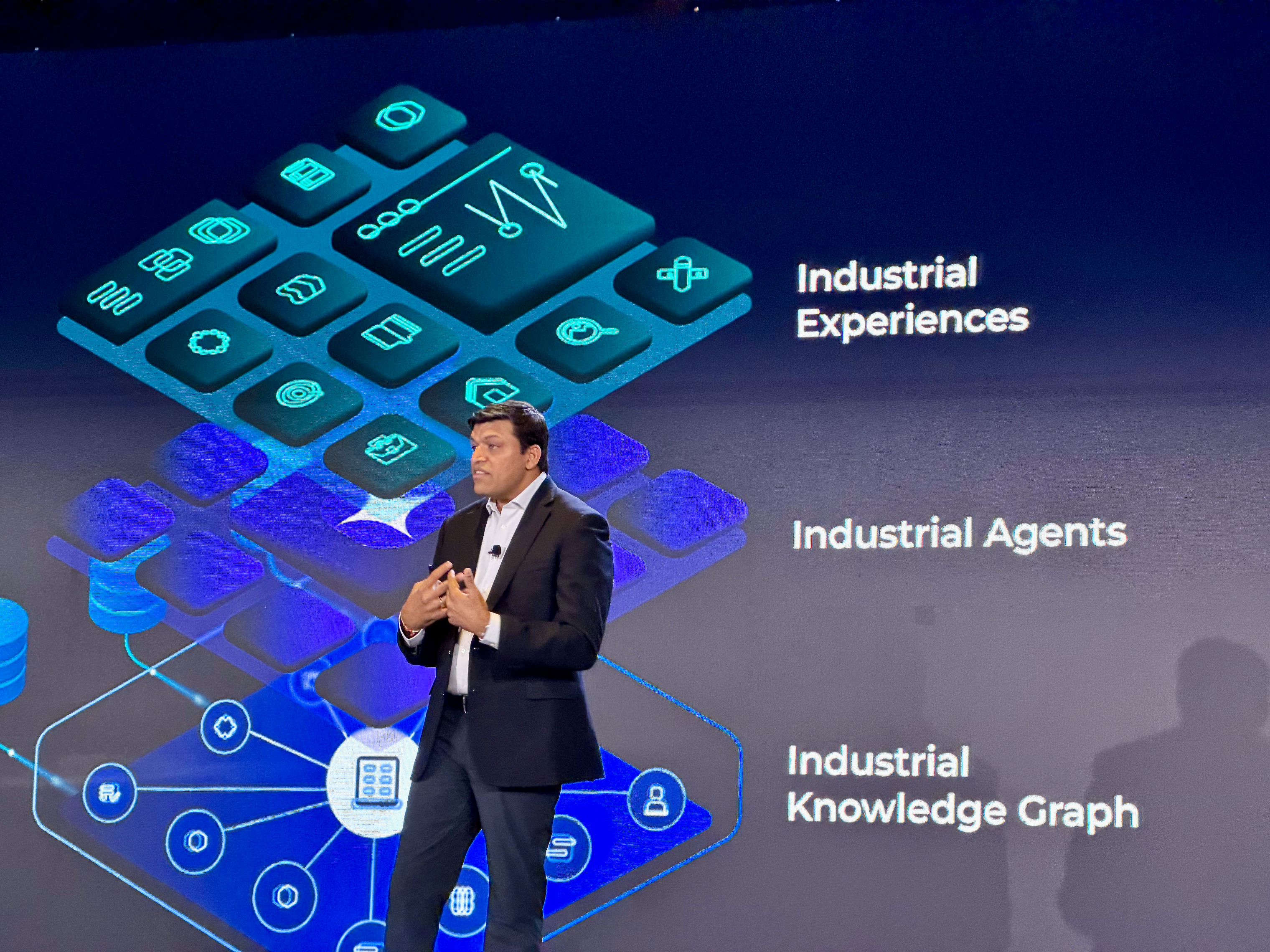
Cognite Atlas AI™ is the platform driving this agentic capability, serving as a low-code agent workbench designed to empower domain experts to build, deploy, and manage industrial AI agents. This capability is fundamentally reliant on context engineering.
Context Engineering is the required discipline of orchestrating the entire information ecosystem—system instructions, retrieved knowledge from the IDF/IKG, execution tools (APIs), and conversational memory—to ensure an agent can reason and act reliably in critical industrial settings.
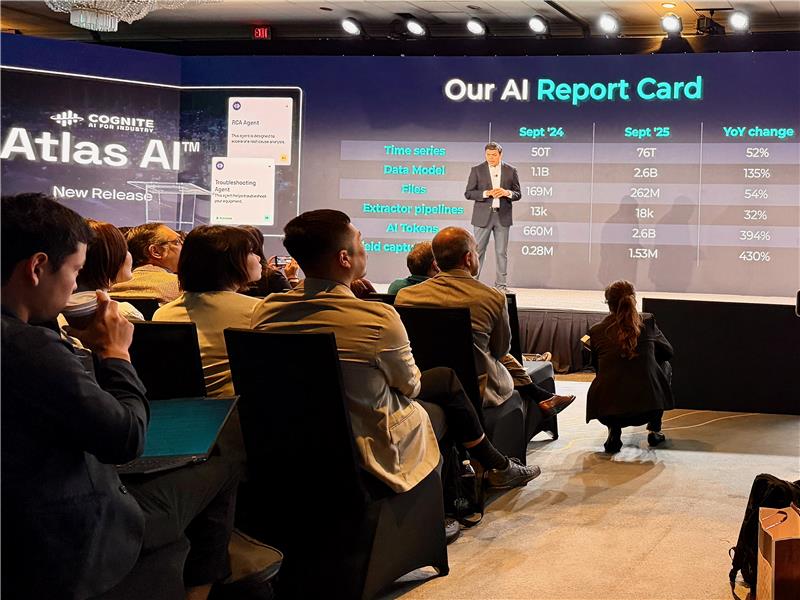
The momentum behind Atlas AI is translating directly into measurable value:
Rapid adoption: Cognite is onboarding approximately one new customer per week into Atlas AI, demonstrating strong market pull for agent-based solutions.
Quantifiable results: Customers like NOVA Chemicals reported that the time required for a complex root cause analysis task, which previously consumed two weeks, can now be completed in a single day using the platform. Celanese, which scaled data across 49 plants into CDF, is leveraging agents for high-value activities such as troubleshooting. And Aker BP has seen a staggering 97 percent reduction in time for root cause analysis, from weeks to hours.
Multi-agent orchestration: Aker BP, a leading pioneer, is making ambitious plans to build “hundreds of Atlas AI colleagues” that will function as 24/7 teammates. Crucially, Aker BP is testing sophisticated agent-to-agent (A2A) communication to coordinate between Atlas AI agents and agents run by third-party Centers of Excellence. This aligns with the emerging necessity for A2A protocols to enable multi-agent systems to collaborate and execute complex industrial workflows autonomously.
To fuel this adoption, Cognite announced a major release of Atlas AI, focused on accelerating and simplifying the deployment of production-ready agents with features like preconfigured templates, smarter knowledge-graph queries, and enhanced governance controls.
The most significant strategic maturation unveiled at Impact 2025 is Cognite’s decision to double down on its domain specialization—owning the industrial context layer—while embracing an open, best-of-breed partner ecosystem.
This strategy powerfully validates ARC’s long-standing research. We’ve consistently argued that you can’t buy a single, monolithic industrial data fabric from one vendor that satisfies the divergent needs of all stakeholders across IT, OT, ET, and data science. Instead, leading organizations are assembling their fabrics, weaving together best-of-breed components from different vendor archetypes.
Cognite is positioning itself not as the entire fabric, but as the indispensable industrial thread in that weave.
The deep, technical partnerships are cemented by the commitment to “bidirectional, zero-copy data-sharing integration,” a critical architectural choice that removes the complexity, cost, and latency associated with traditional ETL pipelines and data duplication.
NVIDIA: The AI compute engine. This partnership brings together Atlas AI’s capabilities with NVIDIA’s accelerated compute and foundation models. This collaboration is designed to energize NVIDIA’s NV-Tesseract foundation model (a powerful time-series model lacking contextualized industrial data) with Cognite’s rich industrial data. The objective is high-performance predictive outcomes, such as forecasting failures in equipment like compressors and pumps, with a dramatic increase in accuracy.
Databricks: The lakehouse hub for data science. The zero-copy partnership positions Databricks as the enterprise data-science environment. This integration allows data scientists to drive computation using industrial data sitting in Cognite, and vice versa. Databricks’ Unity Catalog is leveraged for unified governance over this hybrid data, complementing its own move toward agentic AI with platforms like Agent Bricks.
Snowflake & Microsoft Fabric: Enterprise BI and analytics bridges. Similar zero-copy arrangements with Snowflake and a deep, customer-driven integration with Microsoft Fabric ensure that Cognite’s rich, contextualized OT/ET data is instantly available for enterprise business intelligence and analytics. Microsoft views CDF as the “essential element for contextualizing the operational data” within its unified Fabric ecosystem. Customers like Aker BP are already actively synchronizing data from CDF into Fabric to drive business value, proving the model.
This open strategy elevates Cognite above the data-platform wars, solidifying its role as an impartial “industrial contextualization service” for the entire ecosystem. It extends beyond the foundational tech giants to a vibrant ecosystem of industrial solution providers. Partners like Radix, for instance, are building dozens of applications on top of CDF, from their own “Jo.AI” platform developed with Celanese to the “Golden Run” production optimization solution for International Paper. This demonstrates how the platform acts as a springboard for specialized, high-value industrial applications, further enriching the assembled fabric.
Cognite’s ecosystem-first strategy reshapes the competitive landscape, bringing it into a new dynamic with industrial software incumbents, most notably AVEVA. This isn’t a simple case of one platform versus another; it’s about one ecosystem’s philosophy versus another’s.
AVEVA, with its PI System™, is the de facto system of record for time-series data in much of the industrial world. Its own rich ecosystem is deeply rooted at the factory level, excelling at plant-level DataOps and equipment control. AVEVA is also pursuing an aggressive AI strategy, and like Cognite, it is partnering with NVIDIA to do so. However, the nature of their collaboration is fundamentally different and reveals their distinct strategic approaches.
AVEVA’s partnership with NVIDIA focuses on creating AI-driven autonomous operations by leveraging AVEVA’s Dynamic Simulation platform, optimized to run on NVIDIA GPUs, with the NVIDIA Raptor reinforcement-learning engine. Their goal is to use physically accurate digital process twins to train AI agents that can autonomously control the plant, even through complex and unpredictable transient conditions. This is a simulation-first, physics-driven approach to AI control.
The Cognite/NVIDIA approach, in contrast, is data-first. It applies NVIDIA’s NV-Tesseract foundation model to the vast, contextualized historical and real-time IT, OT, and ET data within Cognite Data Fusion. The goal is to uncover hidden patterns, predict failures, and provide deep analytical insights across the enterprise. This is a data-driven, pattern-recognition approach to AI-powered decision support.
While AVEVA’s Industrial Intelligence and its AI-powered advanced analytics—incorporating technology from TwinThread to deliver no-code predictive insights for process and energy optimization—are powerful, the Cognite/NVIDIA approach offers a compelling alternative for enterprise-scale AIOps. The value proposition is distinct: it tells customers to keep their trusted historian, but to supercharge a more advanced, specialized AI engine with context from across their entire IT/OT/ET landscape for more powerful predictive insights.
This doesn’t necessarily mean a zero-sum game. The “coexistence” scenario is highly plausible, where AVEVA continues its dominance as the system of record for high-fidelity OT data and simulation on the factory floor, while Cognite serves as the enterprise-level contextualization layer that consumes that data and fuses it with IT and ET sources for broader, strategic AI applications. An industrial leader could conceivably use both: AVEVA/NVIDIA for autonomous process control of a specific unit, and Cognite/NVIDIA for enterprise-wide asset monitoring and anomaly detection.
While Cognite’s long-term vision aims toward autonomous operations, it is essential to apply ARC’s strategic nuance to this concept. We must temper the aspiration of “lights-out” or “dark factories” with the pragmatic reality confirmed by ARC’s latest AI Pacesetter Survey: we are a long way from full Level-5 autonomy.
The immediate and more achievable future is the symbiotic factory. This model embraces the collaboration between autonomous AI agents and the data- and AI-aware human workforce—more than a “connected worker”—what I think of as the synapse worker. The AI agents handle the automated sequences of actions—the transition from decision support to programmatic decision automation—but the synapse worker retains the critical function of strategic oversight, exception management, and governance.
To foster the necessary trust for this symbiosis, the reliability of the agents must be assured. This requires mechanisms like model explainability (XAI). The core principle of XAI is to ensure that the agent’s decision-making process is fully traceable and understandable to a human operator, which is critical for relying on AI for important operational decisions.
Cognite’s strategy—to use CDF as the foundational memory and Atlas AI as the execution layer—provides the architectural framework for the symbiotic factory. The goal of 100 billion dollars in customer value by 2035 is attainable because it rests on enabling the synapse worker to be exponentially more productive through reliable, contextualized agentic AI.
The future isn’t about replacing humans; it’s about augmenting them with tireless, data-driven digital colleagues. Cognite Impact 2025 made it clear that the assembly of that future is well underway.
For ARC Advisory Group recommendations for Navigating the AI Wars, Closing the Digital Divide by Embracing Industrial AI, assembling your Industrial-Grade Data Fabric, and governing and guiding major decisions about enterprise, cloud, industrial edge, and AI software, please contact Colin Masson at [email protected] or set up a meeting with me, or my fellow Analysts at ARC Advisory Group to find out more about our Executive Insights Service for industrial organizations, and Industrial AI Insights Service for Vendors.