Representative End User Clients







Representative Automation Clients







Representative Software Clients










Digital transformation is reshaping industries at an unprecedented pace—from “precision profiling” in retail to “one-stop government services” in public administration, and from “robots replacing human labor” on factory floors to “digital twins” for cloud-based collaboration. The annual Year in Infrastructure (YII) Going Digital Awards showcase cutting-edge applications of digital technologies such as AI, cloud platforms, and digital twins.
This year, Bentley YII 2025 received nearly 250 projects from 47 countries and regions. An independent jury, including ARC Advisory Group, selected winners across 12 categories and 18 Founder’s Honor Awards. Projects from China won four awards: Baosteel Engineering & Technology Group (Energy Production category), China Energy Engineering Group Guangxi Electric Power Design Institute (Energy Delivery category), PowerChina Henan Electric Power Survey & Design Institute (Founder’s Honor Award), and Shanghai Investigation, Design & Research Institute (Founder’s Honor Award). These four projects will be introduced one by one in this four-part series.

Founded in 1997, Baosteel Engineering & Technology Group is a world-leading, full-process technology service provider in the metallurgical industry. Its business covers full-process solutions for iron and steel manufacturing as well as digital transformation services. A decade ago, the Group began developing Baosteel’s digital cloud platform, “Baoshu Cloud.” With the support of Bentley technologies, this platform has evolved into a complete technical roadmap encompassing digital design, digital delivery, digital twin plants, and full-lifecycle management of engineering projects.
In 2024, Baosteel Engineering & Technology Group was recognized as one of the first batch of “Industrial Internet + Digital Twin” pilot and demonstration enterprises by the Ministry of Industry and Information Technology of the People’s Republic of China.
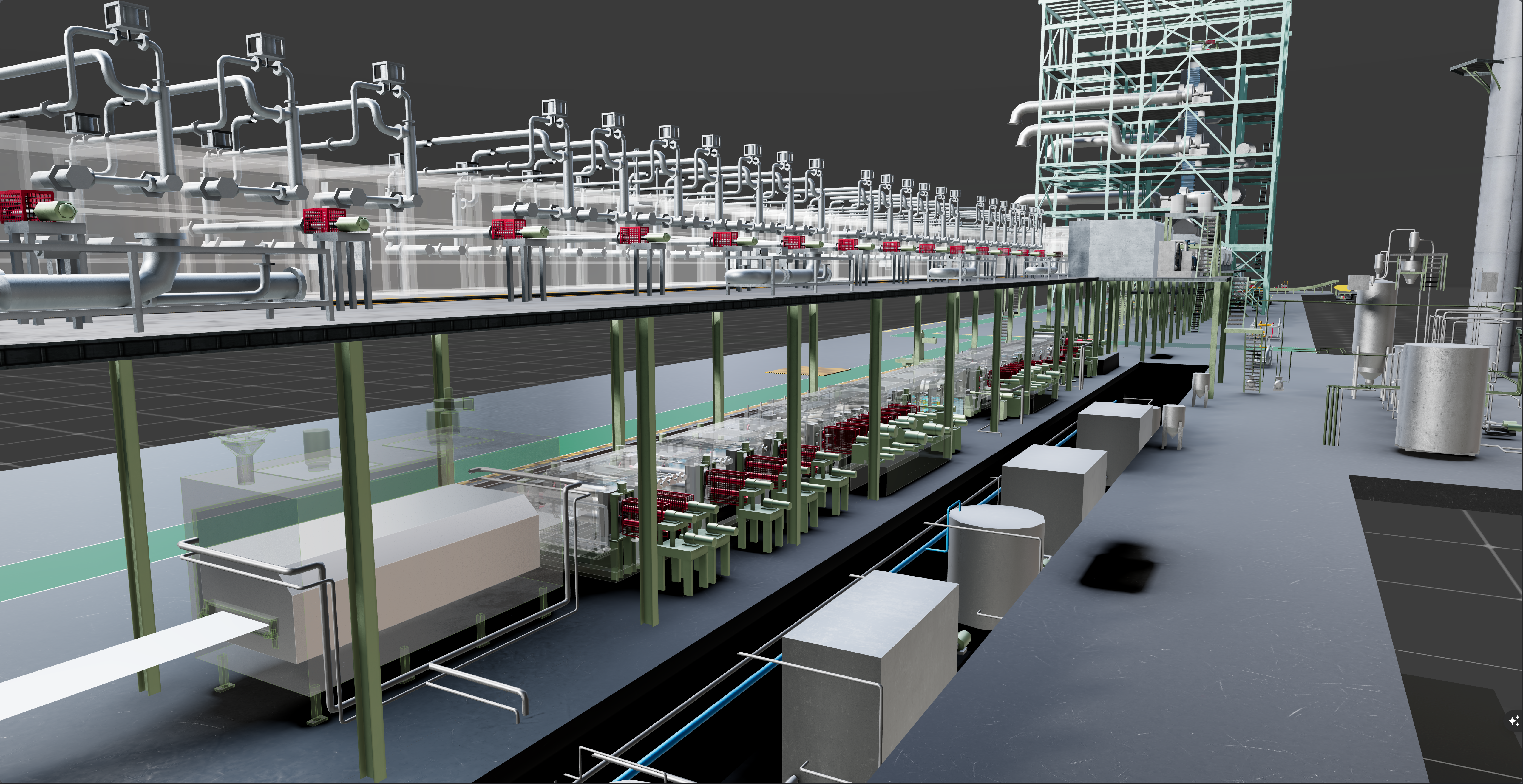
The award-winning project this year is the “Color-Coated Substrate Structure Optimization Project” at the Cold Rolling Plant of Baoshan Iron & Steel Co., Ltd., located in Baoshan District, Shanghai. In collaboration with equipment suppliers, the project replaced traditional color-coated substrates by building a new high-aluminum zinc-aluminum-magnesium hot-dip galvanizing line with an annual capacity of 310,000 tons, significantly enhancing product corrosion resistance and service life. Integrating process design, equipment upgrading, smart manufacturing, and digital delivery, this project has become a benchmark for green transformation in the metallurgical industry.
Baosteel Engineering leveraged AI technology to enable digital design despite the challenges of limited space in older plants and complex existing equipment. The team efficiently completed full-set equipment technical integration for production lines, realized pre-installation of ultra-large models (including engineering design, full-line equipment, plant steel structures, and pipelines), and achieved multiple innovative applications such as simulation performance analysis and forward design.
Foundation Construction of Digital Twin: ContextCapture was used to generate cloud models, MicroStation was applied to correct spatial errors of new and existing structures, and ProStructures was adopted to create a template library of parametric steel structures.
Paradigm Innovation in Full-Process Collaboration: A digital workflow covering “requirement submission—model approval—change closure” was established based on ProjectWise, and OpenBuildings was utilized to build a multidisciplinary equipment foundation model, enabling multiple collaborative iterations between civil engineering and process disciplines.
Technology Breakthroughs in Intelligent Construction: OpenPlant Modeler drove modular pipeline design, with prefabricated pipe sections reaching 24 meters in length (compared to the industry average of 15 meters). SYNCHRO was used to simulate and optimize seven high-risk hoisting paths.
Value Release of Digital Asset: An iModel engineering database was built, containing STAAD.Pro structural parameters and AutoPIPE stress data. It increased the digital twin’s loading speed severalfold, and an algorithm library was developed to optimize coating process parameters.
The project also leveraged two major advantages of Bentley’s products. The first is openness, enabling the integration of models and data across different software products, fully reflecting the value of digital twins. The second is complete data flow, which connects data standards, breaks down silos, and forms a seamless data stream—a vital step toward achieving a true digital twin.
Design change rate reduced by 42 percent.
Total construction cost saved 6 percent.
16 granted patents.
Annual CO₂ emissions reduced by 45 percent (~12,000 tons), and particulate matter emission intensity reached 0.8 kg per ton of steel.
First Chinese project to collaborate with Bentley in R&D and successfully apply AI to OpenPlant PID.
The digital twin factory not only accelerates process upgrades but also provides a foundation for next-generation equipment development. After becoming operational, the plant’s energy consumption per ton of steel has outperformed similar products both domestically and internationally, contributing to the advancement of urban steel plants.
“I went to the site not long ago, and the factory director was very happy,” shared Lei Yuan, Chief Engineer and technical lead of Key Technological Innovation Projects at China Baowu Steel Group. “He took out his mobile phone on the spot and could check the operation of each indicator. I was also surprised that our carbon emissions could be reduced by 45 percent—we really did it!”
This achievement aligns with China's proposed climate target of “reducing net greenhouse gas emissions across the entire economy by 7-10 percent from the peak by 2035.” Yuan added, “I believe all these are promising.”
As the first full-lifecycle digital delivery project in the metallurgical industry, this initiative has enabled Baosteel Engineering & Technology Group to transition from technological exploration to standardized output, and from project practice to ecosystem co-construction. It has reshaped the construction and O&M models of metallurgical engineering while, leveraging the dual advantages of forward-looking technological reserves and leading industry practices, providing a clear path for the traditional metallurgical industry to transform toward intelligence, green development, and high efficiency. It also offers valuable guidance for the digital transformation of other process industries.